When collecting data at scale, manually managing proxy IPs and dealing with frequent IP blocks can quickly become challenging. Rotating proxies automate IP switching, helping reduce interruptions caused by IP restrictions and providing access to fresh IPs for large-scale data tasks.
In this guide, we review 6 best rotating proxy providers in 2026 and compare their features, pricing, and performance. Whether you need proxies for web scraping, market research, or other data-driven projects, this comparison will help you find a provider that fits your requirements.
Not all rotating proxy services deliver the same level of performance. A large IP network alone does not guarantee better results. For this comparison, we evaluated each provider across several key aspects to identify the rotating proxies that offer the best balance of performance, features, and value.
IP Pool Size: The size of a provider's proxy pool affects how many unique IP addresses are available for requests. Larger pools help reduce IP reuse and are better suited for high-volume data collection.
Rotation Flexibility: Different rotation methods, such as per-request rotation and sticky sessions, support different data collection needs. Flexible options allow users to switch IPs frequently or keep the same IP for a set period.
Geographic Coverage: The number of supported locations and available geo-targeting options determines how well a proxy service can handle location-specific tasks and region-based data collection.
Performance and Reliability: Speed, success rates, and proxy stability play a key role in maintaining smooth performance during continuous data operations.
Pricing and Value: Pricing models, upfront costs, and traffic flexibility are compared to evaluate the overall value of each service.
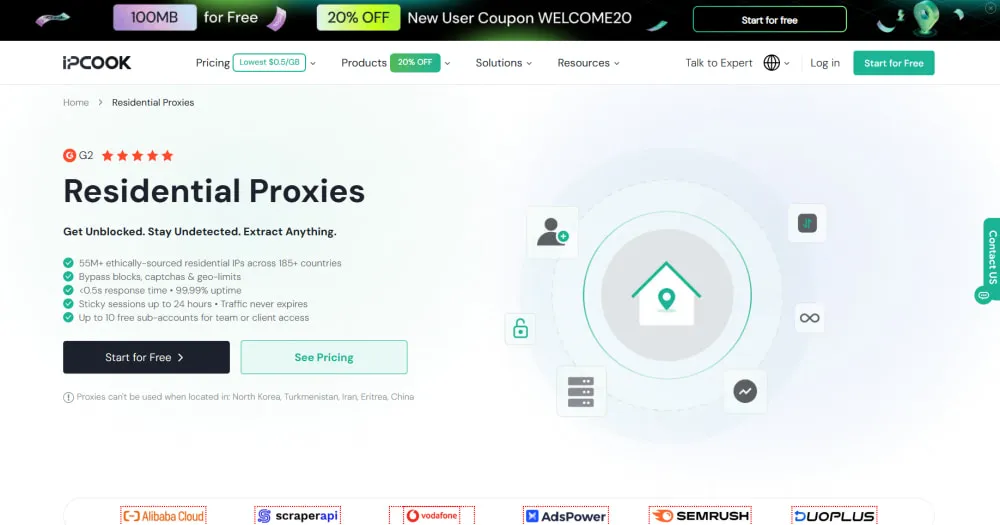
IPcook provides Residential Proxies, ISP Proxies, and Datacenter Proxies, supporting different use cases and traffic requirements. Its rotating residential proxy service is one of the main offerings, providing access to a pool of 55M+ residential IPs across 185+ countries. The large residential IP pool offers broad geo coverage and diverse IP addresses for web scraping, market research, and SEO monitoring.
Per-request and timed IP rotation are available, with intervals as short as 1 minute. Sticky sessions are also available, with customizable durations of up to 24 hours. Beyond IP management features, the service supports both HTTP and SOCKS5 protocols for flexible proxy usage. Low latency and high success rates help ensure stable connections during continuous data operations.
IPcook follows a pay-as-you-go pricing model, with affordable rotating residential proxy plans ranging from $0.3–3.2/GB. You only pay for the traffic you consume, with no subscription requirements or traffic expiration.
Pros
55M+ real residential IPs across 185+ countries with lower fraud detection risk
Per-request and timed IP rotation with flexible switching intervals
Sticky sessions supporting up to 24-hour IP persistence
HTTP and SOCKS5 protocol support
Pay-as-you-go pricing from $0.3–3.2/GB
High success rates across diverse proxy use cases
Cons
Advanced features like geo-targeting may not be as granular as some enterprise providers
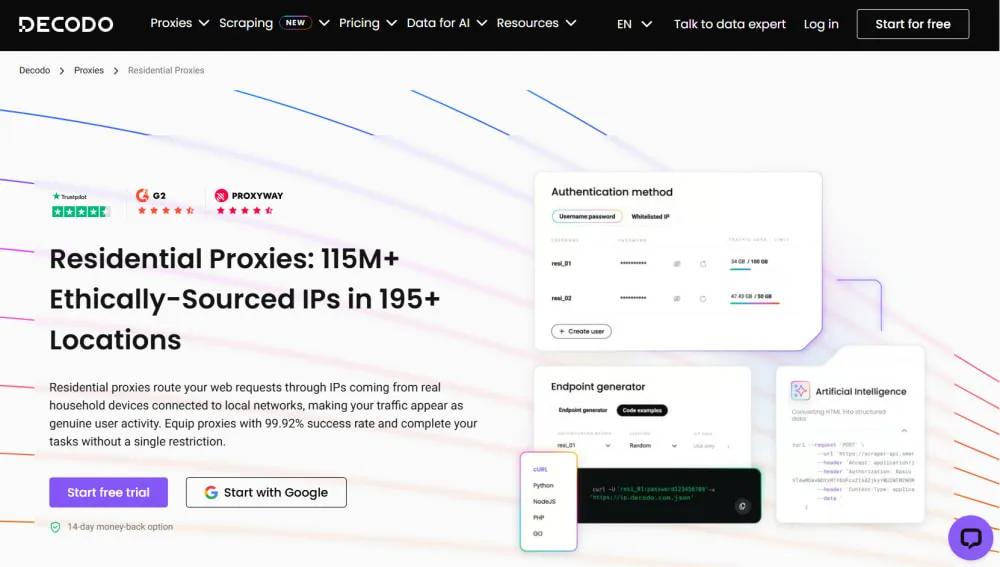
Decodo provides rotating residential proxies with access to a pool of 115M+ ethically sourced residential IPs worldwide. It supports multiple protocols and provides precise geo-targeting options down to country, state, city, ASN, and even postal code levels. With high speeds and high success rates, it delivers reliable IP rotation for high-demand web scraping and browsing. Flexible rotation intervals, unlimited concurrent threads, and sticky session options are also available to support different use cases.
For easier integration and management, Decodo provides comprehensive APIs, browser extensions, detailed documentation, and 24/7 technical support. The pricing includes two options, with regular plans priced at $2.75-4.00/GB and enterprise plans ranging from $2.00-2.50/GB. Smaller-scale or occasional users may find the pricing slightly higher compared with budget-focused alternatives.
Pros
195M+ residential IP pool size with 115 M+ IPs
Precise geo-targeting options (country, state, city, ASN, postal code)
Fast speeds (<0.6s) and high success rate (~99.7%)
Flexible API integration for web scraping, SERP scraping, and e-commerce data collection
Cons
Pricing may be relatively high for low-volume users
Some advanced features are locked behind higher-tier plans
Setup can be relatively complex compared with more beginner-friendly providers
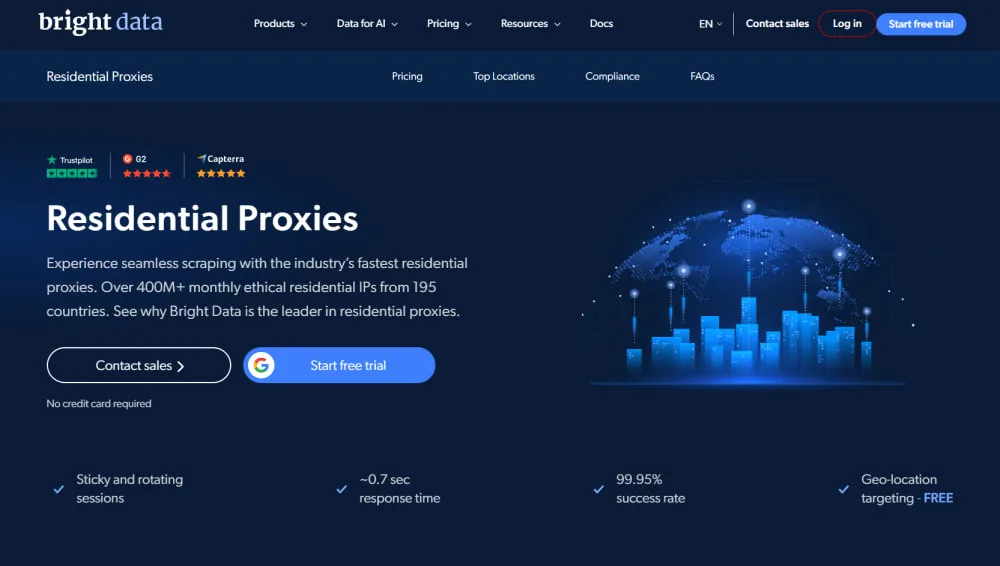
With access to a 400M+ IP pool across 195+ countries, Bright Data offers rotating proxies that support large-scale data collection and different proxy requirements. The service offers flexible IP rotation controls and advanced geo-targeting options, allowing you to target specific countries, cities, ZIP codes, carriers, and ASNs as needed. It also supports unlimited concurrent connections and delivers response times of around 0.7 seconds for stable performance during high-volume operations.
Bright Data is mainly designed for enterprise users, with pricing ranging from around $2.5-4.0/GB after discounts. Since July 7, 2026, Bright Data has introduced stricter access requirements for newly created Residential Proxy zones, requiring additional verification for new users. This makes the platform less convenient for individuals, developers, and small teams that prefer instant self-service setup.
Pros
400M+ IP pool with 195+ global coverage
Flexible IP rotation controls and precise geo-targeting options
Fast response times with unlimited concurrent connections
Stable performance for large-scale data operations
Cons
Higher pricing for smaller-scale users
Complex setup process requiring technical knowledge
Requires company verification for new Residential Proxy users
ProxyRack offers rotating residential proxies with a 35M+ IP pool across 140+ countries. Rotation intervals can be configured from 3 minutes to unlimited duration, making it suitable for low- to medium-intensity tasks such as lightweight scraping, ad verification, and multi-account management. The user-friendly dashboard helps you manage proxy settings, monitor traffic usage, and track connection details. Combined with flexible rotation settings, it provides better control over IP switching and proxy management.
Pricing starts at around $110 for 100GB, with larger plans available for higher traffic requirements. However, users requiring advanced geo-targeting options or enterprise-level proxy features may find the service less configurable compared with premium providers.
Pros
35M+ rotating IPs across 140+ countries
Flexible rotation intervals from 3 minutes to unlimited duration
User-friendly dashboard for proxy management and usage monitoring
Unlimited concurrent connections for multiple requests
Cons
Performance may vary depending on location and use case
Not ideal for high-frequency or enterprise-scale scraping
Limited advanced filtering capabilities for users who need detailed targeting options
💡Read More:
How to Create Bulk Facebook Accounts Without Getting Banned
How to Create Bulk Instagram Accounts: Tools & Tips for Growth
Webshare offers flexible rotating residential proxies designed for users who prefer control over automation. With access to over 80 million IPs across 195 global locations, users can manage their IP lists and set rotation behavior at the session level. This makes it well-suited for those who need more granular proxy management, whether for lightweight scraping, social media automation(e.g., creating a Twitter bot), or research use cases.
This rotating IP proxy service is beginner-friendly, with low monthly pricing and a simple setup. It's ideal for small projects or individual use, but the lack of web scraping APIs and third-party integrations may make it less suitable for larger-scale projects or users requiring more automation.
Pros
80 M+ IPs in 195 countries
Self-managed IP list with session-based rotation
Affordable monthly pricing, great for beginners
Simple UI and quick onboarding
Cons
Limited API and third-party integration options for advanced automation needs
Limited automation for high-scale scraping
Performance may vary by region or use case
💡Update: NetNut's Network Disruption
NetNut faced a major disruption in July 2026 after its proxy infrastructure was linked to a network abuse investigation involving compromised consumer devices used as proxy nodes.
Law enforcement actions targeted related infrastructure, resulting in domain seizures and service interruptions.
This incident highlights the importance of ethical IP sourcing and reliable proxy infrastructure. If you need an alternative residential proxy provider, IPcook uses residential IPs sourced from real users with consent, offering stable connections and flexible rotation options.
NetNut delivers a high-performance rotating proxy service with access to over 85 million IPs across residential, ISP, mobile, and datacenter networks. Its ISP-backed architecture delivers stable, low-latency connections for market research, price intelligence, and e-commerce scraping. An intuitive dashboard and simple setup help you manage proxies with less complexity.
With flexible pricing models, including pay-as-you-go and enterprise-scale plans, this rotating proxy service supports both short-term and long-term data operations. However, its relatively high entry price and business-oriented focus may not suit smaller teams or individual users just starting.
Pros
85 M+ IPs across residential, ISP, mobile, and datacenter networks
ISP-backed infrastructure for high speed and reliability
99.9 %+ uptime with stable, low-latency connections
Clean, beginner-friendly dashboard and setup
Cons
Higher pricing threshold compared to budget alternatives
Some features are more tailored to enterprise-level users
Limited support for ultra-short rotation intervals
Geo-targeting may require manual configuration in some cases
The table below compares the top rotating proxy providers based on pricing, key features, IP types, and ideal use cases. NetNut is excluded from this comparison as its website is currently unavailable following a law enforcement action.
Provider | Price | Key Features | IP Types | Best For |
IPcook | $0.3–3.2/GB |
| Residential, ISP, Datacenter | All-purpose, budget-conscious users |
Decodo | Regular plans: $2.75–4.00/GB Enterprise plans: $2.00–2.50/GB |
| Residential, ISP, Mobile, Datacenter | Developers, geo-targeted scraping |
Bright Data | Around $2.5–4.0/GB after discount |
| Residential, ISP, Datacenter | Enterprise-scale data collection and complex proxy requirements |
ProxyRack | Starting at $110/100GB |
| Residential, Mobile, Mobile | Budget users, small-scale automation |
Webshare | $1.4–3.5/GB |
| Residential | Manual control, low-barrier entry |
Yes, IPcook is a cost-effective rotating proxy solution that combines performance with flexible management features. It delivers response times under 0.5 seconds and supports one-line API integration for quick deployment. Real-time traffic monitoring, usage reports, and sub-account management also make it easier for teams to manage proxy operations efficiently.
Absolutely yes. Most modern rotating proxies are fully compatible with tools like Python, Selenium, Scrapy, and Playwright. They allow IP rotation per request or session, making them ideal for automation frameworks. Just plug in the proxy credentials into your HTTP request or Selenium driver configuration, and you're ready to go.
When it comes to the best rotating proxies, there is no one-size-fits-all solution. Each provider comes with its strengths tailored to specific use cases. Among them, IPcook stands out as the most well-rounded, cost-effective choice. With genuine rotating residential proxies, long session persistence, and low latency, IPcook provides a flexible solution for businesses. It supports use cases such as social media account management, data scraping, and ad verification.