








Decodo (Formerly Smartproxy) Review: Is It Worth the Price?

Decodo, formerly known as Smartproxy, sits near the top of the residential proxy market. Picking a provider is rarely simple, though. You have to weigh IP quality, speed, pricing, and trust all at once, and finding a provider that balances these factors can be challenging. This Decodo review breaks down each factor in plain terms. You will see what the service actually delivers and whether the price is justified.
What is Decodo
Decodo is a proxy provider based in Lithuania. The company started in 2018 under the name Smartproxy and rebranded to Decodo in April 2025. It belongs to the Tesonet business group and runs with a team of roughly 100 to 150 people. Proxyway, a proxy testing site, ranks Decodo among the top 5 proxy providers by size today.
The brand began as an affordable option for sneaker collectors, social media managers, and small-scale scrapers who wanted residential IPs without enterprise pricing. It has since grown into a full proxy and web data platform. The lineup now covers residential, ISP, datacenter, and mobile proxies, plus several scraping tools.
What Does Decodo Bring to the Table
Decodo offers 4 types of proxies, along with tools for web scraping and browser management. Its product lineup covers different proxy requirements, from precise location targeting to carrier selection and large IP pools. Here's a closer look at its main features.
Residential proxies with precise geo-targeting: Decodo offers 115M+ residential IPs across 195+ locations, with targeting by country, state, city, ZIP code, and ASN.
Mobile proxies with carrier-level targeting: Its network includes 10M+ mobile IPs across 160+ locations, with filtering options for 700+ mobile carriers.
ISP proxies with premium ASNs: Access IPs associated with major providers such as AT&T, Verizon, Orange, and Tele2 for more reliable provider-level IP selection.
Datacenter proxies with 500K+ IPs: A large global IP pool provides the address capacity needed for large-scale scraping and automation.
A Site Unblocker: JavaScript rendering, CAPTCHA handling, and automatic retries are built into the tool. It's designed for websites with anti-bot protection and reduces the need to manage each step separately.
Web scraping APIs: Scraping, search, site mapping, and crawling are all covered. Depending on the task, you can extract page content, retrieve search results, discover URLs, or crawl websites.
Browser extensions for proxy management: Decodo provides Chrome and Firefox extensions for configuring proxies and switching locations. You can also connect its proxies to compatible third-party tools for managing browser profiles and multiple accounts.
Security and usage policies: ISO/IEC 27001:2022 certification covers the company's information security management system. Customer screening helps identify potential fraud, while identity verification may be required to access certain restricted websites.
Is Decodo Legit & Safe
Decodo appears to be a legitimate proxy provider rather than an unknown reseller. Its business registration in Lithuania and association with the Tesonet group provide some reassurance about its business credibility. On the security side, ISO/IEC 27001:2022 certification for its information security management system is a positive sign for businesses concerned about data protection.
Its identity verification process is another factor to consider. Decodo uses Know Your Customer (KYC) verification to help businesses confirm customer identities, but most users don't need to complete KYC at signup. All new customers undergo fraud screening, while flagged accounts or users accessing certain restricted websites may face additional ID checks. Signup is generally straightforward, though some users may need to provide extra documentation.
IP Quality and Success Rate
When assessing Decodo's residential proxies, we looked at 3 key factors: IP diversity, connection success rates, and session stability. IP diversity is a standout strength. Proxyway's 2026 proxy market research supports this finding, reporting nearly 1 million unique US IPs from 1.2 million requests. Decodo ranked first among the providers tested for US IP diversity, and its global results were also close to Oxylabs. For scraping workflows that require frequent IP rotation, this breadth of IPs is a meaningful advantage.
We found Decodo's connection reliability impressive overall. Its global success rate reached 99.92%, with rates of 99.32% in the US, 99.84% in the UK, and 99.90% in the EU, according to Proxyway's 2026 research. However, our assessment of session stability is more cautious. Only around 82% of tested sessions lasted at least 25 minutes out of 30, and several competitors performed better. We'd rate Decodo highly for connection reliability, but its consistency during long sessions could be better.
Proxy Speed and Response Time
Our assessment of Decodo proxy connection speed is positive, with a global average response time of 0.53 seconds. Its regional performance was less even, however, with the US averaging 0.75 seconds compared with 0.43 seconds in the UK and 0.48 seconds in the EU. Proxyway's 2026 research supports this picture, reporting a global average of 0.53 seconds for Decodo, faster than Oxylabs at 0.60 seconds.
When it comes to real-world website access, we consider its performance less impressive. While its infrastructure response time averaged just 0.53 seconds, Proxyway's tests across Amazon, Google, and Instagram recorded an average of around 3 seconds. This gap suggests that Decodo's fast connection speed doesn't translate as well to actual website access. Google also proved challenging across providers, indicating that target website behavior can affect response times.
How to Use Decodo
Setting up a Decodo proxy is straightforward. You can configure your proxies in the dashboard and connect them to your preferred tools in a few steps.
Create an account. Sign up on the Decodo website and verify your email address.
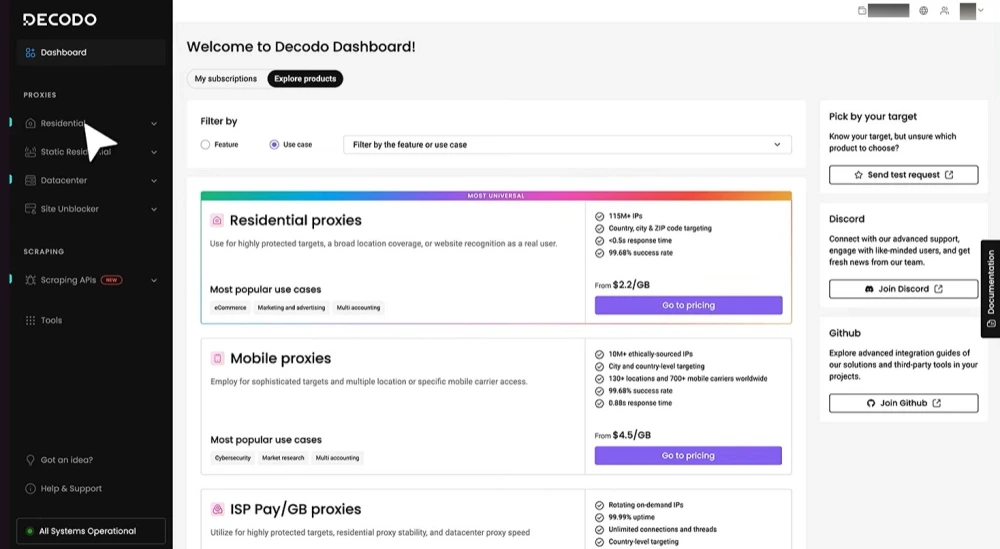
Choose a proxy type and plan. Select residential, mobile, ISP, or datacenter proxies based on your needs. Residential and mobile proxies charge by bandwidth, while ISP and datacenter plans charge per IP.
Configure your proxy settings: After purchasing a plan, you'll land on the proxy setup page. The screenshot below shows the residential proxy setup as an example. Here, you can choose a location, select a session type, set the number of endpoints, and configure authentication.
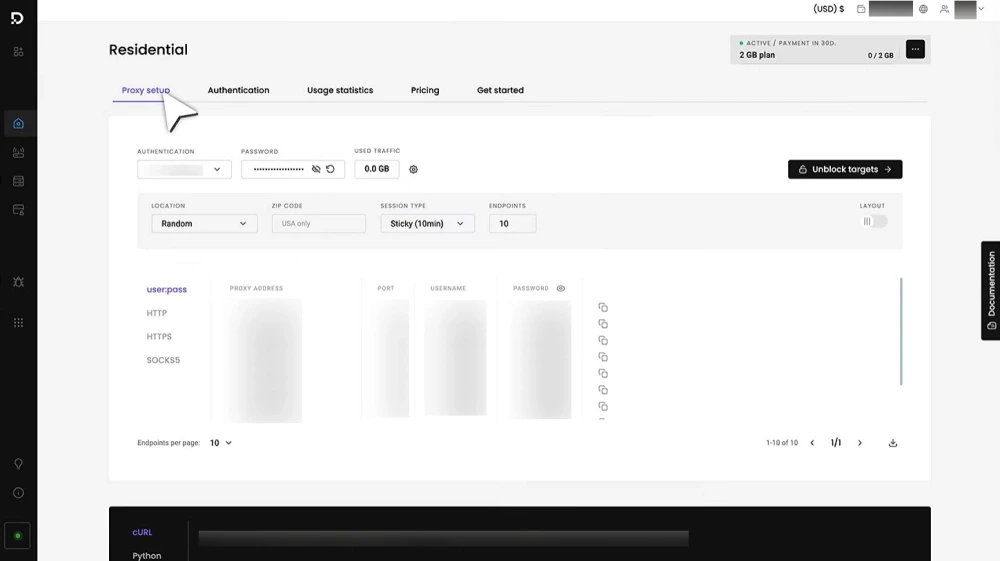
Get your proxy credentials: On the same page, you'll find the proxy hostname, port, username, and password. Once you've configured your settings, copy your proxy credentials directly from the setup page.
Connect to your preferred tool. Depending on your setup, you can use a browser extension, a compatible antidetect browser, or your own code.
Decodo Pricing: Plans and Rates
Decodo offers a range of proxy and web scraping solutions with different billing models to suit different needs. Regular plans are suitable for smaller-scale projects, while enterprise plans offer different rates for higher-volume usage. The table below compares the pricing ranges and billing options for each product.
Product | Billing Model | Regular Plan Pricing | Enterprise Plan Pricing |
Residential Proxies | Pay per GB | $2.75/GB - $4/GB | $2/GB - $2.5/GB |
ISP Proxies | Pay per IP or per GB | Dedicated: $2.2/IP - $3.33/IP | Dedicated: $2/IP - $2.3/IP |
Datacenter Proxies | Pay per IP or per GB | Dedicated: $1.35/IP - $1.85/IP | Dedicated: $1.15/IP - $1.25/IP |
Mobile Proxies | Pay per GB | $2.75/GB - $4/GB | $2.25/GB - $2.5/GB |
Site Unblocker | Pay per GB or per req | Pay/GB: $6.75/GB - $10/GB | Pay/GB: $5.5/GB - $6/GB |
Web Scraping API | Monthly subscription | Free plan: 5k crawl/10k pages scraped | $499/month - $1499/month |
Strengths and Weaknesses of Decodo
No provider is perfect. Decodo offers a well-rounded proxy service, with accessible tools and flexible plans. However, connection stability, target-site compatibility, and costs at scale are worth weighing before committing.
Strengths
Low learning curve: We consider Decodo accessible to beginners while offering enough flexibility for more involved proxy workflows.
Good value for general use: Its balance of performance and cost makes it a practical choice for projects that don't require enterprise-level customization.
Versatile product lineup: We see its proxy and scraping solutions as a useful advantage for different data collection needs, without having to piece together services from multiple providers.
Flexible account management: Self-service controls make it easier to adjust proxy configurations and scale usage without relying heavily on support.
Practical for ongoing projects: The range of available plans gives users room to start small and expand as their data collection needs grow.
Weaknesses
Connection stability isn't flawless: Disconnections and timeouts can interrupt automated workflows, making connection consistency worth monitoring.
Target-site compatibility varies: We assess that success on one website doesn't guarantee success on another. Production workloads may need target-specific testing and adjustments.
Costs rise with usage: Decodo may be less economical for high-volume workloads, particularly when lower-cost providers can meet the same requirements.
Refund terms have limitations: The refund policy isn't unconditional, so you should check eligibility before purchasing or committing to a larger plan.
Advanced requirements may need extra work: Complex scraping workflows can require additional configuration or integration rather than working seamlessly out of the box.
Decodo Alternative: A More Affordable Proxy Option
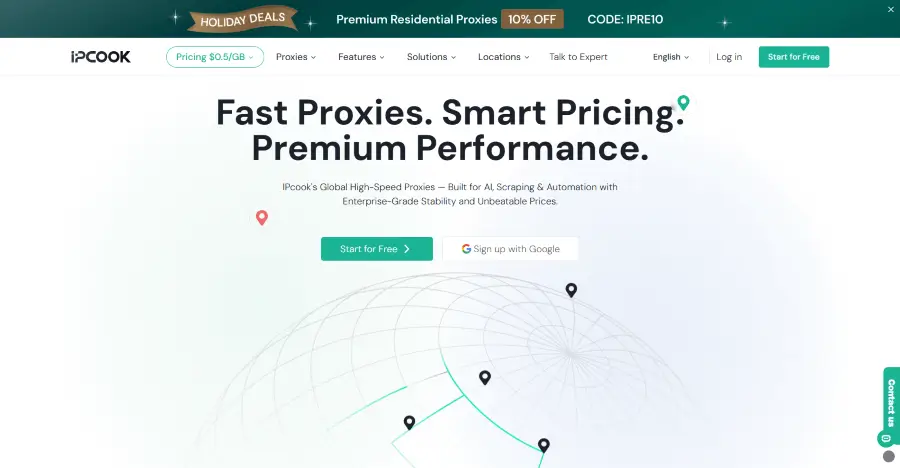
Decodo offers a range of proxy solutions, but its pricing may not suit every budget, especially for high-traffic projects. If cost is a priority, IPcook is worth considering for its competitive pricing, diverse proxy options, and strong performance. It offers residential, unlimited residential, ISP, and datacenter proxies. All 4 types support HTTP and SOCKS5, with UDP supported through SOCKS5.
Decodo's residential proxies start at $4/GB on its pay-as-you-go regular plan, while IPcook Residential Proxies start at $3.20/GB, with rates dropping to $0.30/GB at higher traffic volumes. For even higher traffic needs, IPcook Unlimited Proxies offer unlimited residential traffic at a fixed price of $350/100Mbps/30 days, with higher bandwidth and longer durations available. Both residential options provide access to a pool of 55M+ IPs, with sticky sessions lasting up to 24 hours. You can also rotate IPs with each request or at scheduled intervals.
IPcook also offers a free 100 MB residential proxy trial with no expiration. Its all-in-one dashboard lets you purchase a plan, configure your proxies, and get your credentials in a few simple clicks.
Final Verdict
Decodo offers a well-rounded mix of proxy options, competitive connection speeds, and a large residential IP pool. Its infrastructure performs well in Proxyway's tests, though session stability and success rates vary by region and target website. Its pricing is flexible, but costs can add up for high-traffic projects, and occasional connection issues may require extra monitoring.
If Decodo's pricing doesn't fit your budget, IPcook is worth considering. It offers residential proxies starting at $3.20/GB, volume discounts down to $0.30/GB, and unlimited residential plans for higher traffic needs. You can try IPcook Residential Proxies for free with 100 MB of traffic and no expiration.