Octoparse: A No-Code Web Scraper Built for Real Data Collection

Getting useful data off the web sounds simple until you try to do it at scale. Copy-paste breaks down after the first hundred rows. Most scraping tools assume you know what XPath means. And hiring a developer every time you need a fresh dataset isn't a workflow. It's a bottleneck.
Octoparse is built around a simple idea: data collection should be something anyone can do, without writing a single line of code.
What Is Octoparse?
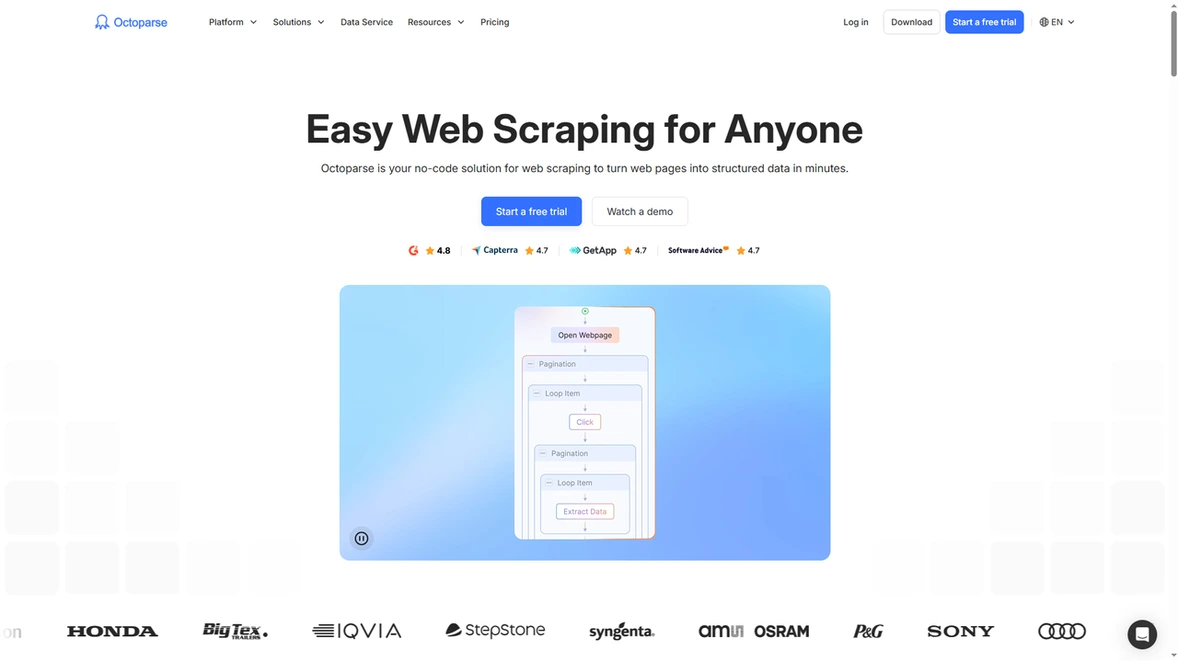
Octoparse is a no-code web scraping tool built for people who need data but don't write code. You interact with websites visually, clicking on a price, a job title, a business name, and Octoparse figures out the extraction logic from there. It runs on Windows and Mac, and a cloud option handles tasks in the background while you're doing something else.
Over 4.5 million users across industries use it, from solo researchers to enterprise teams running hundreds of scheduled tasks a month.
What Are the Key Features of Octoparse Web Scraper
1. 600+ Ready-Made Templates
This is the fastest on-ramp. After downloading the free version, search for your target site (Amazon, LinkedIn, Indeed, Google Maps, Zillow, and hundreds more), pick a template, enter your search terms, and run. Most users are pulling real data within the first ten minutes. No workflow setup, no configuration.
For anything the template library doesn't cover, the visual builder lets you construct custom scrapers by clicking through a site the way a normal user would. No code required at any point.
2. Octoparse MCP Server
Octoparse MCP Server connects directly to ChatGPT, Claude, Cursor, and other AI tools. Ask in plain language, and Octoparse runs the collection and returns structured results in your chat. 200+ templates work out of the box, with a free weekly quota of 2,000 records, no credit card required.
3. Cloud Scraping and Scheduling
Local scraping ties up your machine. Cloud scraping runs on Octoparse's servers, so tasks can run overnight, on a schedule, or continuously, without keeping a laptop open. This is where the tool shifts from a research aid to actual production infrastructure. Paid users use cloud scraping at roughly four times the rate of free users, which tracks: once you're running regular workflows, local scraping gets in the way.
4. Clean Exports, Multiple Formats
Data comes out as Excel, CSV, JSON, XML, HTML, Google Sheets, databases, cloud storage, and more. No cleaning step, no intermediate formatting. What the scraper collects is what lands in your destination of choice.
5. JavaScript and Dynamic Content
A lot of modern websites don't load their data in plain HTML. Content renders after the page loads via JavaScript. Octoparse handles this the same way a real browser does, so you're not limited to static pages.
6. Anti-Bot Handling
Most websites that are worth scraping have some form of protection. Octoparse handles the common ones: CAPTCHA solving, IP proxy rotation, cookie management, and User-Agent switching. This means routine scraping tasks run without manual intervention, even on sites that actively discourage automated access.
What People Actually Use Octoparse For
Competitive Price Monitoring
Ask any e-commerce team how they track competitor prices and you'll usually get one of two answers: a fragile spreadsheet someone updates manually, or a developer-built solution that requires constant maintenance. Octoparse sits between those two options. A European B2B wholesale company managing roughly 50 portfolio companies replaced gut-feel pricing decisions with automated weekly scraping, pulling article numbers, prices, and units from competitor sites, then feeding that data into pricing formulas. Based on their experience across the portfolio, the shift to data-driven pricing typically moves profit margins by 2-4%.
Lead Generation
A digital marketing agency in Spain scrapes Google Business Profiles daily to catch newly registered local businesses before competitors do. Their 30-person remote sales team works from structured lists (business name, rating, whether the business has a website) and their internal benchmark is reaching new entrepreneurs within 15 days of their Google listing going live. That kind of freshness requires daily automated collection. Doing it manually isn't feasible.
Market Research and Academic Work
Job postings, property listings, social media content, public datasets: researchers use Octoparse to build corpora that would otherwise take weeks of manual work. The no-code interface matters here. The person doing the analysis can also build and run the scraper, without filing a ticket with an engineering team.
Enterprise Automation
At the high end, Octoparse stops looking like a scraper and starts looking like workflow automation. An international music rights agency uses it to manage registration and royalty tracking across 160 collection societies, cycling through roughly 1,500 separate accounts automatically. They save at least one full business week per month on work that was becoming infeasible to do by hand.
Pricing of Octoparse
Octoparse is free to start, with no trial period or expiry. Paid plans begin at $69/month (billed yearly) and add cloud scraping, IP rotation, and automatic CAPTCHA solving. Teams with heavier workloads can move to the Professional plan at $249/month (billed yearly) for more concurrent processes, advanced API access, and dedicated support.
Conclusion
Web scraping doesn't have to be a developer-only skill anymore. Octoparse handles the heavy lifting through templates, cloud runs, and AI assistant integration, leaving the strategy work to you. Start with the free tier, run something real, and see what the data tells you.