Japanese websites, e-commerce platforms, search results, and online services may restrict access or show different content based on your IP address. This can lead to blocked content, inaccurate local data, repeated verification, or account restrictions, making a reliable Japan-based IP address essential for many tasks.
We compared 8 of the best Japan proxies that can help address these issues. Read on to find a fast, stable, and affordable option that fits your needs.
Before comparing providers, it helps to understand the main types of proxies. Each type differs in speed, stability, blocking risk, session length, and cost, so knowing the difference can help you avoid paying for features you do not need.
Residential proxies: Their IPs come from real household internet connections, giving them high authenticity and a lower risk of being blocked. The tradeoff is a higher price.
Mobile proxies: Backed by 4G or 5G carrier networks, these IPs generally receive a high level of trust from websites and are less likely to be blacklisted. They are also usually the most expensive option.
ISP proxies: ISP-assigned IPs are hosted in data centers, combining residential credibility with fast speeds. They can keep the same IP for long sessions, although availability and location targeting are often more limited.
Datacenter proxies: These IPs come from cloud servers and data centers. They are fast and affordable, but websites can identify and block them more easily.
With these differences in mind, the table below gives you a quick overview of the 8 Japan proxy providers.
Provider | Proxy Types | Rotating Residential Pricing | ISP Proxy Pricing | Best For |
IPcook | Residential, ISP, Datacenter | $0.30–$3.20/GB | From $2.40/IP/month | Affordable scraping and geo-targeted data collection |
Bright Data | Residential, Mobile, ISP, Datacenter | $2.50–$4.00/GB | From $1.30/IP/month | Enterprise-scale scraping and data intelligence |
Oxylabs | Residential, Mobile, ISP, Datacenter | $2.50–$6.00/GB | From $1.20/IP/month | High-success-rate scraping and protected sites |
SOAX | Residential, Mobile | $0.85/GB (Japan Tier 1 pricing varies by usage) | — | Precise geo-targeting |
Webshare | Residential, ISP, Datacenter | $1.40–$3.50/GB | From $0.23/IP/month | Budget testing and small projects |
DataImpulse | Residential, Mobile, Datacenter | $1.00/GB | — | Pay-as-you-go scraping |
ProxyEmpire | Residential, Mobile, Datacenter | $0.75–$3.50/GB | From $0.75/GB | Flexible proxy trials |
Geonode | Residential, ISP, Datacenter | $0.27/GB | From $1.25/IP/month | API automation and developers |
Prices are based on publicly listed plans and may vary by traffic volume, location, and billing model. Check each provider's current pricing before purchasing.
Each provider takes a different approach to pricing, targeting, and proxy management. Here is a closer look at what each one offers.
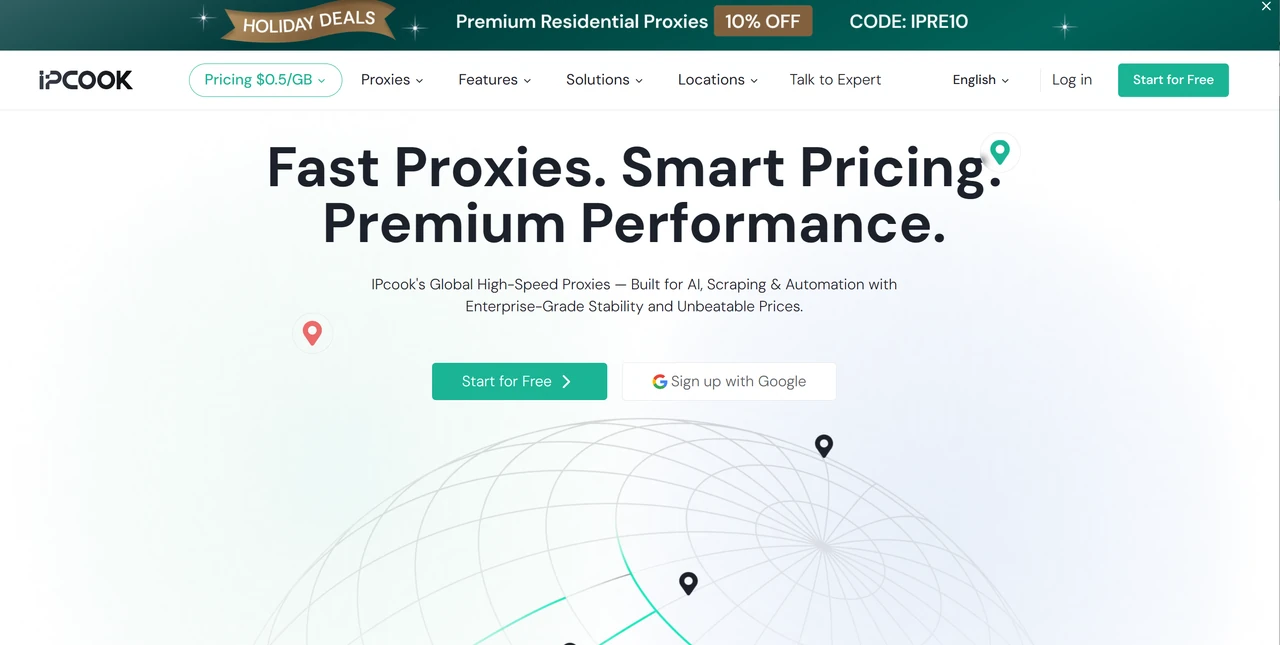
Founded in 2023, IPcook focuses on affordable and flexible proxy services for individuals and small teams. Its network includes more than 55 million residential IPs across 185+ countries and regions, with an average response time below 0.5 seconds and 99.99% uptime. It offers rotating residential, static ISP, and static datacenter proxies.
For Japan-related tasks, IPcook residential proxies support city-level targeting in locations such as Tokyo and Osaka. They can be used for monitoring prices on Rakuten and Amazon.co.jp, collecting public data from X or Instagram, or checking local ads on Google Ads and Yahoo! Japan.
Some tasks require a consistent IP for longer sessions, such as managing authorized social media or business accounts. IPcook Static ISP proxies provide fixed IPs with unlimited traffic, helping maintain a stable connection without worrying about bandwidth limits.
Key features:
Flexible IP Rotation: Residential IPs can rotate with every request or remain sticky for 1 minute to 24 hours.
Flexible Authentication: Residential proxies support username/password authentication with up to 10 free sub-accounts, plus IP whitelisting for up to 999 IPs.
Unlimited Static Traffic: ISP and datacenter proxies have no bandwidth or traffic limits and support renewal.
Broad Protocol Support: Residential, ISP, and datacenter proxies all support HTTP and SOCKS5.
IPcook is a good fit if you need Japan IPs with city-level targeting without paying enterprise-level prices. And new users can also test the service with 100 MB of free residential proxy traffic before committing to a paid plan.
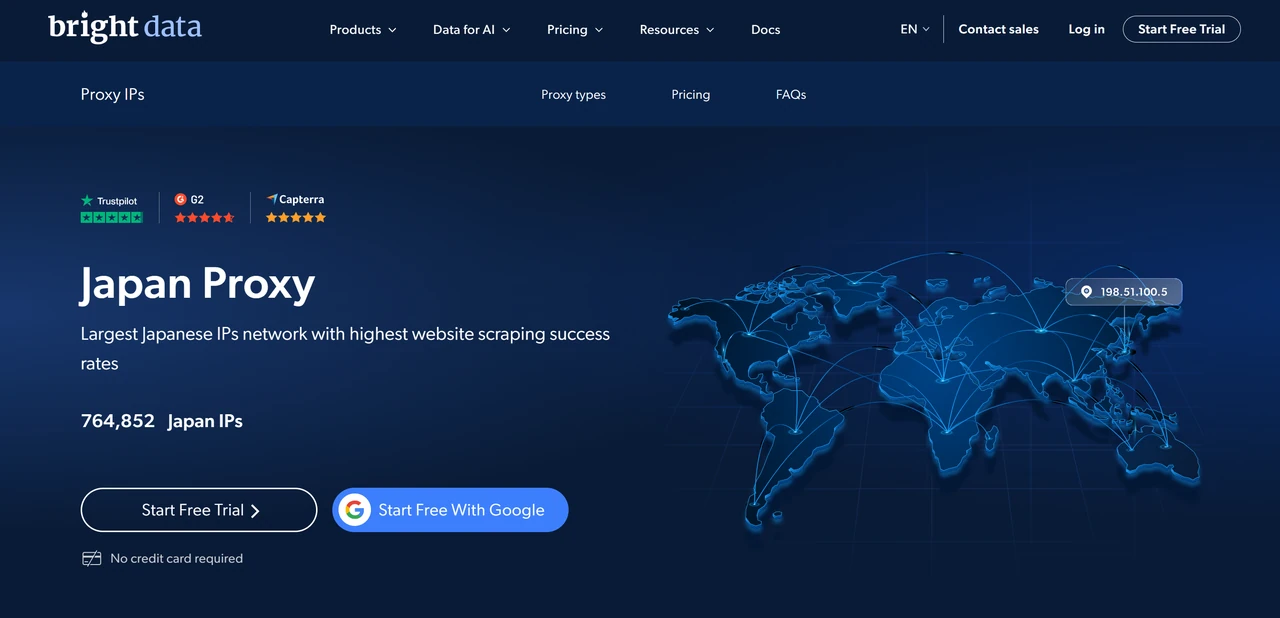
Bright Data operates a large global proxy network across 195 countries, with 400M+ residential IPs, 1.3M+ datacenter IPs, 700K+ ISP proxies, and 7M+ mobile IPs. Its residential pool is partly built through consent-based SDK partnerships and is designed around GDPR and CCPA compliance.
Key features:
Precise Carrier Targeting: Residential proxies support ASN-level targeting, allowing users to request IPs from specific network operators.
Faster Connections: Some residential nodes support QUIC and HTTP/3, which Bright Data says can improve response speed.
Stable Long-Term IPs: ISP proxies remain fixed after purchase and include 100 GB of monthly traffic per IP.
High Scalability: Datacenter proxies support large concurrent workloads, with both shared and dedicated IP options.
Bright Data offers a large proxy network, advanced targeting, and strong enterprise compliance. However, the pricing is relatively high, and access to some residential and mobile proxy services may require KYC verification. It is better suited to larger businesses with the budget and technical resources for enterprise-scale projects.
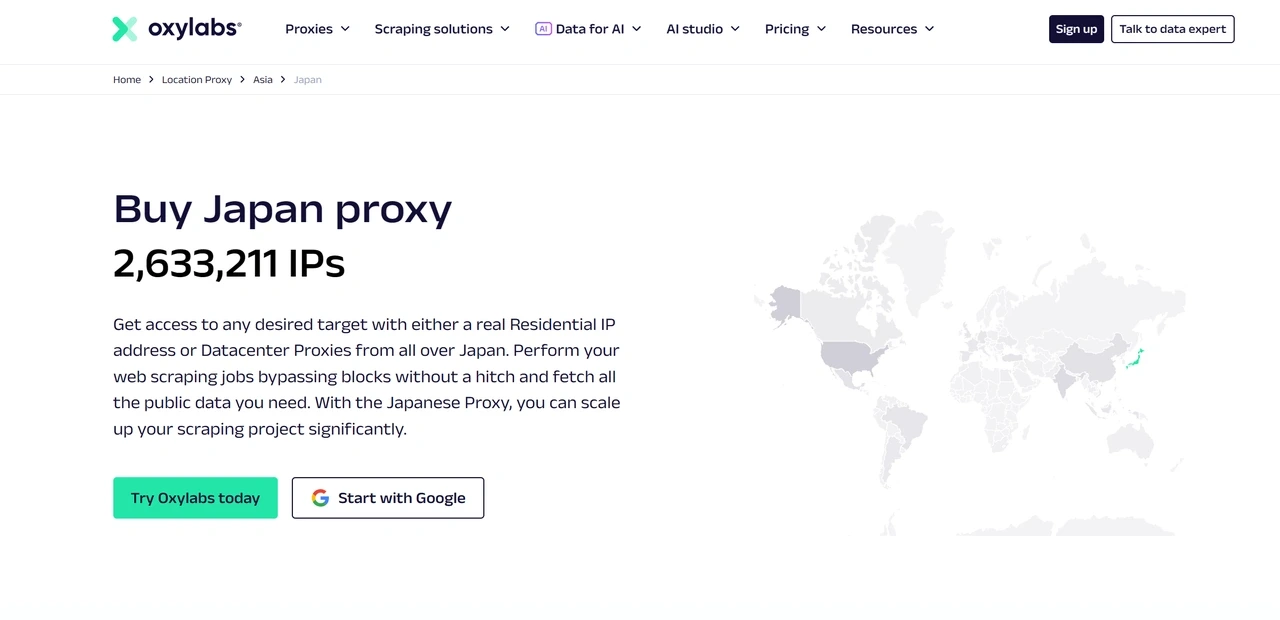
Oxylabs was founded in 2015 and emerged from Tesonet, a well-known startup accelerator, growing into an enterprise-grade proxy provider. Its product range covers residential, mobile, ISP, and datacenter proxies, while the residential network includes 177M+ IPs across 195 countries. Reported residential performance includes an average response time of around 0.65 seconds and a success rate above 90%.
Key features:
Unlimited Scalability: Residential proxies support unlimited concurrent sessions for large data-collection workloads.
Better Access to Protected Sites: Alongside its rotating residential network, Oxylabs offers premium static residential and ISP proxies from trusted ASNs for more difficult targets.
Ready-to-Use Search Data: Its Web Scraper API can return structured search data without requiring additional parsing.
Better Cost Control: The dashboard provides real-time usage statistics and spending controls.
For teams that need high concurrency and a large-scale Japan proxy network, Oxylabs is a strong option, though pricing is a trade-off: residential proxies start at around $6/GB, while 1 TB+ plans start from roughly $2.50/GB.
💡For users working with a smaller budget, IPcook Japan proxies also support high concurrency and city-level targeting at $0.30–$3.20/GB, with residential traffic that does not expire.
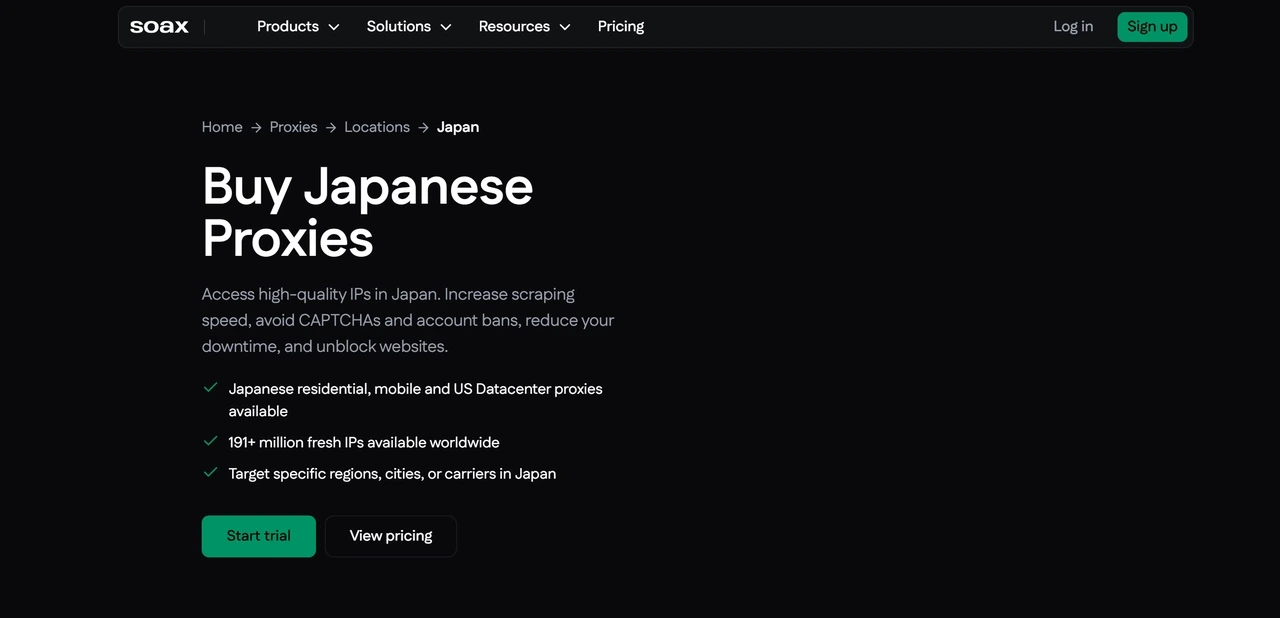
SOAX focuses on detailed geo-targeting and flexible usage-based pricing. Launched in 2019, its residential and mobile networks cover 195 countries. Residential proxies have a reported response time of about 0.55 seconds and a 99.95% success rate.
Key features:
Precise Geo-Targeting: Residential proxies support country, city, ZIP code, carrier, and ASN targeting.
Flexible Session Control: Residential sticky sessions can be set as short as 10 seconds.
Mixed Proxy Sessions: Residential and mobile IPs can be used within the same session without separate proxy configurations.
Simpler Account Access: Email-based MFA can be used to access the account without a traditional password.
SOAX is useful when detailed location control matters, especially for ad verification and localized market testing. Its pricing is also accessible to smaller teams, although some advanced targeting results may still need to be checked against the target website.
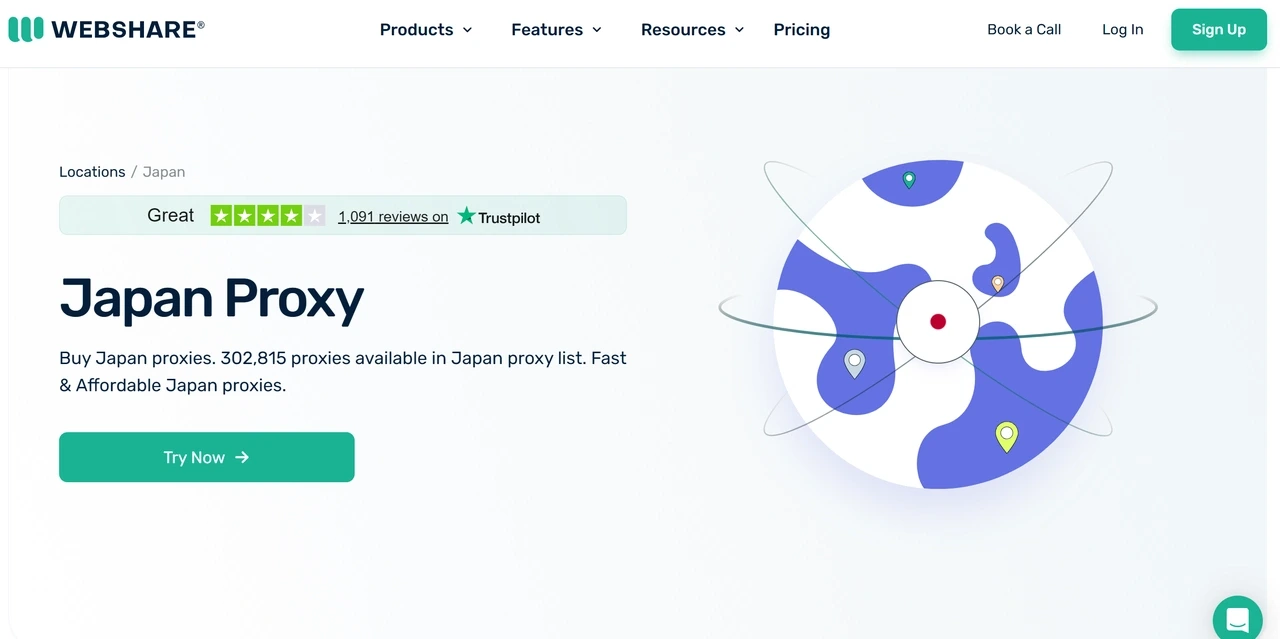
For users who want a low-cost entry point, Webshare keeps the setup relatively simple. The company has operated since 2018 and offers datacenter, static residential/ISP, and rotating residential proxies. Its rotating residential pool includes more than 80 million IPs with country- and city-level targeting.
Key features:
Easy and Free to Test: The free plan includes 10 data center proxies and 1 GB of monthly bandwidth, with no need to use a credit card at all.
Long Sticky Sessions: Rotating residential proxies can keep the same IP for up to 24 hours.
Community Support: Active Discord community for troubleshooting and user assistance.
Webshare works well for proxy testing and smaller data-collection projects, but its targeting is less detailed than providers that support state-, ASN-, ZIP-, or carrier-level filters, and it does not offer mobile proxies. As a result, more advanced scraping workflows may also require separate tools for CAPTCHA handling or JavaScript rendering.
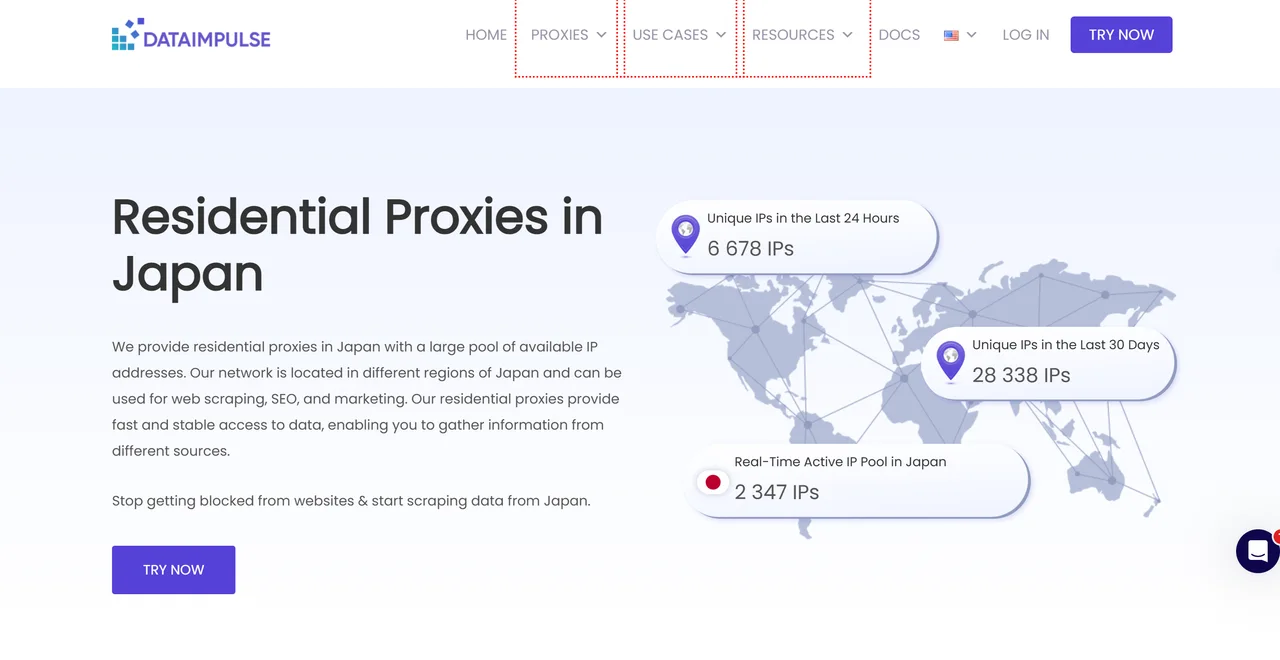
DataImpulse offers affordable pay-as-you-go proxies across 195 countries and regions, including residential, mobile, and datacenter options. Standard residential traffic starts at around $1/GB.
Key features:
Sticky Sessions: Residential IPs can remain fixed for up to 120 minutes.
Datacenter Connections: Datacenter response times can fall below 100 milliseconds, with IPs remaining active for up to 30 minutes.
Real Mobile Networks: Mobile proxies come from genuine 3G, 4G, 5G, and LTE carrier connections.
Traffic That Never Expires: Purchased traffic remains available until it is used, with no mandatory subscription.
DataImpulse is a practical option for smaller scraping, price-monitoring, and testing projects, especially when traffic varies from month to month. However, its standard residential proxies only include country-level targeting, while city, state, ASN, and ZIP code targeting require an additional fee. And its residential sticky sessions also last up to 120 minutes, which is shorter than the 24-hour sticky sessions available with IPcook and Webshare.
ProxyEmpire offers residential and mobile proxies across 170+ countries and regions, with traffic rollover as one of its main advantages. Its network includes more than 30 million residential and mobile IPs, making it suitable for projects where proxy traffic varies from month to month.
Key features:
Traffic Rollover: Eligible rotating residential plans allow unused bandwidth to roll over to the next billing period.
Flexible Geo-Targeting: Rotating residential proxies support country, region, city, and ISP targeting.
High Concurrency: Rotating residential proxies support unlimited concurrent sessions for compliant use cases.
ProxyEmpire is useful for seasonal campaigns or project-based workloads where monthly traffic changes significantly. Its 30M+ residential and mobile pool is smaller than IPcook's 55M+ residential IP pool, but the rollover policy can reduce wasted bandwidth.
Geonode sources much of its residential network through its own platforms, including Repocket and Zenshield, rather than relying entirely on third-party resale. Operating since 2021, it provides residential, static ISP, and datacenter proxies, with around 2.5 million active residential IPs across 195+ countries and regions.
Key features:
Direct IP Sourcing: Residential IPs come largely from Geonode-owned channels rather than third-party resellers.
Detailed Geo-Targeting: Geonode's proxy API supports country-, state-, city-, ISP-, and ASN-level targeting, with filtering for supported IP types.
Long Sticky Sessions: Supported rotating proxy connections can keep the same IP for up to 24 hours.
Developer-Friendly Tools: REST API access, browser extensions, and proxy configuration tools are available.
Geonode keeps pricing relatively low and offers enough developer tools for teams that prefer to build their own collection workflow. Its residential pool is much smaller than those of providers such as Bright Data and Oxylabs, so scale is the main tradeoff.
The right Japan proxy depends on your budget, targeting needs, session length, and project scale.
Best for Budget-Friendly Scraping: IPcook
IPcook combines affordable pricing with Japan city-level targeting and flexible IP rotation, making it suitable for scraping projects that need both cost control and location accuracy.
Best for Large-Scale Data Collection: Bright Data or Oxylabs Both providers offer large proxy pools, high concurrency, and advanced scraping capabilities, making them better suited to enterprise projects where scale matters more than price.
Best for Precise Geo-Targeting: SOAX SOAX supports country, city, ZIP code, carrier, and ASN targeting, making it a suitable option for ad verification and local market checks that require detailed location control.
Best for Stable Sessions: IPcook or Bright Data Static ISP proxies are better suited to workflows that require a consistent IP. IPcook offers a more budget-friendly option, while Bright Data provides ISP proxies aimed at larger-scale business use.
Best for Variable Traffic: DataImpulse DataImpulse uses a pay-as-you-go model, so you only pay for the traffic you use. Purchased traffic also does not expire, making it useful for projects with unpredictable or occasional proxy usage.
The best proxies for Japan depend on your budget, targeting needs, session length, and the scale of your project.
If you are still unsure where to start, IPcook Japan proxies are worth a try. The pricing is relatively accessible, and new users can test the residential proxy service with 100 MB of free traffic before committing to a paid plan.