








Oxylabs Review 2026: Does Its Performance Match the Price?

Not every proxy provider is worth the price it asks, even when it has a strong reputation. What matters is whether the service delivers enough value for your specific needs to justify the cost. In this Oxylabs review, we look beyond the name to help you decide whether it is a worthwhile investment or whether your money would be better spent elsewhere.
What Is Oxylabs
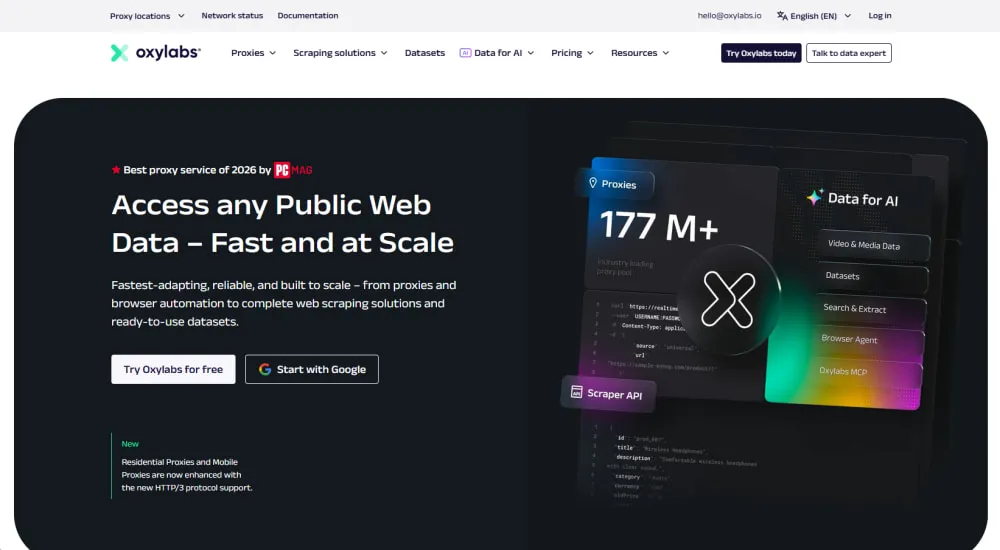
Oxylabs is a proxy and web data provider headquartered in Vilnius, Lithuania. It serves businesses with large-scale data collection needs through a broad product lineup that includes residential, datacenter, ISP, and mobile proxies, as well as scraper APIs and other web data solutions.
With its focus on enterprise customers, Oxylabs offers more than proxy connections alone. Its products support a range of business data collection needs, from accessing online content through different types of IPs to automating data extraction with dedicated scraping tools.
Oxylabs Key Features and Tools
Oxylabs covers 4 proxy types and offers a range of scraping APIs and browser tools. The lineup is extensive, particularly for businesses that need more than proxy access alone. Below are the key features that deserve a closer look.
Proxy Types
Residential Proxies with a Large IP Pool: The network includes over 175 million IPs across 195 countries and locations, with city- and state-level targeting. Configurable IP rotation, sticky sessions, and ASN filtering let you control IP selection and connection behavior. The service also supports HTTP/3 through MASQUE.
Fast Datacenter Proxies: Available options include shared, dedicated, and rotating proxies, offering different levels of control over IP access and rotation. Oxylabs also reports an average response time of 0.222 seconds and a 99.9% success rate.
ISP Proxies with Premium ASNs: IPs sourced from premium ASNs, including Lumen, Comcast, and Cox Communications. Supports HTTP(S) and SOCKS5 protocols.
Mobile Proxies backed by 3G and LTE coverage: A pool of 20M+ mobile IPs across 140+ countries, with filtering by continent, country, state, city, coordinates, and ASN.
Scraping APIs and Browser Tools
Web Scraper API and SERP Scraper API: The Web Scraper API supports data extraction from websites, while the SERP Scraper API focuses on search engine results. Depending on the endpoint and configuration, features include JavaScript rendering and structured data output, reducing the need to build these components into a custom scraping system.
AI Scraping and Browser Automation: Oxylabs AI scraper and Agent Browser extend the offering beyond conventional proxy connections. Browser-based interactions can help with dynamic pages and multi-step tasks that basic HTTP requests cannot handle easily.
Chrome Proxy Extension: Supports proxy configuration, multiple profile management, and switching between proxy connections directly in Chrome.
Oxylabs Pricing: Plans, Costs, and Changes
Oxylabs uses a tiered subscription model, with pricing varying by proxy type and usage level. A single subscription provides access to all its proxy products, starting at $30/month. Here's how the pricing breaks down across its plans.
Proxy Type | Pricing Model | Starter ($30/mo) | Basic ($100/mo) | Flexible ($500/mo) | Enterprise ($2,500+/mo) |
Residential Proxies | Pay Per GB | $6/GB | $5/GB | $4/GB | $2.50/GB |
Mobile Proxies | Pay Per GB | $7.50/GB | $6.67/GB | $5/GB | $3.50/GB |
ISP Proxies | Pay Per IP | $1.50/IP | $1.40/IP | $1.20/IP | $1.10/IP |
Dedicated ISP Proxies | Pay Per IP | $3/IP | $2.78/IP | $2.60/IP | $2.20/IP |
Datacenter Proxies | Pay Per IP | $1/IP | $0.90/IP | $0.80/IP | $0.60/IP |
Dedicated Datacenter Proxies | Pay Per IP | $2/IP | $1.75/IP | $1.45/IP | $1.20/IP |
Datacenter Proxies | Pay Per GB | $0.60/GB | $0.55/GB | $0.45/GB | $0.40/GB |
We found that Oxylabs' current pricing centers on a monthly subscription, with proxy rates varying by product and plan. Although its general terms still mention pay-as-you-go (PAYG) billing, the public pricing page does not clearly list standalone PAYG options for each product. This makes it harder to assess costs for low-volume use without committing to a monthly plan.
Our pricing review also found that Oxylabs no longer publicly promotes the previous 40%–50% discount offers reported in the market. Eligible new customers can still get 30% off their first month, but those who relied on the older discounts may face higher costs over time.
IP Quality & Reliability
We tested Oxylabs' IP quality against Proxyway's 2026 benchmark data and found a clear strength in its residential pool. It ranked first globally by pool size, but Decodo had the stronger US pool. For projects targeting multiple countries, Oxylabs' scale is a major advantage. However, if most requests target US websites, its global lead alone isn't enough to make it the better choice.
The datacenter results were less convincing. Oxylabs recorded just 89 distinct /24 subnets, the lowest among the providers tested. We consider this a weakness because a high IP count means less if addresses are concentrated within fewer network ranges. For tasks that depend on subnet diversity, Oxylabs may be less competitive than providers with a broader distribution. Overall, its residential pool is more impressive than its datacenter network.
Success Rate & Speed
Our performance assessment points to request consistency as one of Oxylabs' strongest assets. In Proxyway's 2026 residential proxy tests, it achieved a 99.93% global success rate, outperforming every other provider in the comparison. We consider that result particularly valuable for large-scale data collection, where even a small drop in successful requests can create substantial rework. Actual results will still depend on the target site and scraping conditions.
Response times tell a different story. The fastest global infrastructure result in the same study belonged to Byteful at 0.41 seconds, rather than Oxylabs. We therefore wouldn't rank Oxylabs first on speed alone. Its benchmark advantage lies in completing requests successfully, which may matter more than marginal latency differences for demanding workloads. Smaller projects with fewer requests, however, may not gain enough from that edge to justify the higher spend.
How to Use Oxylabs Proxy
Getting started with Oxylabs is straightforward once you have a plan. We walked through the basic setup using residential proxies as an example.
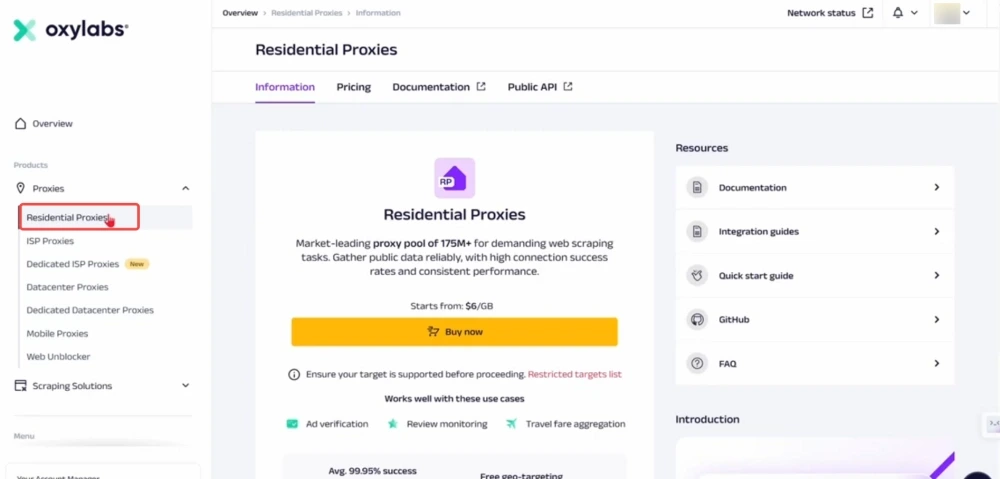
Step 1: Choose a Proxy Plan. Log in or sign up for Oxylabs and select the proxy product you want to use. The setup process varies by proxy type, so make sure you choose the right product for your task. In this example, we select Residential Proxies under Proxies to get started.
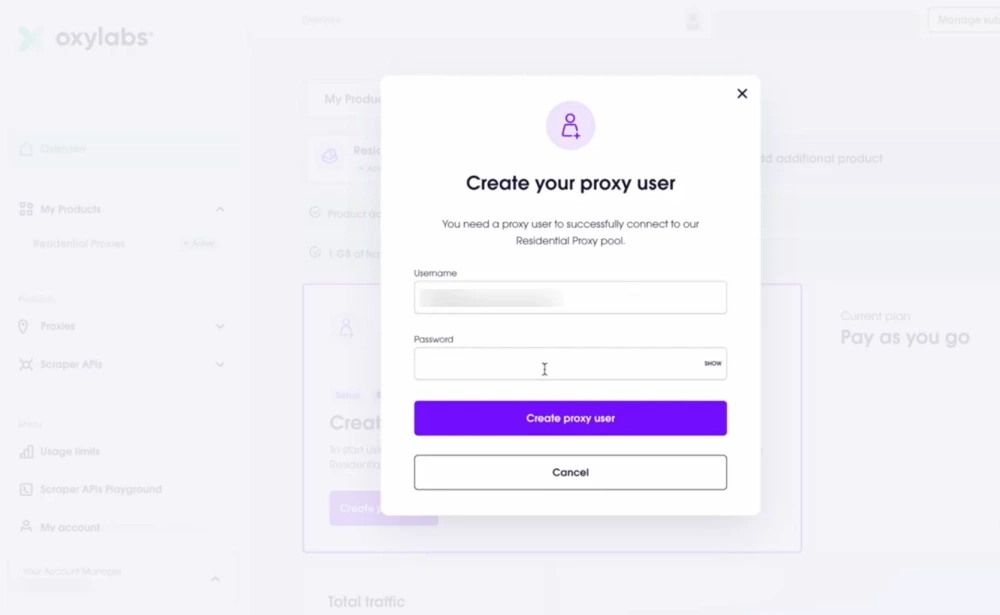
Step 2: Create Your Proxy Credentials. After purchasing your proxy plan, you'll be prompted to create a proxy user with a username and password. Enter your credentials and click Create proxy user. Once the user is created, copy the generated cURL command.
Step 3: Run a Test Request. Open a terminal on your computer and paste the copied cURL command. Enter the URL you want to access, then press Enter to send the request through the proxy.
Pros and Cons of Oxylabs
Oxylabs has several strengths, but its premium pricing and product complexity may not suit every project. We've summarized the main advantages and drawbacks to help you decide whether it's worth the investment.
Pros
Extensive residential IP coverage: We rate Oxylabs highly for its global residential pool, which ranked first worldwide by size in the benchmark data we reviewed. Its US pool trails Decodo, so the advantage is more pronounced in global reach than in every individual market.
A comprehensive proxy toolkit: Having residential, mobile, ISP, and datacenter proxies alongside scraping APIs gives us a broad range of options without requiring separate providers for each function.
Excellent residential success rate: Oxylabs recorded a 99.93% global success rate in the benchmark results we reviewed. For projects processing large request volumes, that level of consistency can reduce retries and keep data collection running more smoothly.
Technical support for complex setups: We consider access to knowledgeable assistance a plus for businesses managing multiple proxy types, particularly when configuration issues require more than basic troubleshooting.
Cons
High costs as usage grows: Our main concern is the financial commitment. Lower residential rates come with higher spending tiers, which can put Oxylabs out of reach for smaller projects with limited budgets.
Limited flexibility for irregular workloads: The public pricing page emphasizes monthly subscriptions, while standalone PAYG availability remains unclear across products. This makes budgeting less straightforward for occasional use.
Low datacenter subnet diversity: The benchmark recorded only 89 distinct /24 subnets for Oxylabs' datacenter pool, the lowest among providers tested. We see this as a specific weakness for operations that depend on a wider spread of network ranges.
A demanding setup for newcomers: Oxylabs offers a broad range of products and configuration options, but that breadth comes with a learning curve. Beginners looking for a quick, uncomplicated setup may find it more involved than they need.
A Cheaper Oxylabs Alternative: Try IPcook Proxy
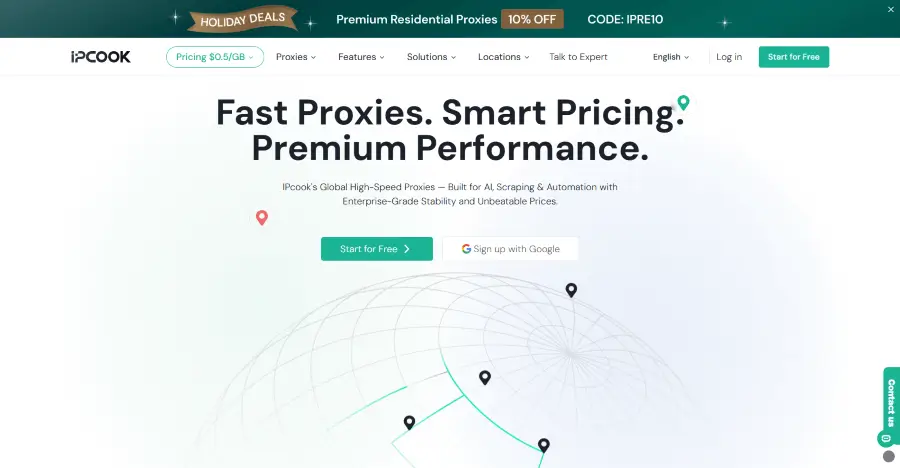
Oxylabs offers a broad proxy portfolio, but its pricing can be difficult to justify for smaller projects or teams with high traffic needs. If you want more affordable options without giving up a range of proxy types, IPcook is worth considering. Its lineup includes residential, unlimited residential, ISP, and datacenter proxies. All proxy types support HTTP and SOCKS5, making integration with existing tools straightforward.
IPcook Residential Proxy comes with 55 million+ IPs across 185+ countries and locations. Pay-as-you-go pricing starts at $3.20/GB and drops to $0.30/GB at high traffic, with traffic that never expires. Connections average under 0.5 seconds, with 99.99% uptime and sticky sessions lasting up to 24 hours. You also get 10 free subaccounts for easier account management, while a single-line API simplifies integration with existing workflows. You can try the service with 100MB of free residential proxy traffic, with no expiration.
For projects that consume traffic continuously, IPcook Unlimited Proxies cost $350 for 30 days, with unlimited residential traffic at 100 Mbps. Higher bandwidth and longer durations are also available. This flat rate is easier to budget for than paying per gigabyte as usage grows. IPcook also offers static ISP proxies from $0.05 per IP per day, giving you another option when you need fixed IPs with unlimited traffic. You can also choose IPs from different major countries.
The Bottom Line: Is Oxylabs Worth It
Oxylabs remains a strong choice for enterprise teams running large-scale scraping projects, especially those that want scraping APIs and high-performing proxies under one provider. Its broad product range and strong residential proxy performance can justify the cost for demanding workloads, though smaller projects may not need everything it offers.
For small to mid-sized teams, freelancers, and budget-conscious buyers, IPcook offers a more affordable option. Its range of residential, unlimited residential, ISP, and datacenter proxies comes with flexible pricing to suit different traffic needs. If you need reliable proxy access without the cost of a full enterprise solution, IPcook is worth considering as your projects grow.