Geonode Proxy Review: Features, Pricing, and Best Alternative


Finding a reliable proxy service is often the biggest challenge in web scraping and large-scale data collection. Without high-quality IPs, your crawlers face constant blocks and CAPTCHAs that stall your progress. Geonode Proxy has emerged as a premium provider designed to solve these issues by offering a versatile range of proxy solutions. Whether you need residential, ISP, or rotating datacenter proxies, they provide the necessary infrastructure to keep your projects running smoothly.
What really makes Geonode Proxy stand out are its powerful features, such as precise city-level targeting and flexible rotation options. Moreover, both its residential and datacenter proxies come with full API support, giving you greater control over your tasks. To help you decide if it's the right fit, this review will dive into Geonode's use cases, key features, pricing, and main pros and cons. We will also look at an alternative to give you a complete picture.
Overview of Geonode Proxy
Geonode Proxy is a premium proxy provider known for its extensive and reliable network. It offers 3 main types of proxies to suit different needs: residential, ISP, and rotating datacenter.
Residential Proxies: These utilize real home-based IP addresses. It provides the highest level of privacy and bypass regional restrictions effectively.
ISP Proxies: These use official provider IPs, offering the reliability of a home connection with superior uptime. Ideal for social media management.
Datacenter Proxies: This option provides high-speed connections from cloud servers, making it a cost-effective choice for heavy automation and bulk data scraping.
Among these options, its residential proxies are particularly noteworthy for their high quality and consistent performance, making them a popular choice for demanding tasks. What really helps Geonode proxy stand out is its massive pool of ethically sourced IPs, which spans over 190 countries. This global reach is complemented by powerful features like precise city-level targeting and flexible session control. These capabilities make Geonode a versatile tool for anyone needing reliable and anonymous web access.
Use Cases: Who is Geonode Proxy for?
Geonode is a great fit for various professionals and businesses whose work depends on reliable and anonymous online access. Here are some of the main users:
Web scrapers and data scientists who need to scrape vast amounts of public data from websites without getting their IP addresses blocked.
E-commerce professionals for monitoring competitor prices, tracking stock levels, and gathering market intelligence from retail websites.
Social media managers who handle multiple accounts or automate social media tasks, as proxies help prevent accounts from being linked and banned.
Marketing and ad verification agencies that need to confirm ad placements and check for fraudulent activity from various geolocations.
SEO experts who perform keyword tracking and competitor analysis from different locations to get accurate, localized search engine results.
Key Features and Performance of Geonode Proxy
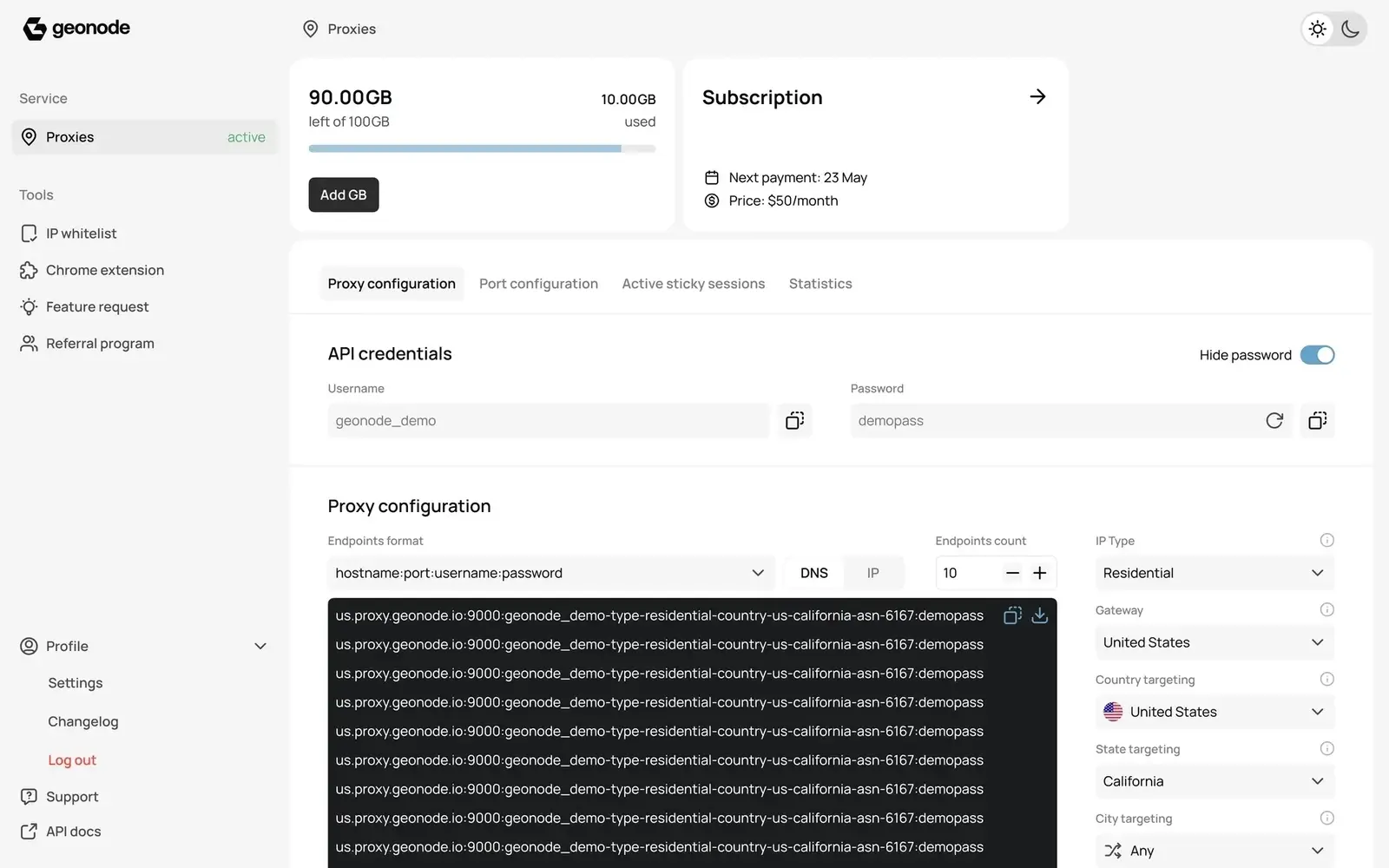
Worldwide Network Coverage with Geolocation
One of Geonode Proxy's biggest strengths is its massive global network. It boasts millions of IPs spread across more than190 countries, giving you truly worldwide coverage.
What makes this network particularly powerful, however, is its precision. All of its proxy types, including residential, ISP, and rotating datacenter, support city-level targeting. This level of control is perfect for tasks like verifying localized ads or analyzing search engine results for a specific area, ensuring you see the web exactly as a local user would.
API Integration and Developer-Friendly Setup
Geonode Proxy also caters well to developers, especially when using its residential and rotating datacenter proxies. It offers a robust API that simplifies integration into any custom script or application. The API provides flexible endpoint formats, such as the common hostname:port:username:password structure, and it supports generating entire lists of proxies in bulk. This feature is a major time-saver for anyone running large-scale data collection or web scraping operations.
Multiple Protocols and IP Rotation
Flexibility is another key area where Geonode's residential and rotating datacenter proxies shine. They support both HTTPS and the more versatile SOCKS5 protocols, making them adaptable for a wide range of applications beyond simple web browsing.
Moreover, you get complete control over IP rotation. You can use rotating sessions that change your IP with each request, which is perfect for large-scale web scraping. Alternatively, you can choose sticky sessions to maintain the same IP for a set period, a feature that is essential for managing online accounts or completing multi-step processes without interruption.
Moderate Speed and Stability
When it comes to speed and stability, Geonode Proxy offers moderate performance. This is generally sufficient for many standard tasks like market research or social media management. However, the connection speed can be inconsistent. Users report that while it can be very fast at times, it often runs on the slower side.
This makes it less suitable for activities requiring a consistently fast and stable connection, such as online gaming on platforms like Epic Games. This variability is also noticeable with their residential proxies, where a portion of the IPs can be unresponsive, so it may not be the best choice for mission-critical projects.
Geonode Proxy Pricing and Plans
Geonode Proxy offers different plans for its various proxy types, catering to a range of budgets and project sizes. Here's a quick breakdown of their starting prices:
Residential Proxies: Geonode proxy offers 2 different kinds of pricing. For the pay-as-you-go plan, it costs $3/GB. For the monthly plan, the prices start from $50 for 50 GB.
Rotating Datacenter Proxies: This type of proxy also offers 2 different plans. As for pay-as-you-go, the price starts at $0.6 GB (minimum commitment). The monthly plan starts from $50 for 100GB.
ISP Proxies: ISP proxies are priced per proxy instead of by data. The shared plan starts at $17 monthly, while the dedicated option begins at $30 monthly.
Pros and Cons of Geonode: Is It Worth It?
To help you decide if Geonode proxy fits your specific needs, we have summarized the main advantages and drawbacks based on real user experiences.
Pros:
Extensive Global Network: With millions of IPs in over 190 countries, Geonode provides excellent coverage for nearly any geolocation requirement.
Precise Targeting Options: The ability to target specific cities gives users granular control, which is perfect for location-sensitive tasks like ad verification or SEO analysis.
Flexible Session Control: Its residential proxies and rotating datacenter proxies support both rotating and sticky sessions, offering the adaptability needed for web scraping.
Developer-Friendly API: A robust API makes it easy to integrate Geonode proxy into custom scripts and applications, simplifying automation.
Cons:
Inconsistent Performance: The connection speed and stability can be unreliable. While sometimes fast, some users often experience slower performance, which can be a problem for time-sensitive projects.
Reliability of Residential IPs: A portion of the residential proxies can be offline or unresponsive, potentially disrupting automated workflows.
Can Be Costly for Heavy Use: The pay-as-you-go model for residential proxies can become expensive for users who require a large amount of bandwidth.
A More Stable Alternative: IPcook Residential Proxies
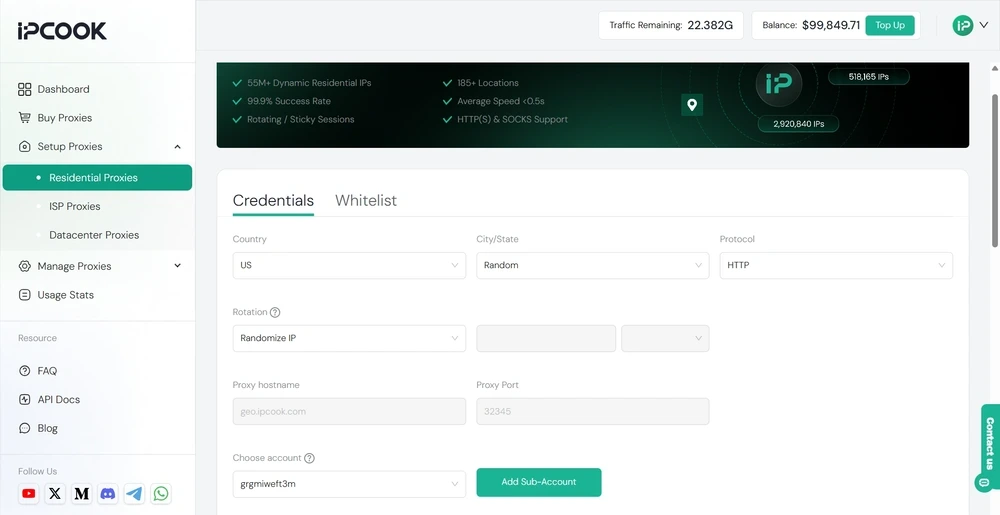
Though Geonode offers a broad range of features, users have noted inconsistencies, particularly concerning the stability and speed of its residential IPs. If consistent performance and reliability are your top priorities, IPcook Residential Proxies serves as a robust alternative. This provider resolves common connectivity issues with a massive pool of over 55 million ethically sourced IPs. It covers more than 185 regions and supports precise city-level targeting for local data access.
It also provides both rotating and sticky sessions, with the latter maintaining an IP for up to 24 hours. Furthermore, IPcook is known for its fast speeds and a highly reliable 99% uptime, ensuring your projects run smoothly. For the pricing, it goes for a pay-as-you-go model starting at just $3.2/GB. The cost per gigabyte decreases significantly as your usage volume increases.
Comparison of residential proxy offerings: Geonode Proxy vs IPcook
Here is a direct comparison of Geonode and IPcook's residential proxy offerings:
Feature | Geonode Residential Proxies | IPcook Residential Proxies |
Geographic Coverage | 190+ Countries | 185+ Countries and Regions |
IP Pool Size | 2M+ | 55M+ |
Speed | Moderate, can be inconsistent | ✔️ Fast and consistent |
Stability | Moderate, occasional slowdowns, some IPs offline | ✔️ Highly stable, 99% uptime |
Protocol Support | HTTPS, SOCKS5 | HTTPS, SOCKS5 |
API Integration | ✔️ | ✔️ |
City-Level Targeting | ✔️ | ✔️ |
Session Type | Rotating & Sticky | Rotating & Sticky (Up to 24h) |
Pricing Model | Subscription (from $50 for 50 GB/mon) & Pay-as-you-go ($3/GB) | Pay-as-you-go (From $3.2/GB, scales down) |
Verdict
This review has evaluated Geonode Proxy based on its features, pricing, and overall performance. While Geonode offers great flexibility with its city-level targeting and developer-friendly dashboard, the moderate speeds and occasional stability issues can be a drawback for intensive tasks.
For users who are looking for a faster and more stable option, IPcook serves as the best alternative. With a massive pool of 55M+ IPs and a guaranteed 99% uptime, IPcook provides the high-speed reliability needed for professional data collection. Ultimately, if you need superior stability and a higher success rate, IPcook is the more robust choice.