What are Rotating Proxies? Setup Guide, Pros and Cons Explained


In this article, you'll learn what rotating proxies are, how they work, their main types, real-world applications, how to choose a reliable provider, and simple setup instructions.
What are Rotating Proxies
Rotating proxies are a type of proxy service that periodically changes the assigned IP address or switches it with each new connection request to hide the user's real IP address.
Static proxies use a single fixed IP address to mask a user's identity. In contrast, rotating proxies regularly switch IP addresses or assign a new one per request. As a result, each request or group of requests appears to originate from different devices or geographic locations. This is why rotating proxies are often used for tasks that require high levels of privacy or large-scale data access.
How Rotating Proxies Work
A rotating proxy works by using a pool of IP addresses and automatically switching between them when sending requests online. The system assigns a new IP after each request or at set time intervals, all running in the background through the proxy server without requiring any manual action. From the perspective of the target website, the traffic appears to come from multiple real users across different locations or devices.
Consider local SEO research as an example. When checking keyword rankings in different cities, using a single IP typically limits results to your own location. By contrast, rotating proxies allow you to switch IPs based on location for each search, making it possible to view accurate local search results from various regions without triggering suspicion or abnormal traffic signals from search engines.
There are two common modes of rotating IP behavior:
Per-request rotation: A new IP is assigned for every HTTP/SOCKS5 request made. This is ideal for large-scale web scraping or traffic simulation, where high anonymity is needed.
Sticky sessions: The same IP is maintained for a fixed duration (e.g., 1-30 minutes), useful for tasks like session-based browsing or multi-step automation that require temporary consistency, e.g., automatically scraping websites.
Here's a quick look at how rotating proxies work:
Your request is sent to a rotating proxy server.
The proxy server selects a residential IP from its pool.
The request is forwarded to the target website using that IP.
The response returns through the same proxy.
You receive the data, now masked by a different IP address.
This smart rotation setup is essential for bypassing rate limits, avoiding bans, and slipping past anti-bot systems, especially on websites with strict security protocols. A reliable rotation strategy is the backbone of any successful data operation, which is why an advanced rotating proxy service will let you fully control rotation modes, timing, and session duration.
Rotating Proxy Types
Although all rotating proxies work by switching IP addresses, they differ significantly in their IP sources and capabilities. We'll begin with rotating residential proxies, followed by datacenter proxies and then mobile proxies, which provide the highest level of anti-detection performance.
Rotating Residential Proxies
Residential proxies are rotating proxies that use IP addresses assigned by Internet Service Providers (ISPs) to real household internet connections. Because these IPs come from actual homes, they can effectively hide your device's real network identity and make your traffic look like normal user activity, rather than coming from a proxy.
These proxies rely on a well-developed IP rotation system, with two common options: switching IPs automatically at set time intervals or assigning a new IP for every request. With access to a large pool of residential IPs and flexible rotation settings, your traffic appears to come from many different real users. This helps avoid detection by anti-bot systems and reduces the risk of blocks, all without the need to manually manage IPs.
Rotating residential proxies are often used in scenarios with strict security measures, such as scraping data from protected websites, monitoring e-commerce prices, tracking search engine rankings, and managing social media accounts. Compared to datacenter proxies, they tend to be slower and more expensive. However, their high level of authenticity makes them much more effective at bypassing advanced detection systems, leading to higher success rates in sensitive tasks.
Rotating datacenter proxies
Unlike residential proxies, rotating datacenter proxies use IP addresses generated from data center servers, combined with automatic IP rotation. These IPs come entirely from cloud providers or server infrastructure rather than real household networks.
The main advantages of rotating datacenter proxies are speed, stability, and cost efficiency. Data center servers typically offer high bandwidth, low latency, and reliable uptime, making them suitable for fast and continuous requests. They are also significantly cheaper than residential IPs, and many providers offer large IP pools that support high concurrency. With automatic rotation, users do not need to manually switch IPs, which improves efficiency for large-scale tasks.
In practice, rotating datacenter proxies are commonly used when speed and cost matter more than strong anonymity, such as for data collection, API requests, automated testing, and scraping public data. They are more likely to be detected than residential proxies and may face stricter limits, but they still offer a good balance of performance, scalability, and affordability for high-volume or lightweight tasks.
Rotating mobile proxies
Rotating mobile proxies operate through IP addresses assigned by mobile networks such as 4G and 5G, with automatic IP rotation built in. Unlike proxies that depend on data centers or fixed residential broadband, these connections originate directly from cellular carriers, so the traffic closely mirrors that of regular smartphone users on mobile data.
One of their strongest advantages lies in their high level of legitimacy in the eyes of target platforms. Because mobile carriers assign and rotate IPs across a large user base, traffic patterns appear highly natural and difficult to distinguish from real human activity. As a result, they are harder to detect, less likely to be correlated across accounts, and more resilient against bans in sensitive environments.
Rotating mobile proxies work well in environments with strict anti-bot measures, such as account creation and warming, ad verification, and data collection from heavily protected websites. The trade-off is cost and performance. Mobile proxies are typically more expensive than both residential and datacenter options, and the routing process can introduce slightly higher latency. Even so, when reliability under aggressive detection is the priority, they remain one of the most resilient proxy types available.
Common Applications for Rotating IP Proxies
Rotating residential proxies are used across diverse fields where large-scale, distributed, and location-specific internet access is required. Typical scenarios include:
Web Scraping: Collecting large amounts of data from websites while avoiding detection and IP blocking.
Account Management: Creating, logging into, or managing multiple accounts without getting flagged.
Ad Verification & Anti-Fraud: Checking ad placements across regions and detecting fraudulent clicks or impressions.
Price Monitoring: Tracking competitor prices and market trends from different locations.
Localized Testing: Verifying how websites or services appear and function in various geographic locations.
What unites these use cases is the need for frequent IP changes, high anonymity, and broad geographic coverage. Using the right rotating proxy provider, like IPcook, is critical to meeting these demands. For more details, scroll down to discover it!
Why Use Rotating Proxies: Key Benefits Explained
Using rotating proxies in online workflows offers several practical advantages that can significantly improve performance and reliability.
Stronger anonymity: Automatic IP rotation ensures that each request uses a different IP address or switches at set intervals, making it difficult for websites to trace activity back to a single source. This helps protect user privacy and reduces digital footprints.
Better protection against IP bans: Many websites rely on IP-based blocking to prevent automation or repeated requests. By distributing traffic across a large pool of IPs, rotating proxies lowers the risk of detection and helps avoid bans.
Access to geo-restricted content: With IPs available from multiple locations, rotating proxies allow users to access region-specific content and view localized versions of websites that may otherwise be unavailable.
Improved scalability and stability: Fewer IP blocks and account restrictions allow rotating proxies to run large-scale tasks such as data collection and continuous web access with greater stability and efficiency.
Key Factors to Consider When Choosing Quality Proxies
Not all rotating proxies deliver the same level of performance. When evaluating providers, consider the following factors:
IP pool size and diversity: A large, geographically distributed IP pool helps reduce repetition and lowers the risk of blocks.
Rotation control: Look for providers that offer flexible rotation options, including per-request switching, timed intervals, and sticky sessions.
Speed and uptime: High-speed connections and reliable uptime (99.9% or higher) are critical for time-sensitive tasks like scraping and ad verification.
IP reputation: For residential and mobile proxies, make sure IPs are clean, reputable, and not flagged or blacklisted by major platforms.
Protocol support: Ensure support for HTTP, HTTPS, SOCKS5, and any other protocols required by your tools or scripts.
Pricing and scalability: Choose plans with transparent pricing and the ability to scale as your usage grows, without hidden fees.
How to Integrate Rotating Proxy into your High-Stakes Tasks
Integrating rotating proxies into your tools or scripts is usually straightforward, especially with user-friendly providers like IPcook that offer ready-to-use configurations. Below is a step-by-step guide with a practical example.
Get rotating proxies from IPcook
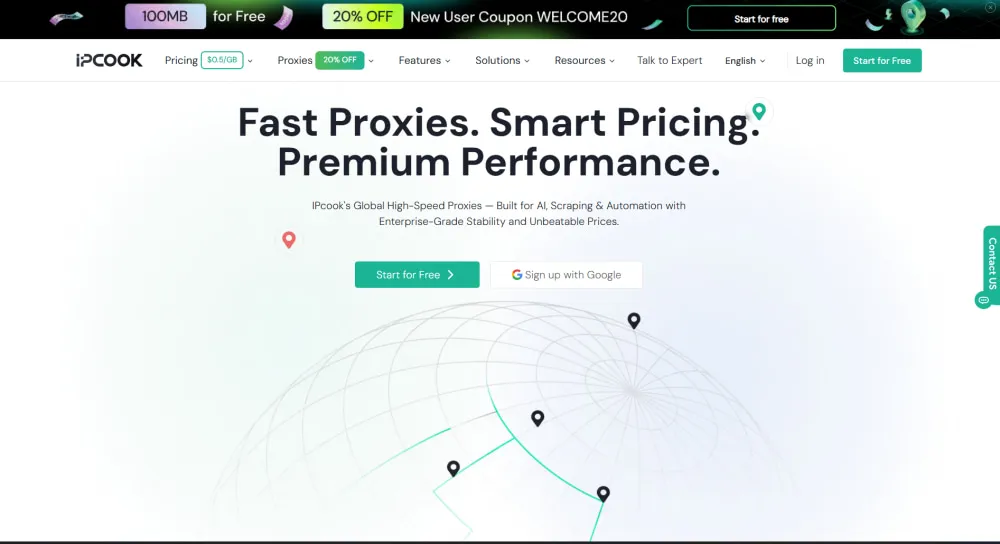
IPcook is an IP proxy provider offering high-performance rotating proxy solutions, including ISP proxies and residential proxies. It delivers customizable rotation settings, easy integration with tools and scripts, and IP coverage across 185 countries.
Sign up for an IPcook account and select a proxy plan that fits your use case, such as residential proxies for web scraping.
Configure proxy settings in the dashboard, including rotation rules (per-request or timed-rotation), sticky session duration, and target locations.
Retrieve your proxy credentials from the dashboard, including IP, port, username, and password, then apply them in your tools or scripts.
cURL example configuration
curl -x http://USERNAME:PASSWORD@PROXY_HOST:PROXY_PORT "https://www.ipcook.com/"Python example configuration
import requests

def get_ip():
    proxy = 'USER:PASS@HOST:PORT'
    url = 'https://ipv4.icanhazip.com'
    proxies = {
        'http': "http://"+proxy,
        'https': "http://"+proxy
    }
    try:
        response = requests.get(url, proxies=proxies, timeout=10)
        response.raise_for_status()
        return response.text.strip()
    except requests.exceptions.RequestException as e:
        return f'Error: {str(e)}'

print(get_ip())
Java example configuration
import java.io.BufferedReader;
import java.io.InputStreamReader;
import java.net.*;

public class demo {

    public static String auth = "USER:PASS@HOST:PORT";
    public static String proxyHost;
    public static int proxyPort;
    public static String proxyUser;
    public static String proxyPass;

    static {
        String[] userHost = auth.split("@");
        String[] userPass = userHost[0].split(":", 2);
        String[] hostPort = userHost[1].split(":", 2);
        proxyUser = userPass[0];
        proxyPass = userPass[1];
        proxyHost = hostPort[0];
        proxyPort = Integer.parseInt(hostPort[1]);
    }

    @SuppressWarnings("deprecation")
    public static void getIPByHttpProxy() {
        try {
            Authenticator.setDefault(new Authenticator() {
                @Override
                protected PasswordAuthentication getPasswordAuthentication() {
                    return new PasswordAuthentication(proxyUser, proxyPass.toCharArray());
                }
            });
            Proxy proxy = new Proxy(Proxy.Type.HTTP, new InetSocketAddress(proxyHost, proxyPort));
            URL url = new URL("http://ipv4.icanhazip.com");
            HttpURLConnection conn = (HttpURLConnection) url.openConnection(proxy);
            conn.setConnectTimeout(10000);
            conn.setReadTimeout(10000);
            conn.setRequestMethod("GET");
            int code = conn.getResponseCode();
            if (code == 407) {
                System.out.println("Proxy Authentication Required (407).");
                return;
            }
            BufferedReader in = new BufferedReader(new InputStreamReader(conn.getInputStream()));
            String inputLine;
            StringBuilder content = new StringBuilder();
            while ((inputLine = in.readLine()) != null) {
                content.append(inputLine);
            }
            in.close();
            conn.disconnect();
            System.out.println(content.toString().trim());
        } catch (Exception e) {
            System.out.println("Error: " + e.getMessage());
        }
    }

    public static void main(String[] args) {
        getIPByHttpProxy();
    }
}
Summary
This article provides an overview of rotating proxies, explaining how they work and the differences between major types. It also covers how they are used in real workflows through integration with providers like IPcook. Overall, it helps users understand how rotating proxies can improve efficiency, reduce blocking risks, and support more stable and scalable online operations, while also highlighting the key trade-offs to consider when choosing and deploying them.
FAQ
What are rotating proxies used for?
Rotating proxies are mainly used to distribute web traffic across multiple IP addresses, making it easier to perform large-scale online tasks without being easily blocked or flagged. They are commonly applied in data collection, web scraping, SEO monitoring, ad verification, and managing multiple online accounts, where stable and continuous access is required.
Are rotating proxies legal to use?
Yes, rotating proxies is generally legal to use. They are simply a networking tool used to route internet traffic. However, how they are used matters. Using them for legitimate activities like data analysis or testing is allowed, but using them to violate website terms of service, bypass restrictions unlawfully, or engage in illegal activities can lead to consequences.
What is the difference between rotating and static proxies?
Rotating proxies automatically change IP addresses at set intervals or with each request, making them suitable for large-scale or automated tasks where avoiding detection is important. Static proxies, on the other hand, keep the same IP address for a longer period, offering more stability but less anonymity. Rotating proxies are typically used for web scraping, data collection, and account management at scale, while static proxies are preferred for activities that require a consistent identity.