UK VPN Ban: What's Happening and What It Means

In October 2023, the UK passed the Online Safety Act (OSA), which now sits at the centre of the country's approach to regulating online content and platform responsibility. Building on this, in June 2026, the UK government announced further restrictions on social media access for users under the age of 16, covering platforms such as YouTube, TikTok, and Instagram. The aim is to reduce under-16 users' exposure to harmful content such as sexual, violent, or otherwise age-inappropriate material (Source: GOV.UK).
This sits within the wider Online Safety Act framework and is overseen by Ofcom, the UK's communications regulator, which is responsible for ensuring platforms actually follow the rules on age assurance. The policy is expected to be fully rolled out by spring 2027.
As these age checks become more robust, there has naturally been more discussion about whether VPNs could be used to get around restrictions. That has raised questions about how far enforcement can realistically go in practice.
For now, VPNs are still completely legal in the UK and widely used for normal privacy and security reasons. However, regulators are looking more closely at the potential for misuse, especially around bypassing age verification systems. The exact boundaries of future enforcement are still being worked out and are expected to become clearer as rollout continues.
Will VPNs Still Be Private?
Following the introduction of stricter online safety rules, VPN downloads in the UK have risen noticeably. At the same time, some officials have raised concerns about potential misuse, prompting debate over applying age checks to VPNs for under-16 users (Source: BBC). However, this approach presents a practical challenge. Age or identity checks would require collecting user data, which conflicts with one of the main reasons people use VPNs in the first place: privacy.
A VPN, or Virtual Private Network, encrypts internet traffic and masks a user's real IP address. It is commonly used for privacy protection, remote work, and accessing content across different regions. Because it limits how much online activity can be tracked, VPNs are widely regarded as an important tool for maintaining online anonymity.
If future regulations place VPN services under stricter controls or introduce age verification, the meaning of VPN privacy could begin to change. For example, age verification VPN requirements might involve identity checks during sign-up or access, reducing the "no identity required" experience that many users currently expect.
While these changes would not affect the core encryption technology, they could reshape how VPN services are accessed and who can use them freely. As a result, VPN privacy may shift from full anonymity toward a more conditional model shaped by regulatory compliance. This could have implications for both individual users and businesses that rely on VPNs for secure and flexible access.
What Could Happen If VPNs Were Restricted?
If VPN services were subject to stricter regulation or age verification requirements, the impact would extend beyond access itself. It would affect both how individuals use VPNs in daily life and how businesses integrate them into secure digital operations.
Reduced Privacy for Individual Users
From an individual perspective, introducing age verification requirements for VPN services could significantly reduce online privacy. VPNs are widely used because they allow users to browse the internet without directly linking activity to their identity. If age checks or identity verification were introduced, this could weaken that anonymity and make users easier to trace. It may also raise concerns about data storage and security, especially if sensitive personal information is required to access VPN services.
Meanwhile, the number of available VPN providers may decline, as smaller or privacy-focused services may struggle to meet regulatory requirements and be forced to exit the UK market.
In everyday use, introducing age verification to VPN services could affect users in several practical ways:
Personal data exposure may increase, as users' IP addresses may no longer be fully hidden when using VPN services.
Access to certain online content could become restricted when location-based VPN bypass is less effective.
On public networks, the lack of VPN encryption increases the risk of data interception.
Higher Costs and Compliance Pressure for Businesses
From a business perspective, the impact would likely be broader and more structural. VPNs are a core part of enterprise IT systems, supporting secure remote access, internal communications, and cross-border operations. If VPN services were brought under age verification or tighter regulatory control, companies could face both operational and compliance challenges.
These changes could affect businesses in several ways:
Increased complexity in managing secure remote access for employees across different regions.
Greater reliance on identity and access management systems to control user authentication.
Possible restrictions on cross-border data access, affecting global teams and workflows.
Higher compliance and operational costs due to system upgrades and regulatory alignment.
Organisations may also need to redesign parts of their cybersecurity infrastructure to maintain secure access while meeting regulatory requirements. This could involve upgrading VPN systems, adding extra authentication layers, or shifting toward alternative secure access technologies.
Overall, for businesses, the main concern is not the loss of VPN functionality itself, but the added complexity, cost, and compliance burden that could come with extending age verification rules to VPN use. For businesses in this situation, an IP proxy can be a useful alternative to VPNs.
💡You May Like:
VPN vs Proxy: Key Differences & How to Choose the Right Tool
IP Proxy as a Business VPN Alternative
An IP proxy is especially useful for operations that require frequent IP switching across different regions. It works by routing internet traffic through an intermediate server, allowing users to appear as if they are browsing from different locations. It can also provide a basic level of anonymity by masking the user's original IP address.
With an IP proxy, companies can assign different exit IPs for specific projects, regions, or tasks without having to rework their entire network setup. This makes it easier to manage access needs while keeping operations running smoothly. When VPN compliance requirements, usage patterns, or setup costs change, businesses often need to rethink their network tools. For teams that want to avoid major infrastructure changes while keeping flexibility, an IP proxy is often the easier option.
Implementing IP Proxies in Business with IPcook
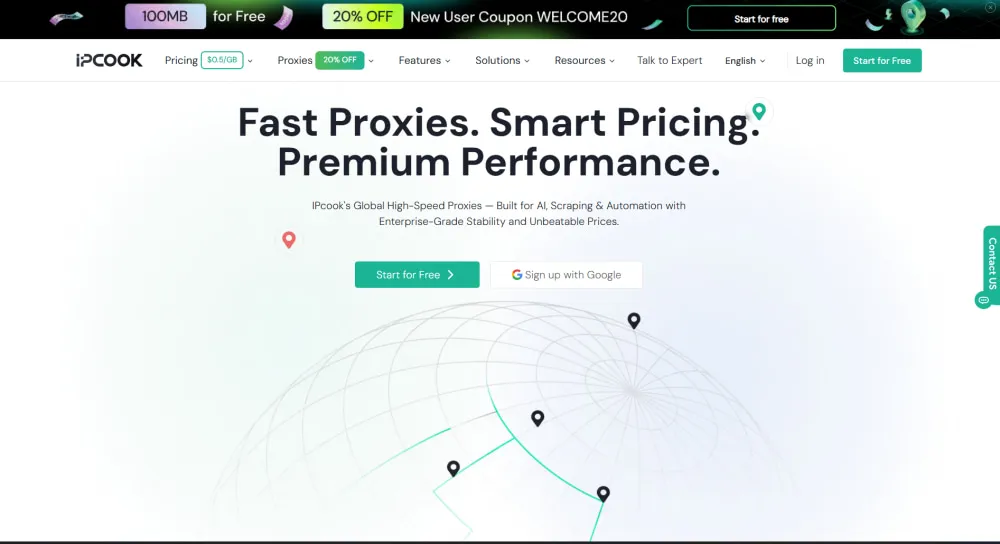
If a business wants to balance flexibility and control, choosing the right IP proxy provider becomes especially important. IPcook is a reliable IP proxy provider that offers both ISP and residential proxies, with coverage across 185 countries.
ISP proxies are provided by internet service providers and run on data centre infrastructure. They are known for stable and consistent performance. Residential proxies use IPs from real home networks, so traffic appears like normal user activity, and they are often used for web testing, ad verification, and region-based access. Together, these proxy types give businesses more flexibility in choosing the right setup for different tasks. Below are the key features of IPcook:
Enterprise custom solutions: IPcook offers tailored setups to meet different business needs. Companies can adjust proxy usage based on their workflows and team structure.
High anonymity: All IPs come from real residential users or ISP networks. Traffic appears more natural and is less likely to be flagged.
API / SDK integration: The API is simple to use, and in many cases, a single line of code is enough to assign proxies. It also supports fast automation and script-based deployment.
Real-time dashboard and analytics: Users can monitor traffic usage and connection status in real time. Reports can also be exported when deeper analysis is needed.
Flexible pricing plans: A range of package options is available, including usage-based and custom plans. Scaling up or down depends on demand.
Multi-account support: Up to 10 free sub-accounts are included, helping teams divide work more efficiently and manage access across users.
Final Verdict
The UK's online safety framework currently focuses on platform responsibility and age verification, rather than restricting VPN use. VPNs remain legal and widely used for both personal and business purposes. However, it is still unclear whether future rules could extend age-related restrictions to VPN services. If that happens, individuals would mainly be affected in terms of privacy and anonymity, while businesses would face greater challenges in maintaining flexible cross-border access.