What Is a Forward Proxy? How It Works, Use Cases, and Proxy Types

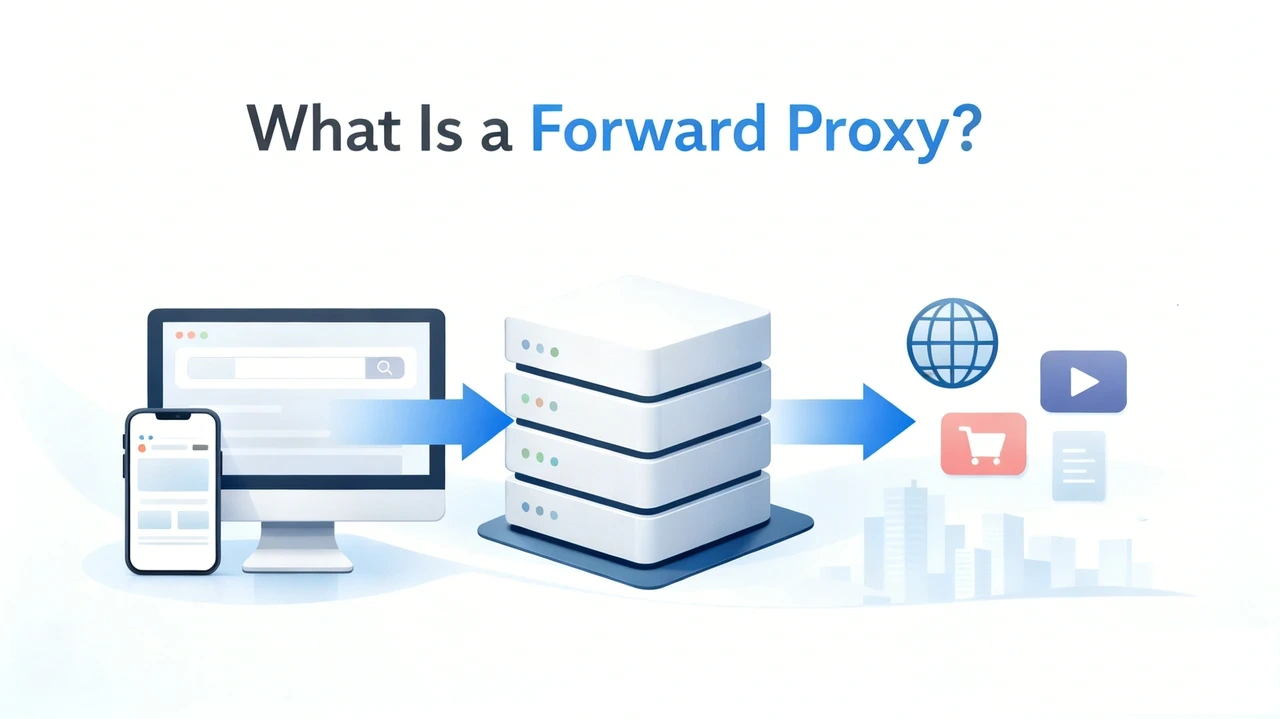
When outbound network traffic needs to be controlled or external access must remain consistent, a common question follows: what is a forward proxy. A forward proxy sits between internal users and the public internet, sending requests on their behalf and controlling how responses return. It is one form of a proxy and manages how outbound traffic leaves a network. In simple terms, a forward proxy acts as a digital gatekeeper that reviews and directs requests before they reach external destinations. This article will show you when a forward proxy becomes necessary, how different implementations behave, and what to consider when long term stability matters.
How a Forward Proxy Server Works
A forward proxy server manages how outbound traffic leaves a network by acting as the single point through which external requests are sent and responses return. Rather than changing how applications behave internally, it controls where requests go, how identity is presented to destination servers, and which rules apply during outbound communication.
How Requests Flow Through a Forward Proxy
A forward proxy sits in the path of outbound traffic, with all external requests passing through it before reaching destination servers and all responses returning through the same point.
Request flow:
Client → Proxy → Destination Server → Response → Proxy → Client
Within this flow, the proxy performs three core functions:
Outbound communication
The proxy sends requests to external servers on behalf of the client and becomes the visible source of traffic.Client identity masking
Destination servers see the proxy address rather than the original client IP, which affects how requests are perceived externally.
Traffic rule enforcement
Access rules can be applied to outgoing requests and incoming responses to control what is allowed to pass.
How Forward Proxy Servers Secure Internal Networks
Within internal networks, a forward proxy server functions as an outbound security control point rather than a passive routing component. By concentrating external access through a single point, organizations gain consistent control over how systems communicate with the public internet.
Key security capabilities include
Access control and content filtering
Outbound requests can be allowed or restricted based on destination, category, or policy.
SSL and HTTPS traffic inspection
Encrypted traffic can be examined to enforce outbound rules when required.
Malicious content blocking
Responses can be screened before reaching internal systems.
Basic data protection controls
Sensitive outbound data patterns can be limited or stopped.
Why Forward Proxies Are Still Used Today
Forward proxies remain relevant because they provide a form of outbound control that direct access models cannot fully replace. By centralizing how requests leave a network, forward proxies keep identity exposure, routing behavior, and access policies consistent across users and systems. This predictability explains why forward proxies continue to appear in modern network design, even as access technologies evolve.
Privacy and Compliance Benefits of Forward Proxies
A key reason forward proxies are still used is their ability to separate internal identity from external access while maintaining visibility within the network. Outbound requests originate from the proxy rather than individual users, while internal policies continue to determine which external destinations can be reached.
This approach supports several operational needs:
User IP addresses and outbound access paths are hidden from destination servers
Compliance, auditing, and access policies can be enforced at a central point
External access can be governed consistently without exposing individual clients
Performance and Traffic Control with Forward Proxies
Forward proxies also contribute to stable outbound traffic behavior by reducing variation in how requests exit a network. When traffic passes through a shared control point, routing patterns become easier to manage and remain consistent over time.
Common advantages include:
Fewer repeated outbound requests through shared caching mechanisms
Centralized traffic handling that keeps routing behavior uniform
More predictable access for long running or scheduled outbound tasks
Common Use Cases for Forward Proxies
Forward proxies are applied in situations where outbound access must remain consistent, observable, and governed across multiple activities.
Data collection workflows that require a consistent outbound identity across repeated access, often paired with scraping or automation tools
Automation and multi account operations where traffic exits through a shared and predictable network point
Cross region content access managed through controlled network exits rather than individual client routing
Enterprise outbound traffic monitoring for centralized visibility and policy enforcement
How Different IP Networks Power Forward Proxies
The behavior and reliability of a forward proxy depend largely on the IP network behind it. While the proxy mechanism itself stays the same, different IP sources affect how traffic is classified by destination servers, how sessions persist over time, and how predictable outbound access remains.
Residential Proxies
Residential proxies use IP addresses assigned to real household connections or end-user devices. Because these IPs reflect normal consumer network activity, outbound requests are more likely to appear natural to destination servers.
Key characteristics include:
IP addresses tied to real residential networks
High authenticity in external access patterns
Limited session consistency and reduced long-term control
ISP Proxies
ISP proxies are built on IP ranges issued directly by internet service providers and delivered through managed infrastructure. They maintain residential credibility while offering more consistent identity behavior than typical residential sources.
Key characteristics include:
Strong IP reputation with stable identity presentation
Predictable session behavior across extended use
Greater control over long-running outbound access
Datacenter Proxies
Datacenter proxies run on cloud or dedicated server infrastructure and are optimized for performance and scale rather than end-user behavior. Their IP ranges support high throughput and consistent routing under load.
Key characteristics include:
High scalability and predictable performance
Efficient handling of large traffic volumes
Increased likelihood of IP recognition during repeated or sensitive access
How to Choose the Right Forward Proxy for Long-Term Use
If you plan to run a forward proxy setup day after day, the priority is keeping outbound access stable while maintaining a consistent external identity. Rather than focusing on proxy types first, it’s more effective to evaluate your needs using three core signals.
What matters most for long-term use
IP stability
Fewer unexpected IP changes help reduce access disruptions and avoid repeated verification or restrictions.
Identity consistency
The same outbound identity should behave predictably across sessions, logins, and repeated access.
Predictable network behavior
Routing quality and response performance should remain steady as traffic volume increases.
Matching common needs to proxy types
Primary requirement | Best starting point | Why it fits |
Realistic origin and flexible rotation | Residential proxies | Rotating IPs provide natural-looking access patterns and broad location coverage. |
High volume and simple scaling | Datacenter proxies | Optimized for speed and throughput, making them efficient for large traffic workloads. |
Long sessions with a steady identity | ISP proxies | ISP-issued ranges offer consistent identity behavior over extended use. |
👉 For step-by-step instructions on configuring proxies, refer to our guide on how to use a proxy server.
If your workflow involves logging into the same platforms daily, tracking pages without triggering verification, or running automation that fails when an IP changes, long-term identity consistency becomes more valuable than frequent rotation. In these cases, staying on a trusted IP often produces more reliable results than switching addresses repeatedly.
For workflows that require stable forward proxy access, IPcook ISP Proxies are a strong choice. ISP IPs from IPcook support consistent identity across repeated visits and extended tasks. Also, its broad country and region coverage helps reduce blocks and CAPTCHA challenges. With unlimited traffic and pricing starting at $0.05 per proxy, IPcook’s ISP proxies remain a cost-effective option for sustained use.
Conclusion
A forward proxy plays a clear role in modern networks by controlling outbound traffic, maintaining a consistent external identity, and enforcing access rules at a central point. Forward proxies help organizations manage security, privacy, performance, and long-term stability, especially when repeated access behavior matters. If you need speed, security, and scalability across different workloads, IPcook offers high-quality static residential proxies (ISP proxies).