How to Scrape Zillow Real Estate Data with Python in 2026

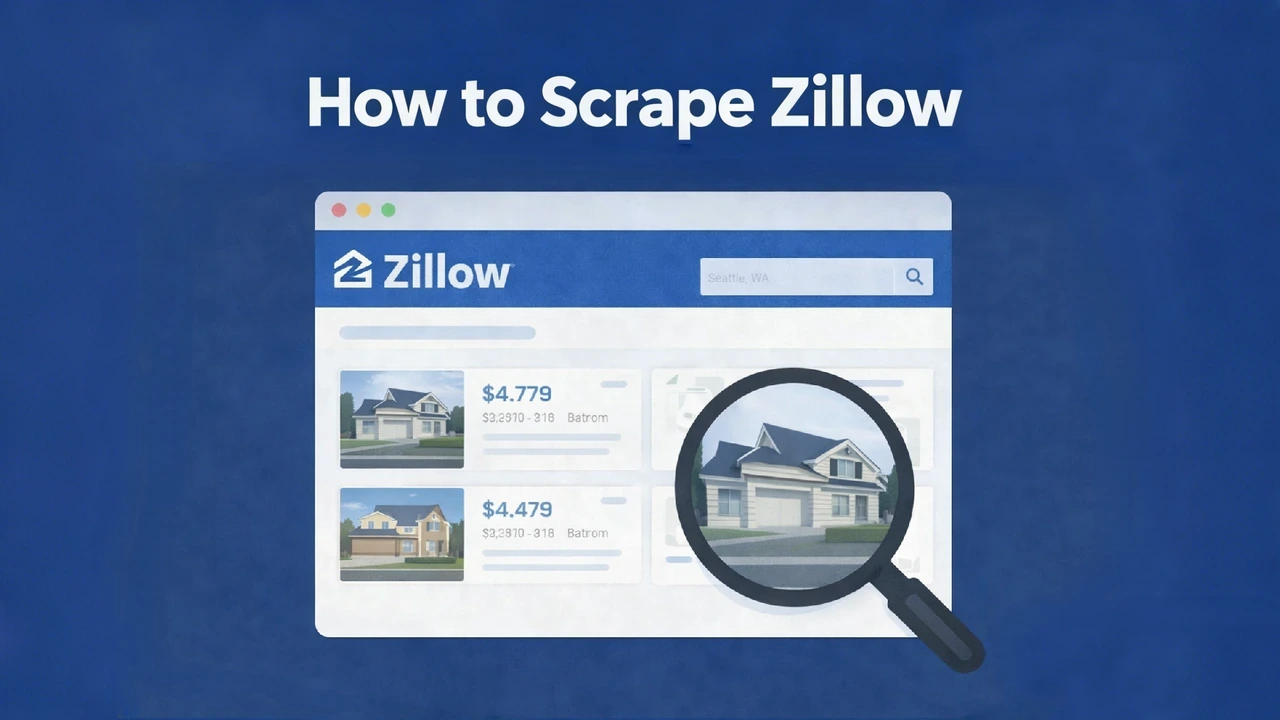
Prices, addresses, and basic property details are visible on Zillow search result pages. Manually copying this information works for one or two listings, but becomes difficult when data is needed across dozens of pages or when tracking changes over time. Collecting the same listing data repeatedly often leads people to scrape Zillow programmatically instead of relying on individual page views.
This guide focuses on how to scrape data from Zillow using Python. The process starts with extracting prices and addresses from a single search results page, then applies the same approach across multiple pages. Each step follows a clear pattern, turning visible listing information into structured data that can be analyzed or monitored.
How Zillow Pages Present Data for Scraping
Zillow search result pages display multiple property listings at once, with each listing showing a small set of visible fields rendered directly in the browser. Zillow data scraping at this level works with information available on the page rather than content hidden behind login or detail views.
What Data You Can Extract from Zillow Pages
From Zillow search result pages, it is possible to scrape data from Zillow that appears consistently across listings. These fields are visible in the results view and can be collected without opening individual property pages.
Common listing fields include:
Listing price
Property address
Bedroom and bathroom counts
Basic listing indicators shown in the results
These fields repeat across search result pages and are typically collected at the search results level.
How Zillow Search Pages Organize Listing Data
Zillow search pages present listings as a repeated set of similar blocks. Each block represents a single property and groups the same set of visible fields.
Key structural traits include:
A search results page contains multiple listings
Each listing groups related fields together
The same field structure repeats across listings and pages
For Zillow data scraping, each listing can be handled as an individual entry within a larger results set.
Scraping Zillow Search Results Page with Python Step by Step
This section builds a minimal zillow scraper python flow to scrape zillow data python from Zillow search results pages. The same request and parsing logic runs on a single page and then repeats across multiple pages.
Set Up a Basic Python Scraper
This setup focuses on creating a minimal working scraper that can successfully fetch a Zillow search results page.
Install the required Python packages:
pip install requests beautifulsoup4Create a Python file and import the required modules:
import requests
from bs4 import BeautifulSoup

headers = {
    "User-Agent": "Mozilla/5.0"
}

url = "https://www.zillow.com/san-francisco-ca/"
response = requests.get(url, headers=headers, timeout=30)
html = response.text
This step confirms that a Zillow search results page can be retrieved as HTML.
Scraping a Single Zillow Results Page
This section builds a minimal Zillow scraper Python flow to collect listing data from Zillow search results pages.
Step 1: Define a Zillow Search Results URL
This example uses a single Zillow search results page to demonstrate the basic scraping flow.
url = "https://www.zillow.com/san-francisco-ca/"Step 2: Send a Basic HTTP Request
response = requests.get(url, headers=headers, timeout=30)
html = response.text
The request uses Python requests with a basic User Agent header and targets the same content shown in a browser.
Step 3: Parse the Returned HTML
soup = BeautifulSoup(html, "html.parser")
The parsed HTML is used to locate listing elements within the page. Page structure may change over time, and this selection is used only as a working reference.
Step 4: Extract Key Listing Fields
listings = []

for node in soup.select("article"):
    price_node = node.select_one("[data-test='property-card-price']")
    address_node = node.select_one("[data-test='property-card-addr']")
    meta_node = node.select_one("[data-test='property-card-meta']")
    link_node = node.select_one("a[href]")

    price = price_node.get_text(strip=True) if price_node else ""
    address = address_node.get_text(strip=True) if address_node else ""
    details = meta_node.get_text(" ", strip=True) if meta_node else ""

    href = link_node["href"] if link_node else ""
    if href.startswith("/"):
        href = "https://www.zillow.com" + href

    listings.append({
        "price": price,
        "address": address,
        "details": details,
        "url": href
    })
This example focuses on the extraction flow rather than capturing every available field.
Step 5: Confirm the Output
print(listings[:3])The output is stored in memory as a list of dictionaries and is not written to disk.
Scraping Multiple Zillow Results Pages (Pagination)
Once a single Zillow results page can be scraped successfully, the same logic can be extended to cover multiple pages through pagination.
Step 1: Identify the Pagination Parameter
Zillow search results are split across multiple pages. Different pages are requested through changes in the results URL.
base_url = "https://www.zillow.com/san-francisco-ca/"Step 2: Loop Through Pages in Python
import time

all_listings = []

for page in range(1, 4):
    page_url = base_url if page == 1 else f"{base_url}{page}_p/"
    response = requests.get(page_url, headers=headers, timeout=30)
    soup = BeautifulSoup(response.text, "html.parser")

    for node in soup.select("article"):
        price_node = node.select_one("[data-test='property-card-price']")
        address_node = node.select_one("[data-test='property-card-addr']")
        link_node = node.select_one("a[href]")

        price = price_node.get_text(strip=True) if price_node else ""
        address = address_node.get_text(strip=True) if address_node else ""

        href = link_node["href"] if link_node else ""
        if href.startswith("/"):
            href = "https://www.zillow.com" + href

        all_listings.append({
            "price": price,
            "address": address,
            "url": href
        })

    time.sleep(2)
Step 3: Control Request Pace
A short delay is added between requests during the loop.
Step 4: Aggregate Results Across Pages
print(len(all_listings))
print(all_listings[:3])
The combined list contains listing data collected from multiple Zillow search results pages.
👀 Related scraping guides
Why Zillow Scraping Often Breaks at Scale
Zillow scraping often works during small tests but becomes unstable as scraping volume increases, even when the scraping code itself remains unchanged. As requests repeat across more pages and runs, they begin coming from the same IP address and follow predictable access paths, which makes them easier to recognize and restrict. Most Zillow scraping failures at scale are therefore traffic-related rather than code-related.
Stability improves when repeated requests no longer originate from the same IP address and when pagination keeps a consistent session instead of restarting identities on every page. IPcook supports this by routing requests through residential IPs and allowing controlled session duration during pagination and repeated access, reducing the traffic patterns that commonly trigger restrictions during large Zillow scraping runs.
Key factors affecting scraping stability include:
55M+ residential IPs across 185+ locations, reducing repeated-origin traffic during large Zillow scraping runs.
Per-request to 24-hour IP rotation, supporting both rapid identity changes and session continuity during pagination.
Elite anonymity without proxy-identifying headers, limiting traffic fingerprints tied to proxy usage.
Hundreds of concurrent connections per account, enabling parallel page collection instead of long-running single-session access.
No monthly commitment with non-expiring residential traffic, allowing scraping volume to scale without time-based usage pressure.
Start with a 100 MB free residential proxy trial with IPcook. For larger runs, residential proxy traffic is available from as low as $0.5/GB. Get it now!
How to Use Scraped Zillow Data for Analysis
Scraped Zillow data needs to be exported and prepared before it can support analysis or monitoring.
Export Zillow Data to CSV or JSON
Exporting converts in-memory results into reusable files. CSV works well with spreadsheets and simple scripts, while JSON preserves structured records for programmatic use.
import pandas as pd
import json

# Export to CSV
pd.DataFrame(all_listings).to_csv("zillow_listings.csv", index=False)

# Export to JSON
with open("zillow_listings.json", "w") as f:
    json.dump(all_listings, f)
Prepare Zillow Data for Analysis or Monitoring
Raw scraped data benefits from basic cleaning to keep records consistent.
def clean_listings(listings):
    cleaned = []
    for item in listings:
        # Remove incomplete records
        if not item.get("price"):
            continue

        # Convert price to numeric value
        price_str = item["price"].replace("$", "").replace(",", "")
        item["price_num"] = float(price_str) if price_str.isdigit() else None

        cleaned.append(item)
    return cleaned

cleaned_data = clean_listings(all_listings)
Preparation usually involves removing empty records, standardizing formats, and keeping a consistent field structure. This turns raw scraped Zillow data into a dataset that can be analyzed, tracked over time, or reused in recurring workflows.
Conclusion
Scraping Zillow data effectively depends on stable access as much as on parsing logic. When your requests scale beyond small tests, network consistency becomes the key factor that keeps collection reliable over time.
IPcook’s residential proxies provide broad IP coverage, flexible session control, and non-expiring traffic that supports long-running data collection across pages. Start your first 100 MB free trial and experience smoother Zillow scraping at scale with IPcook.