Facebook Banned Your IP Address? Here's What to Do Next

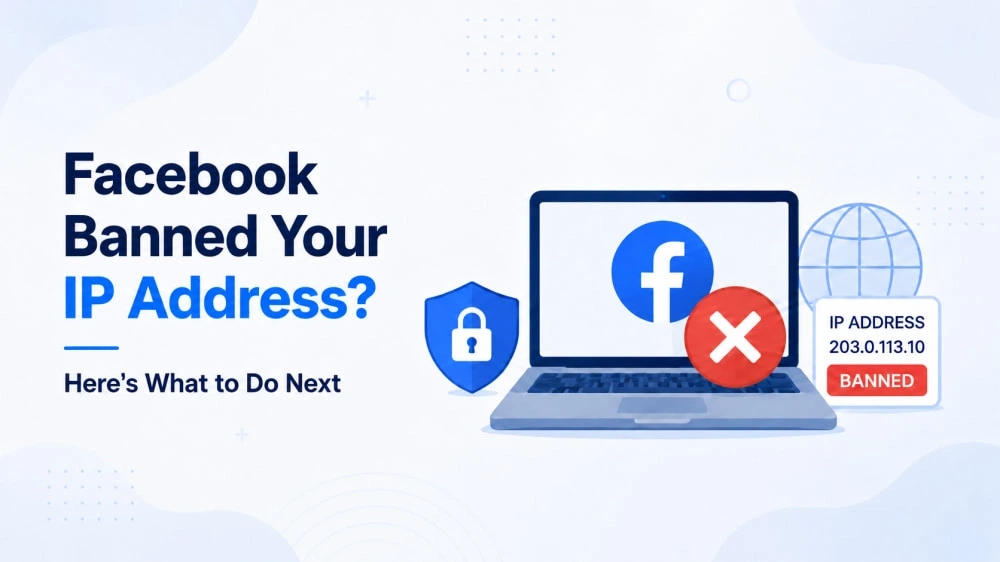
Think Facebook has banned your IP address because you suddenly cannot access the platform? Not necessarily. An account restriction and a network-level block can look similar. However, if access to Facebook is restricted across your country, the problem exists outside your account and cannot be resolved through Facebook's account recovery process.
Before trying to recover your access, this guide helps you identify the type and source of the problem, understand why it happened, and see how long it may last. From there, you can determine whether recovery is possible, take the appropriate next steps, and reduce the risk of another Facebook ban.
Did Facebook Ban Your IP Address or Your Account?
You cannot tell from the access problem alone whether Facebook has banned your IP address or restricted your account. Facebook does not use "IP ban" as an account status, but a quick network comparison can help show whether the problem follows your account or your connection.
On the same phone, turn off Wi-Fi and access Facebook over mobile data:
If Facebook works over mobile data but not over Wi-Fi, the problem is more likely tied to the original network. This does not prove that Facebook blocked the IP address.
If the same restriction notice appears on both connections, the action is tied to your account or an associated asset.
Identify What Facebook Has Restricted
Facebook uses different terms when it takes action against an account or associated asset. They do not mean the same thing:
Restriction: You can usually access Facebook, but certain features are unavailable. The restriction may affect posting, messaging, commenting, advertising, or other activities.
Suspension: Your personal account is unavailable while you have an opportunity to appeal the decision. The login notice should show the deadline and available action.
Disabled account: The account is unavailable, often after an unsuccessful appeal, a missed deadline, or serious enforcement. A disabled account may not have another review option.
A locked account is different. It usually means Facebook detected a possible security problem and wants you to confirm your identity or secure the account.
These labels explain the type of action. Next, confirm which account or asset the notice applies to, since each can be restricted separately:
Affected area | Where to check | What it confirms |
Personal profile or features | Account Status and Support Inbox | A content or feature restriction attached to the profile |
Suspended or disabled account | Login notice and the email linked to Facebook | Whether the account is suspended or disabled |
Locked account | Login or security-check screen | A security check rather than a policy ban |
Facebook Page | Page Status while using the Page profile | An action against the Page that may not affect the personal account |
Ad account or business asset | Meta Business Support Home | The specific Page, ad account, or business account that Facebook restricted |
💡How Your IP Address Affects Facebook Access
Facebook uses IP addresses as one source of login location data.
An unfamiliar login may trigger a security check, but not necessarily a ban.
Facebook publishes no IP quality score or automatic ban threshold.
A VPN or proxy changes the connection, not an existing account penalty.
Why Facebook Bans Accounts and Pages
Facebook may restrict an account or page for several reasons, from prohibited content and suspicious activity to security concerns and business policy violations. They can be grouped into 3 main categories:
Community Standards violations: Facebook's Community Standards define what content and behavior are allowed on the platform. When an account or page breaks these rules, Facebook may remove the content and issue a strike. Repeated strikes or a severe violation can lead to feature restrictions or account disablement.
Fraud or account compromise: Fraud involves intentionally using an account to deceive others, while account compromise means someone has gained unauthorized access. Fraudulent activity can lead to enforcement, while signs of compromise may trigger a security lock. Violations committed through a hacked account can also affect its status.
Business and advertising violations: These issues concern how Pages, ad accounts, and business accounts are operated. Facebook may reject ads or restrict the affected business asset when it violates the applicable rules, while the personal account managing it may remain accessible.
How Long Does Facebook Keep You Banned?
The length of a Facebook ban depends on what triggered it and how many times you've been restricted. Facebook uses a progressive strike system: the more violations you accumulate, the longer each ban tends to be.
Temporary Facebook Ban
A temporary FB ban usually limits specific actions for a set period rather than removing all account access. For most Community Standards violations, Facebook may record a strike after removing the violating content. A strike marks the violation against the account, and restrictions become longer as more strikes accumulate. Serious violations can result in stronger action without following the usual sequence.
1 strike: You usually receive a warning without a time-based content restriction.
2 to 6 strikes: Facebook may temporarily limit specific features, such as posting in groups.
7 strikes: You receive a one-day restriction from creating content.
8 strikes: The content-creation restriction lasts three days.
9 strikes: The restriction lasts seven days.
10+ strikes: The restriction lasts 30 days.
💡Note: These timeframes do not apply to every security lock, advertising restriction, or business asset action. In those cases, rely on the date and instructions shown in the relevant notice.
Permanent Facebook Ban
A suspension is not permanent when Facebook still allows an appeal. It becomes a permanent disablement if the appeal deadline passes or Facebook rejects the appeal.
Account Suspended
Your account is unavailable, and the login screen shows a suspension notice.
Facebook currently allows up to 180 days to submit an appeal.
If the appeal succeeds, Facebook may restore the account.
If you miss the deadline or the appeal is unsuccessful, Facebook permanently disables the account.
Account Disabled
The login screen confirms that the account has been disabled.
A permanently disabled account has no expiration date and will not return automatically.
If the account was disabled after a missed or unsuccessful suspension appeal, Facebook does not provide another review through its standard appeal process.
How to Recover a Facebook Account
Restoring Facebook access requires a process that matches the affected account or asset. Temporary access problems, personal account suspensions, and business asset restrictions each have a different recovery path.
Fixing Access and Temporary Locks
Start here when Facebook shows no suspension or disabled-account notice. These steps address connection failures, security locks, and temporary feature restrictions.
Facebook works on mobile data but not Wi-Fi: Restart the router and temporarily disable any VPN or proxy to test the original connection. If the problem affects only that network, contact the internet provider or network administrator instead of filing an account appeal.
Facebook says your account is locked: Open Facebook, select Get Started, and follow the security check. Facebook may ask you to confirm your identity, change your password, or review recent logins.
Only one feature is blocked: Open Account Status to check the reason and end date. Select Request Review if available. Otherwise, wait for the restriction to expire.
Appealing a Suspended or Disabled Account
A suspension or disablement notice means Facebook has taken action against your personal account. Any available recovery process will appear during login.
Your account is suspended: Log in and follow the appeal prompt within 180 days. Submit any identity documents or information Facebook requests.
Your account was hacked: Visit Facebook's hacked-account recovery tool from a device you have used to access the account before. Recover your account, reset the password, and complete any remaining appeal steps.
Your account is disabled: Submit a review only if Facebook provides the option during login. If the account was disabled after a missed or unsuccessful appeal, another standard review is unavailable.
Reviewing Business and Ad Restrictions
Business assets are reviewed separately from personal profiles. If your profile still works but a Page, ad account, or business account does not, address the restriction through that asset.
A Page is restricted: Open Page Status, review the violation, and select Appeal if Facebook provides the option.
An ad or business account is restricted: Open Business Support Home, select the affected asset under Account Overview, and complete the requested corrections or verification before requesting a review.
How to Avoid Getting Banned From Facebook
Preventing another Facebook ban involves 2 separate areas. First, keep the network used by legitimate business operations consistent. Second, secure the account and follow the policies that govern its activity.
Reduce Connection Risks With a Stable Proxy
Most people who use Facebook from a home or office connection don't need a proxy. It becomes useful when authorized business activity runs through a remote or cloud environment that needs the same public IP over time.
Common situations include:
an agency accessing authorized client pages and ad accounts from a dedicated workspace.
a remote team routing business access through one controlled environment.
a cloud-based workspace that would otherwise use changing public IPs.
In these cases, a static ISP proxy can reduce unnecessary changes in the public IP address and apparent connection region. IPcook is a trusted proxy provider offering static ISP proxies for this type of setup. Its HTTP support is well suited to browser-based access to Facebook and Ads Manager, while SOCKS5 supports compatible desktop tools and a wider range of traffic. With 99% uptime, IPcook helps reduce disruptions caused by proxy downtime, while unlimited traffic supports ongoing management without bandwidth limits.
Protect Your Account and Follow Facebook Policies
Use a unique password, enable two-factor authentication, keep recovery information current, and review active sessions and connected apps. If you notice unfamiliar activity, secure the account immediately and use Facebook's hacked-account recovery process.
Policy compliance also matters. Use authentic account information and avoid spam, unsolicited messages, repetitive posting, and unauthorized automation. Follow Facebook's Community Standards and the rules that apply to Pages and advertising, and do not create replacement accounts to bypass enforcement.
💡More to Explore:
How to Create Bulk Facebook Accounts Without Getting Banned
How to Safely Warm Up Multiple Facebook Accounts With Proxies
Final Thought
Handling a Facebook ban starts with identifying whether the restriction affects your account, a business asset, or your connection. Once you know the cause, you can determine whether recovery is possible and what steps to take next. For businesses using Facebook through remote or cloud environments, IPcook ISP Proxies can help maintain a consistent IP and reduce connection-related risks.