How to Choose a Proxy Provider: A Practical Buyer’s Guide

A low price does not always mean better value, a large IP pool does not guarantee a high request success rate, and a well-known brand may not suit every user.
The right proxy provider can affect connection stability, data collection efficiency, and overall operating costs. To make an informed decision, this guide covers how to assess your needs, compare proxy types, evaluate service quality, review pricing, and verify provider reliability to help you choose from the best proxy providers for your specific use case.
1. Define Your Use Case and Requirements
Before comparing providers, decide what you need proxies for. Different tasks require different IP types, locations, and connection settings.
Web scraping and data collection: Look for reliable requests, IP rotation, sufficient concurrent connections, and coverage in your target regions.
Price monitoring and e-commerce research: Prioritize stable access to target websites, relevant geographic coverage, and reasonable costs for repeated data collection.
SERP tracking and ad verification: Choose a provider with country or city targeting and session controls to help you check localized search results and ads.
Personal browsing and small projects: Focus on affordable plans, easy setup, free trials, and clear refund terms.
Business buyers often prioritize reliable performance, API access, technical support, and the ability to scale as their needs grow. They may also work with multiple providers to expand IP coverage or maintain a backup option. By contrast, individuals and small teams tend to focus more on upfront costs and flexible plans, while also looking to avoid tying up too much money in prepaid balances.
Start with your actual workload and must-have features. This makes it easier to rule out unsuitable services before comparing prices.
2. Choose the Right Proxy Type
Different proxy types vary in IP origin, connection stability, geographic coverage, and cost. The right choice depends on your target website, workload, and whether you need rotating IPs, stable sessions, or high traffic capacity.
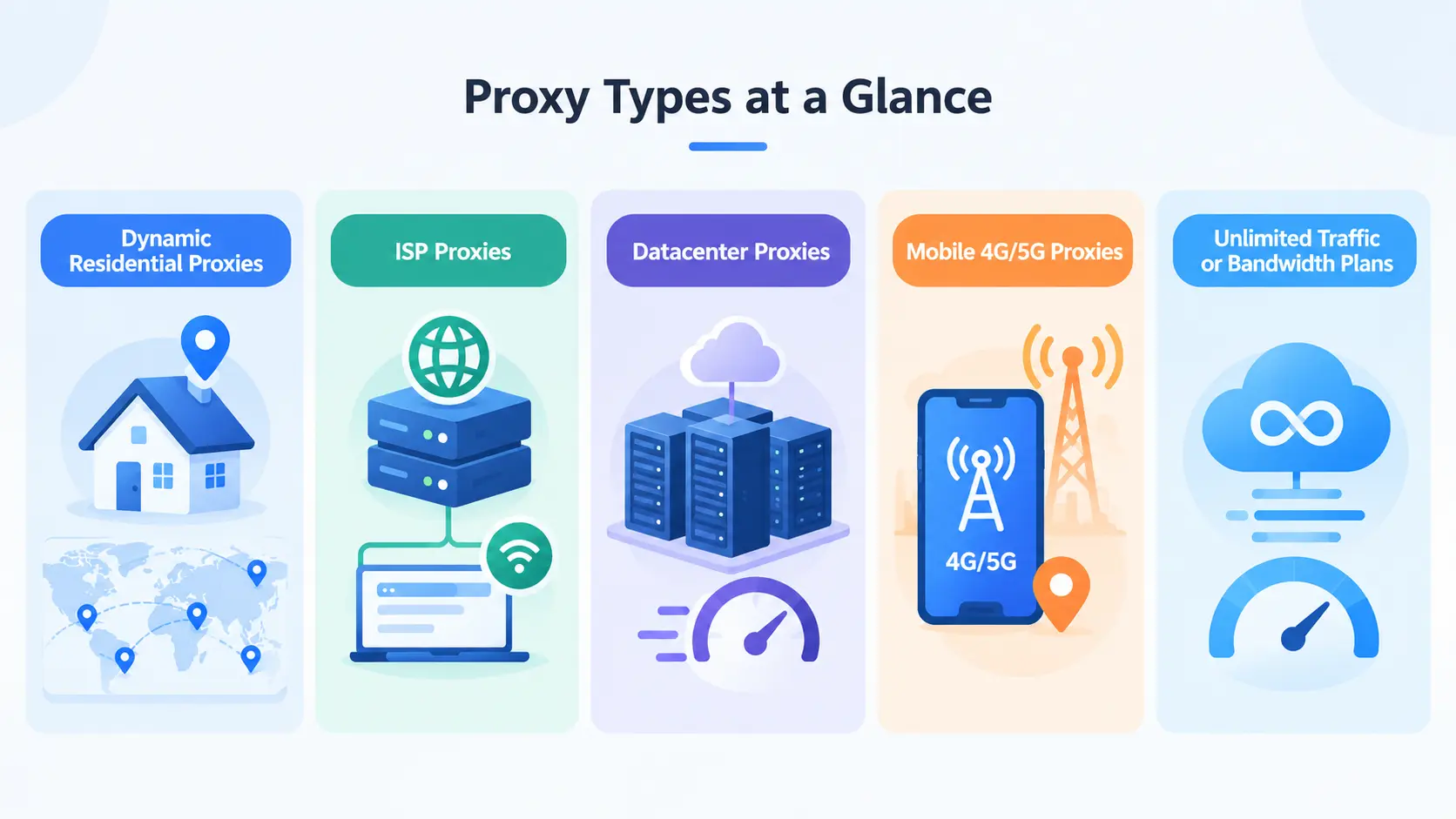
Here are the main options to consider and the tasks each is best suited for:
Dynamic Residential Proxies: Use IPs associated with residential networks and typically support IP rotation. They are suitable for multi-region data collection and tasks that benefit from residential IPs.
ISP Proxies: Use IPs allocated by internet service providers, often delivered through data center infrastructure. Depending on the provider’s setup, they can offer stable IPs for longer sessions.
Datacenter Proxies: Generally provide fast connections at a lower cost per IP, making them suitable for speed-sensitive or large-scale tasks. However, some target websites may restrict traffic from data center IPs.
Mobile 4G/5G Proxies: Route traffic through mobile carrier networks, making them useful for mobile network testing and tasks that require mobile IPs. However, coverage and costs can vary significantly.
Unlimited Traffic or Bandwidth Plans: Offer usage without a standard traffic cap, which can be useful for workloads with high or unpredictable data consumption. However, check for fair usage policies, speed limits, and concurrency restrictions before purchasing.
When comparing these options, look beyond the advertised proxy type or traffic allowance and check the actual plan conditions. For example, Webshare guarantees at least 10 TB of bandwidth per unlimited plan, but speeds may be throttled after the applicable usage threshold is exceeded. So review the current terms to understand what the provider includes and whether any usage restrictions apply.
IP version is another compatibility factor to check before making a decision. IPv4 generally offers broad compatibility, while IPv6 support depends on your target website, proxy provider, and tools. Test the available IP versions with your intended workflow to confirm they meet your requirements.
3. Evaluate Proxy Quality and Technical Capabilities
A proxy provider needs to deliver more than a large list of IP addresses. You also need reliable connections, suitable session controls, and the technical features to support your workflow.
IP Pool Quality, Success Rate, and Stability
IP quality influences how reliably a proxy service performs across different websites and locations. To evaluate a provider, focus on the following factors:
IP Coverage: Check whether the provider offers sufficient IPs in your target countries and cities. A large global pool does not guarantee strong coverage in every market.
Network Reputation: Check the IP’s ASN (Autonomous System Number), which identifies its associated network, and use reputation tools or blacklist checks to identify potential risks. However, no single score guarantees successful access.
Request Success Rate: Test requests against your target website and track successful responses, timeouts, and response times. Actual results may differ from advertised rates depending on the website, location, and testing conditions.
Resource Sourcing: Find out whether the provider manages its own IP resources or relies on third-party suppliers. This helps you understand how its resources are managed and whether its supply depends on external partners.
IP Pool Overlap: If you use multiple providers, compare sample IPs and ASN distributions to assess resource diversity. Different brands may share upstream suppliers, so switching providers does not necessarily give you access to more diverse IPs.
When comparing providers, prioritize IP coverage in your target locations, actual request success rates, and connection stability. For business use, resource transparency and IP pool diversity are also worth considering. Ultimately, base your decision on real-world test results rather than advertised metrics alone.
Rotation, Geo-Targeting, and Session Control
Rotation, geo-targeting, and session controls determine how well you can adapt proxy connections to different tasks. When comparing providers, check whether they offer the following features:
IP Rotation: Can IPs change automatically with each request or at specified intervals?
Geo-Targeting: Can you select specific countries or cities to match your target market?
Sticky Sessions: Can you keep the same IP for a defined period when a consistent connection is needed?
Configuration Flexibility: Can you adjust rotation intervals, locations, and session durations to suit different workflows?
These features serve different purposes in practice. For example, IP rotation can support price and inventory monitoring on Amazon or Walmart, while geo-targeting helps you compare Google search results across locations. Sticky sessions, meanwhile, can help maintain a consistent connection when navigating Amazon Seller Central or eBay account pages.
Since available controls and session limits vary by provider, check the product documentation to ensure the settings match your workflow before purchasing.
API Access, Scalability, and Integration
If you plan to automate requests or scale up data collection, check whether the provider offers a well-documented API, supports the required HTTP(S) or SOCKS5 protocols, and provides clear integration instructions.
You should also verify that its concurrency limits can support your workload and that technical support is available to help resolve integration issues. These factors become more important as your operations grow and workflows become more complex.
For individual users, a simple dashboard and straightforward setup may be sufficient. Business teams running automated workflows should prioritize API compatibility, connection capacity, and the ability to scale without major changes to their existing systems.
4. Compare Pricing and Service Plans
Proxy providers use different pricing models, including traffic-based billing, per-IP charges, usage-based fees, and subscriptions. A thorough proxy comparison should look beyond the advertised price and consider the resources, features, and service terms included in each plan.
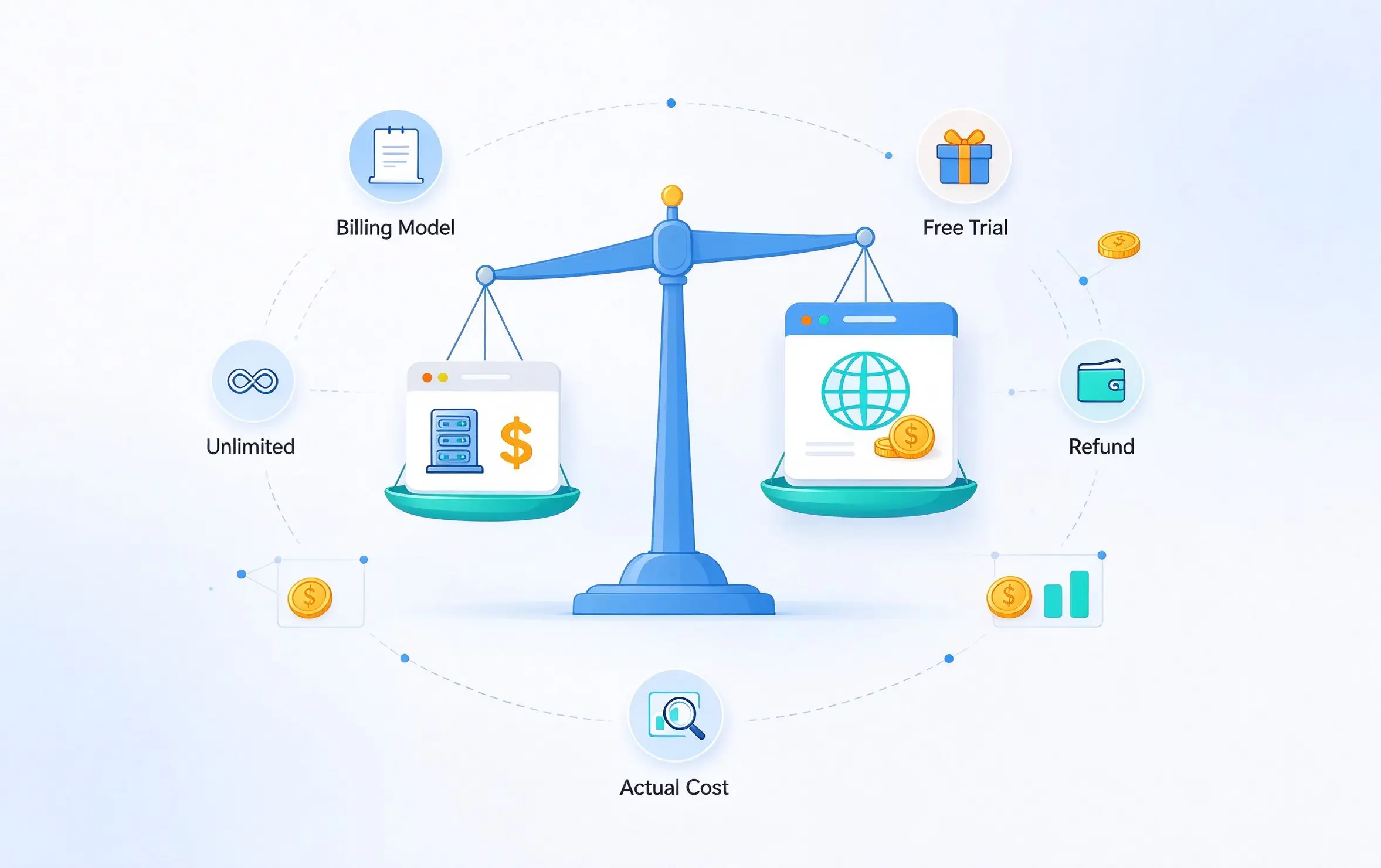
Pricing Model: Check the billing unit, included resources, minimum purchase, and additional fees. Some providers charge extra for city-level targeting or higher concurrency.
Free Trials and Credits: Review trial limits, expiration dates, and payment requirements. Use the trial to test real requests and assess performance before committing.
Unlimited Plans: Check the fair usage policy for potential speed, traffic, or concurrency restrictions. Contact support if the terms are unclear.
Prepaid Balance and Refunds: Review minimum deposits, balance expiration, refund eligibility, and policies for unused funds if service is interrupted.
Actual Cost: Factor in failed requests, retries, and troubleshooting time, not just the advertised price.
For data collection, one useful metric is the effective cost per successful request—the amount spent to obtain a usable response. A low price per GB may offer poor value if frequent failures require repeated requests.
Your priorities will also depend on the scale of your work. Businesses should account for technical support, integration, and future scaling costs, while individuals and small teams may benefit more from flexible plans, free trials, and lower upfront commitments.
5. How to Find a Trusted Proxy Provider
Technical specifications alone are not enough to assess a proxy provider. Before making a purchase, review its business background, service policies, and approach to handling outages and customer disputes.
Check Provider Credibility and Service Continuity
Start by checking the provider’s background and how it communicates with customers. The following factors can help you assess its credibility and ability to maintain service:
Company Background: Check its business information, operating history, and stated service focus through sources such as Trustpilot and LinkedIn.
Website and Social Activity: Look for recent documentation, product updates, and meaningful responses to customer questions.
Service Continuity: Check for service-status updates, maintenance notices, and clear support channels.
Customer Feedback: Compare user experiences and distinguish verifiable reports from promotional claims or unconfirmed rumors.
A long operating history can provide useful context, but it does not guarantee future reliability. Newer providers, such as NodeMaven and IPcook, may also meet specific needs through their product features, pricing, and technical support.
External events can affect established providers as well. In January 2026, Google disrupted the IPIDEA residential proxy network. In July 2026, Google and its partners took action against the NetNut residential proxy network, also known as Popa. These cases highlight the importance of checking a provider’s resource supply and service continuity rather than relying on brand recognition alone.
Review Service Policies and Refund Terms
A provider’s policies determine what happens when the service fails to meet expectations or a payment dispute arises. Before making a large purchase, check the following:
Refund Terms: Review eligibility requirements, deadlines, and application procedures.
Prepaid Balance: Check whether unused funds are refundable and whether expiration dates or other restrictions apply.
Service Issues: Find out how the provider handles outages, unusable proxies, and account problems.
Customer Support: Confirm the available support channels and expected response times.
If any terms are unclear, ask the provider for written clarification before paying. Keep order records and important communications in case you need to resolve a dispute later.
Test the Service Before Committing to a Large Purchase
Even a provider with clear policies and a strong reputation may not perform well for your specific workload. A free trial or small initial purchase lets you evaluate the service before committing to a larger budget.
Start small: Use a free trial or low-cost plan to limit your initial spending.
Test real workloads: Check request success rates, connection stability, location accuracy, and session behavior on your target websites.
Calculate actual costs: Consider failed requests, retries, and the cost of obtaining usable results.
Scale gradually: Increase your spending only after the service consistently meets your requirements.
Avoid making a large prepaid purchase solely to secure a discount. For business-critical workflows, consider maintaining a second provider as a backup. This can help reduce disruption if your primary service experiences an outage or no longer meets your needs, although it also adds cost and management overhead.
👀Explore More Proxy Options
6. Proxy Provider Evaluation Checklist
Before making a purchase, use this checklist to compare shortlisted providers and confirm that they meet your technical, budget, and service requirements.
Proxy Type and IP Version: Are they compatible with your target website and tools?
IP Coverage and Diversity: Are the available locations and IP resources sufficient for your workload?
Performance and Stability: Have you tested request success rates, response times, and connection stability?
Rotation and Session Controls: Do IP rotation, geo-targeting, and sticky sessions work as required?
Technical Capabilities: Are the required protocols, API access, and concurrency levels supported?
Pricing and Policies: Are billing terms, traffic restrictions, extra fees, and refund conditions clear?
Provider Credibility: Have you reviewed the provider’s background, resource sourcing, and customer support?
Trial Testing: Have you tested the service through a free trial or small initial purchase?
Backup Options: Do you have an alternative provider if your primary service becomes unavailable?
For business-critical projects, consider using more than one provider to reduce dependence on a single service. However, compare their IP coverage and performance first to ensure the added cost and management effort provide real value.
Conclusion
Choosing a proxy provider requires balancing IP quality, technical capabilities, pricing, and service reliability. Test providers against your actual workload before committing, and consider multiple suppliers if broader IP coverage or backup options justify the added cost.
For businesses running scraping APIs, DaaS, SERP monitoring, or e-commerce data collection, IPcook is one option worth evaluating. Its residential proxy services can be tested alongside your existing setup to assess performance and suitability before scaling up. For larger deployments, visit IPcook Enterprise Proxies to contact the Business team about your requirements and pricing.