NetNut Full Review 2026: Best For Enterprise, Not Small Teams

When searching for a reliable enterprise-grade proxy solution, many businesses initially consider NetNut proxies.
NetNut’s proxies perform reliably, offering 85+ million residential IPs across more than 195 countries, making them well-suited for tools like scrapers. That said, its pricing lacks flexibility. Even the dynamic plans start at $99, which can feel prohibitively high for small teams, individual users, or those just getting started.
In this NetNut review, we’ll run real-world tests to see how the service performs in workflows like web scraping, highlighting why many teams are turning to better-suited competitors like IPcook for their proxy needs.
🙋Need a NetNut alternative right now?
If NetNut’s steep pricing has held you back, IPcook is the perfect budget-friendly alternative. Right now, we offer a 100MB free trial, letting you test its performance and stability completely risk-free. Don’t miss this chance, give it a try today!
Who Should Choose it?
NetNut is an enterprise-grade proxy provider. Similar to other proxy service providers, Netnut offers a full suite of solutions, including static ISP proxies, residential proxies, data center proxies, and mobile proxies. The proxy provider owns a pool of over 85 million residential IP addresses covering more than 195 countries worldwide, mainly catering to large enterprises with high-volume task processing demands.
Positioned much like IPRoyal, NetNut focuses on meeting the large-scale scraping needs of mid-sized and enterprise-level businesses. To further empower such workflows, it also provides practical supporting tools, such as dedicated scrapers and datasets. Let’s take a quick look at NetNut’s key strengths and weaknesses.
Pros | Cons |
|---|---|
😀 Strong anonymity and privacy | 🙁 High entry cost, no pay-as-you-go |
😀Stable network for cross-region scraping | 🙁 Fixed traffic leads to waste for light use |
😀Smooth performance with high concurrency | 🙁 Overpriced for individuals and small teams |
😀Mature API integration |
Standout Features: What Makes It Exceptional
Next, we will introduce it based on the product use test results.

High Anonymity & Stability for Mission-Critical Business Operations
NetNut’s ISP proxies come with solid anonymity features that hide users’ actual online identities. This layer of protection will effectively cut down the chances of facing detection or blocks from target servers. As one key benefit from this secure setup, these proxies turn out to be a highly practical pick for anyone who needs to access geo-restricted journals and locked regional database resources in daily use.
Furthermore, NetNut outperforms many rival proxy providers with a notable additional benefit: its ISP proxies come with authentic browsing histories. This distinctive feature strengthens overall account credibility and helps replicate natural human browsing patterns. For social media oversight and ad account management, these ISP proxies also enable the safe, stable, long-term management of multiple Facebook accounts.
Ideal for Large-Scale Scraping Projects & Automation Management
As one of the reliable and solid proxy servers, NetNut provides flexible IP rotation tools that help users steer clear of common proxy blocks. It holds steady, gap-free connectivity at all times, even when you run scraping tasks across multiple regional locations, and it also stays stable while handling heavy concurrent requests.
This dependable performance helps teams and other users achieve a strong success rate for daily web scraping and large-scale data collection work. It can fully support users to collect e-commerce product specs and real-time pricing data, so teams can easily track keyword rankings and monitor overall market conditions over time.
But NetNut has a high entry barrier for budget-limited individuals, small teams, or those with lightweight scraping tasks. Its lowest package starts at $99, with often unused bundled traffic. For more pricing details, we’ll go into it in the pricing comparisons part. If you are interested, keep browsing for more.
👍Need a flexible Plan for small-scale scraping?
IPcook can be a budget-friendly alternative. Our residential proxy plans use pay-as-you-go billing (minimum 1GB for $3.2), with 25GB costing around $60. With similar reliable performance, we offer a lower price and a 100mb FREE trial!
Robust API Integration for Customized & Scalable Workflow Demands
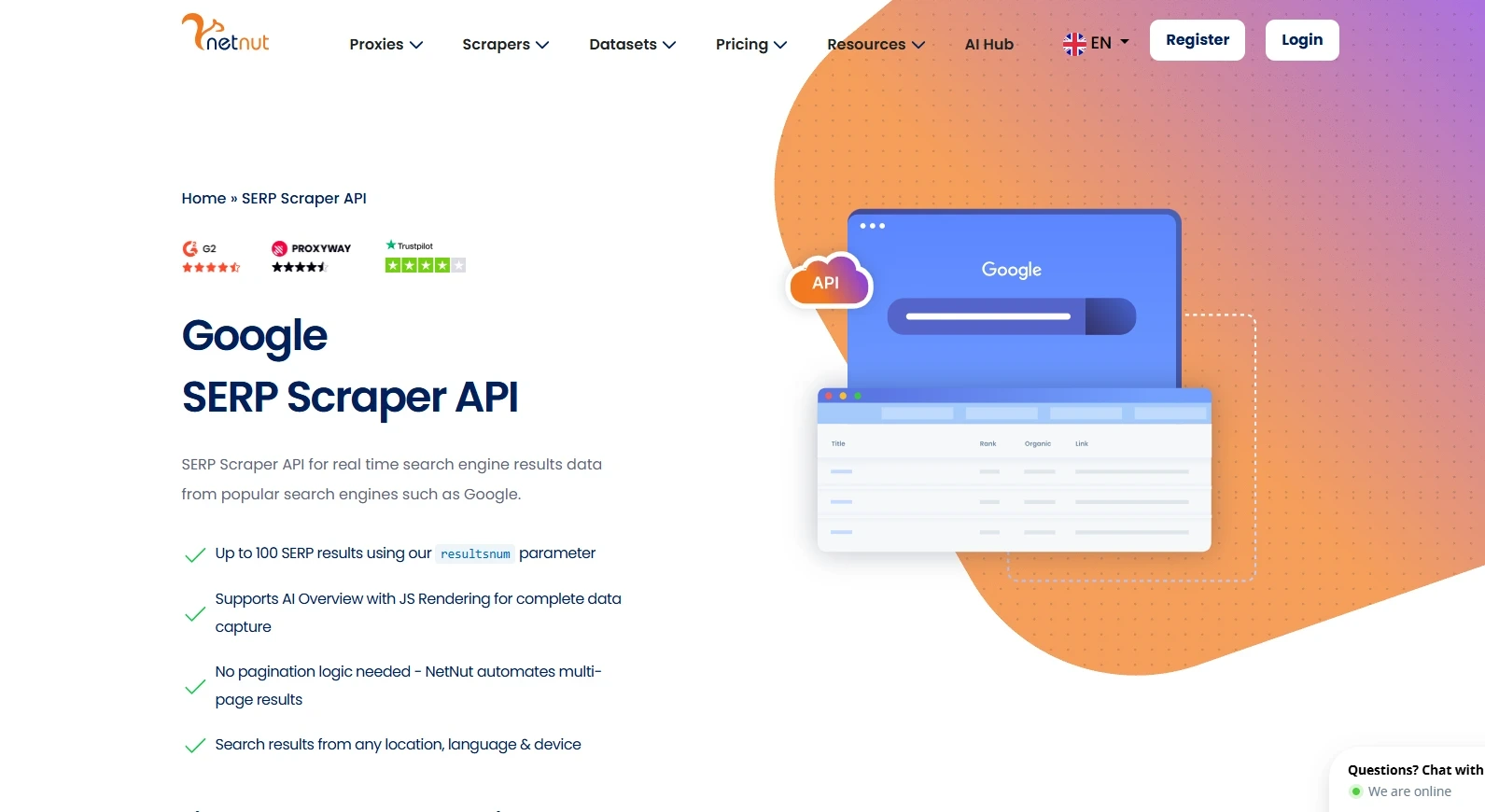
NetNut features truly robust and highly flexible API integration capabilities, which let developers and business teams easily link up its global proxy network directly to internal systems, scraping scripts, and daily automated workflows with much smoother overall connectivity.
On one hand, relying on fully standardized API endpoints, users gain the ability to access and control a huge resource library of ISP, residential, mobile, and data center IPs in real time, and they are also able to tweak key settings, including session duration, geographic targeting, and concurrent IP request limits with great freedom.
On the other hand, powered by steady millisecond-level response times and dependable high-concurrency performance, this platform can deliver stable, seamless integration, flexible, scalable expansion, and continuous non-stop operation for common automated tasks, supporting practical use cases like real-time price tracking and large-scale data gathering work, or scraping valuable SERP results.
The first key aspect is that NetNut’s API can run perfectly alongside mainstream development environments such as Python, Node.js, and Java. The second aspect is that the platform is built with practical automatic failover support and detailed real-time usage monitoring tools. When paired with its inherent high anonymity, long-term stability, and full regulatory compliance, all of these well-rounded built-in features can effectively help businesses streamline daily operations, boost overall work efficiency, and support steady business scaling with lasting operational reliability.
Limitations: What Are Its Main Drawbacks
Despite NetNut’s reliable service quality and smooth user experience, the steep cost and lack of free trials are key deterrents for new users. Let’s take a closer look.
Too Expensive for Newer Users or those with Smaller Initial Projects
NetNut primarily serves enterprise-level business users, and its entry-level plan starts at $99 for 25GB. Normally, small-scale scraping tasks only require 5 to 20 GB of traffic, and any unused volume will expire. For this reason, the per-GB cost is relatively high, which can easily prevent small teams and individual users from accessing the service.
On top of that, you will notice rapid bandwidth consumption whenever your daily tasks require you to run data scraping across multiple e-commerce platforms. Users who try their best to control resource usage and avoid unnecessary plan upgrades will often face clear usage limitations as a result.
One practical alternative you can consider is IPcook. IPcook offers far more flexible pricing on both ISP proxies and residential proxies. It offers a flexible pay-as-you-go billing model and never sets harsh entry barriers. For small and medium businesses, as well as individual operators who only perform lightweight scraping tasks and hope to reduce long-term proxy costs, you can take a look at IPcook.
Inflexible Subscription Plans for Teams
NetNut only offers monthly subscriptions and does not support pay-as-you-go billing. Users must buy fixed monthly traffic packs that expire at the end of each month. For teams with fluctuating demands, unstable usage, or short-term projects, this rigid structure easily causes traffic waste.
Even NetNut’s large-volume plans fall into the mid-to-high price range. Its 800GB package is priced at $1,696, while comparable alternatives like IPcook offer 1000GB for just $800, delivering far more data at a much lower cost.
Indeed, NetNut delivers solid performance, but its high cost can be a bit intimidating. When possible, it’s worth exploring and testing other IP providers as well to help you find the most cost-effective option.
🔥Grab your exclusive 100MB FREE traffic right now. Join us and start testing instantly!
Unintuitive Interface With Limited Guidance for Entry-Level Users
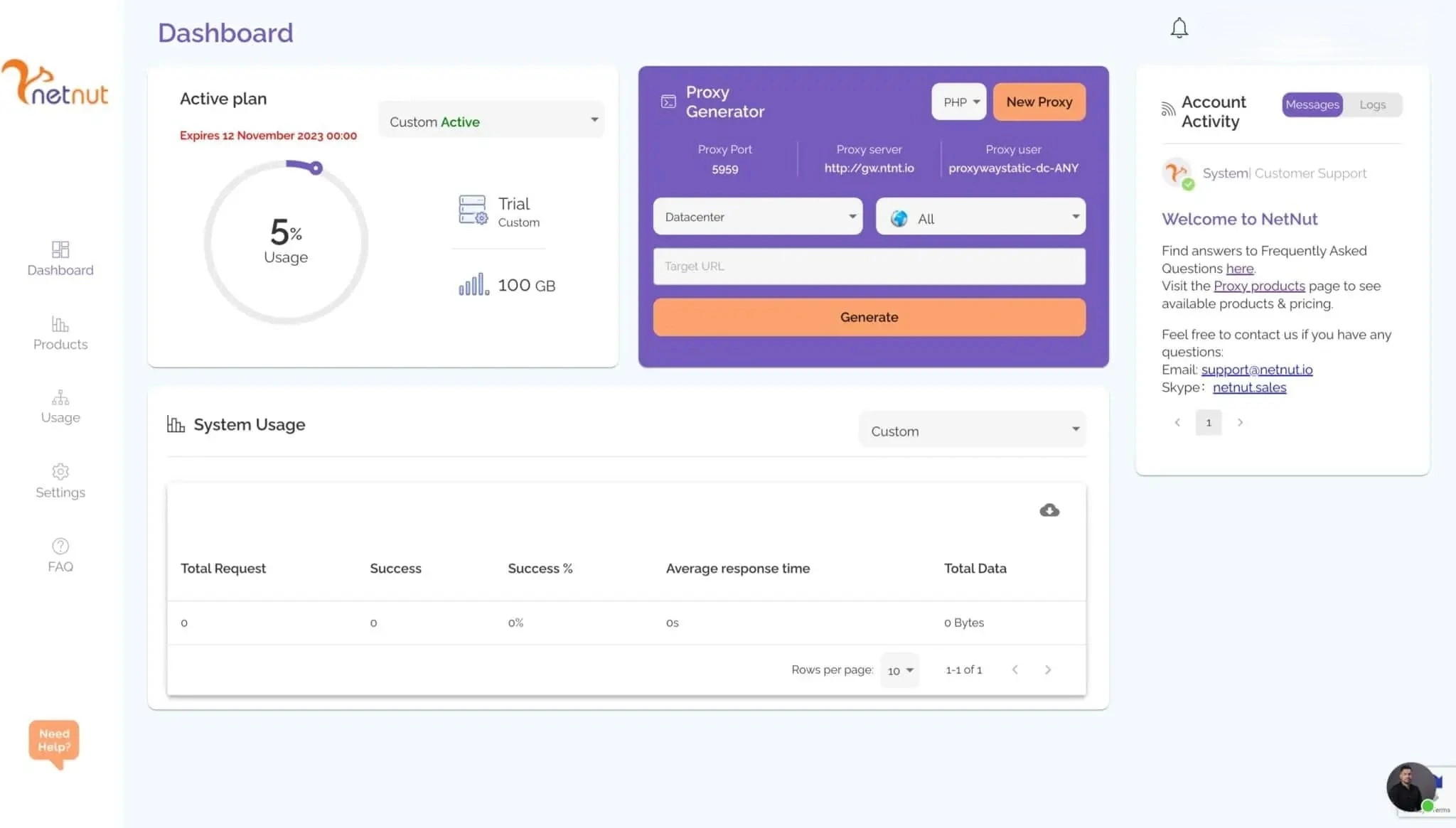
NetNut’s dashboard has long been one of its most widely criticized pain points, since it comes with a host of obvious usability flaws. Its messy navigation layout and disorganized core feature entry points make it hard for users to locate essential functions promptly, and this shortcoming directly hurts daily operational efficiency in practical use.
Critical data metrics are shown in a rather unintuitive layout, and system statistics frequently have noticeable update lags to greatly worsen the overall user experience. It also lacks clear setup guides and in-app operational hints, which creates a steep learning curve for new users. Many beginners will feel confused and run into roadblocks when completing the initial configuration.
Slow Response & Inconsistent Customer Support Experience
NetNut’s customer support is only available during local business hours in Israel. As a result, users outside this time zone often face long wait times whenever they need assistance.
On top of that, email responses are notoriously slow, typically taking over an hour to arrive. Its live chat support also suffers from significant delays, forcing users to wait extended periods before connecting with an agent. This area is in urgent need of improvement.
Pricing Comparison: NetNut vs. IPcook
In terms of pricing, NetNut adopts a rigid pricing structure with high entry-level plans and no pay-as-you-go options. It is better suited for large enterprises, leaving small and mid-sized users facing higher long-term costs and limited traffic flexibility. Here is NetNut’s monthly pricing list for residential proxies.
Features | Starter | Production | Semi-Pro | Professional | Master |
Price per GB | $3.53/GB | $3.32/GB | $2.85/GB | $2.49/GB | $1.83/GB |
Space | 28GB | 150GB | 350GB | 800GB | 2TB |
Price Monthly | $99 | $499 | $999 | $1,999 | $3,750 |
In comparison, IPcook provides cost-effective pricing, pay-as-you-go billing, and flexible plans with no high minimum charges and never expires. It maintains reliable proxy performance at a lower cost, making it an economical alternative for cross-border businesses, social media operations, and small-to-medium teams. Here is IPcook's pricing plan list for residential proxies.
Features | Basic | Advanced | Small Enterprise | Enterprise |
Price per GB | $3.2/GB | $2.4/GB | $0.8/GB | $0.5/GB |
Space | 1GB | 25GB | 1000GB | 10000GB |
Price | $3 | $60 | $800 | $5,000 |
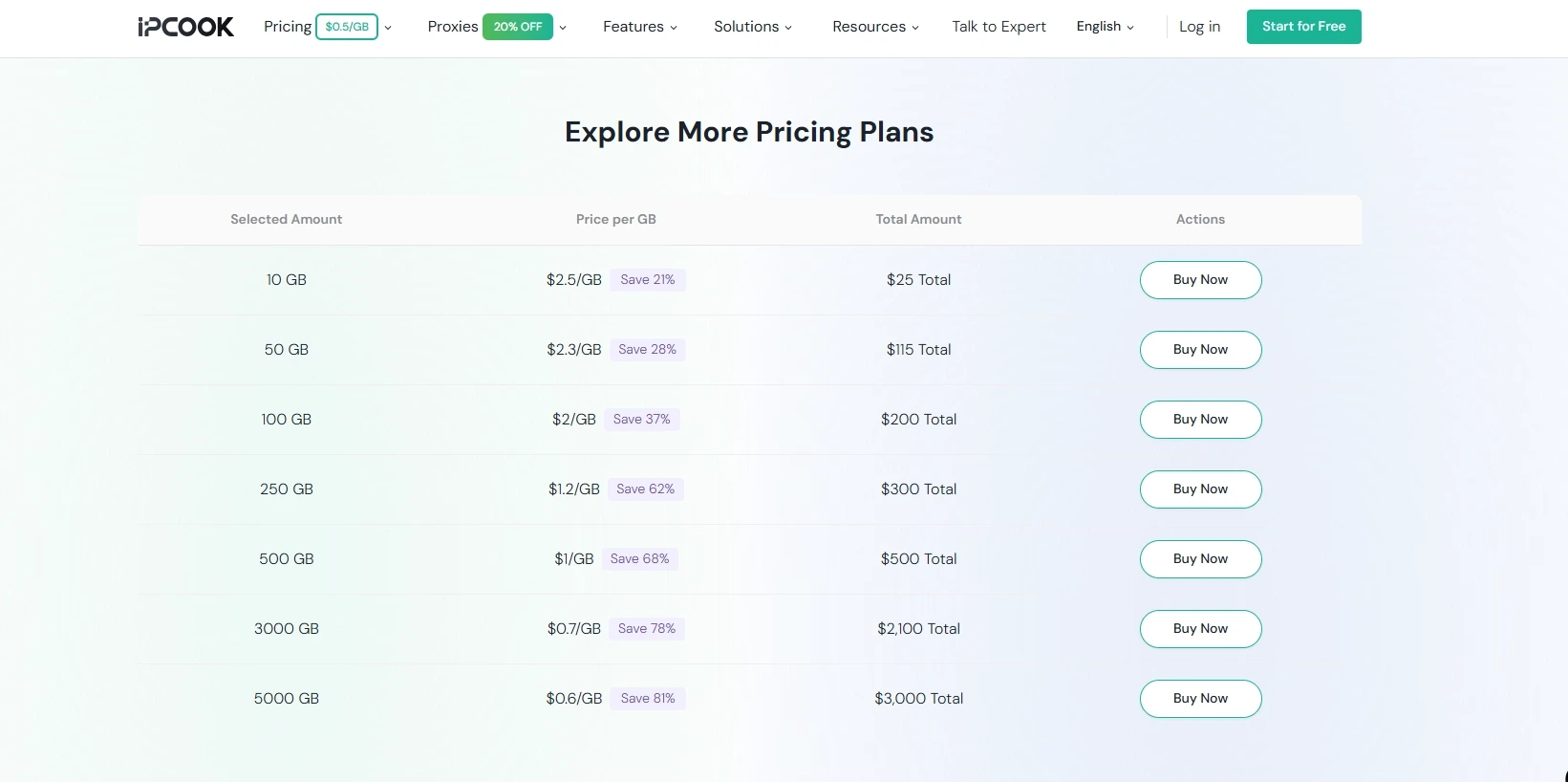
In addition, IPcook also offers more GB plans to meet users' additional needs.
IPcook: A Better Alternative to NetNut
From the above comparison, while NetNut serves large enterprises with unlimited budgets reliably, IPcook fits both small and large projects. It delivers far more flexible pricing with comparable core features, making it a well-rounded alternative.
Key Feature | IPcook | NetNut |
Target Audience | All project sizes, individuals & SMBs | Large enterprises with sufficient budget |
Protocol Support | HTTP, HTTPS, SOCKS5 | HTTP, HTTPS, SOCKS5 |
Billing Mode | ✅️Flexible pay-as-you-go, no minimum fee | ❌️Fixed monthly subscription only |
Free Trial | ✅️100MB free trial available | ❌️Free trial request an application |
Pricing | Flexible billing with purchases starting from 1GB, at a low rate of just $0.5 per GB | Basic plan $99 per month |
Usability | ⭐⭐⭐⭐⭐ | ⭐⭐⭐⭐⭐ |
Customer Support | 24/7 reliable support | Only support working hours in Israel |
Conclusion: NetNut vs. IPcook
Overall, NetNut does work as a reliable enterprise-grade proxy solution, and it is clearly built to serve large businesses with sufficient budgets; on the downside, its rigid monthly billing rules, high costs, confusing dashboard layout, and slow customer support response will greatly limit its overall flexibility for most regular users.
On the other hand, IPcook can offer the same solid core proxy performance while bringing more flexible pricing policies, practical pay-as-you-go plans, and permanent, valid traffic benefits. It also comes with a convenient free trial option, an intuitive operating interface, and fast, responsive support. All of these advantages make it a great fit for individual users, small teams, and growing businesses with fluctuating usage needs, and it stands out as a more cost-effective and well-rounded alternative to NetNut in actual daily use.
Choose IPcook If:
You’re a small-to-mid business, startup, or individual user
You want cost-effective, flexible pricing (pay-as-you-go, no expiry)
You want a simple setup and intuitive management
You require 24/7 support and global coverage
Choose NetNut If:
You’re a large enterprise with a high budget for proxy services
You need enterprise-grade customization (API, dedicated account managers)
FAQs About Choosing a Proxy
What is the best static residential proxy provider for TikTok
IPcook really stands out as the top static residential proxy provider for TikTok. It comes with clean, stable ISP residential IPs, covers locations all around the world, and boasts strong anti-detection performance. What’s more, it has flexible pay-as-you-go pricing, an intuitive management system, and 24/7 customer support, which all combine to make it a perfect fit for multi-account TikTok operations, all at a budget-friendly cost that won’t break the bank.
What are the best trustworthy static residential proxies available?
When it comes to the best trustworthy static residential proxies you can get, the top options include IPcook, Oxylabs, Decodo, NetNut, and IPRoyal. All of these providers deliver genuine ISP-grade IPs, maintain stable uptime, offer global coverage, and stick to strict compliance standards. IPcook stands out thanks to its flexible, low-cost pay-as-you-go plans, while Oxylabs and Decodo excel when it comes to enterprise-grade reliability and top-notch anti-detection performance.