In-Depth NodeMaven Review: Is It Worth the Price?

While most proxy services aim to meet similar usability goals, each provider typically focuses on specific areas, not just the features it offers but also how well those features are implemented. Unlike other popular proxy providers, NodeMaven provides fewer IPs but positions itself around an IP Quality Filter and tighter control over connection behavior. So, where does NodeMaven stand if you are considering its services?
Below, you will find a full review of what NodeMaven offers, what it costs, how it performs, what real users say, and which alternatives deserve a look if it is not quite the right fit for you.
What Is NodeMaven?
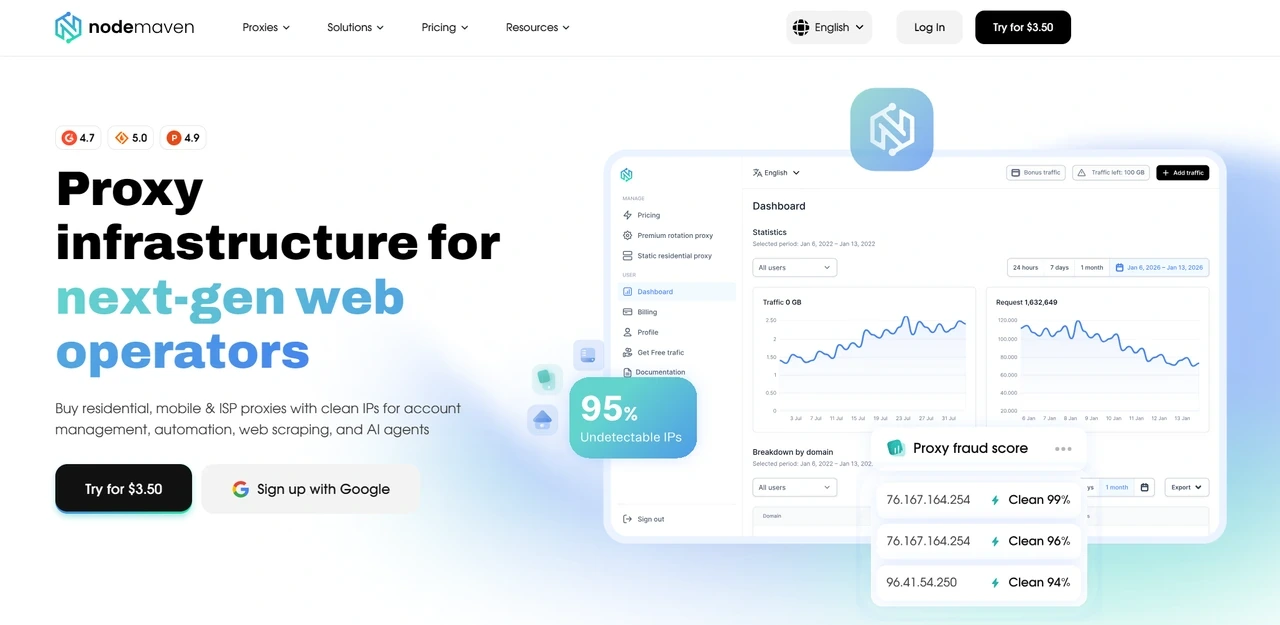
Founded in 2023, NodeMaven is run by the team behind Multilogin, one of the most popular anti-detect browsers. Multilogin separates browser profiles, while NodeMaven provides residential, mobile, and static ISP proxies for affiliate marketers, social media managers, teams managing multiple accounts, and users scraping data. This background also helps explain why NodeMaven prioritizes IP filtering over raw pool size. The provider checks each IP for quality before assigning it to users and offers session controls intended to maintain stable connections for longer.
The lowest monthly plan starts at $8.50 for 2 GB, which is relatively expensive in the market. Whether these benefits justify the price depends on the actual performance.
Feature | Details |
Proxy types | Residential, mobile, and static ISP |
IP pool | 30M+ residential, 250K+ mobile, and 10K+ ISP IPs |
Proxy Pricing | Residential and mobile from $2.20/GB; ISP from $2.99/IP |
Protocols | HTTP and SOCKS5; ISP also supports UDP |
Geo targeting | Country, region, city, ISP, and ZIP; ISP supports country targeting |
Authentication | Username and password or IP whitelist |
Support | Live chat, Telegram, and personal proxy expert |
Payment | Cards, wire transfer, and cryptocurrencies |
Free trial | No; $3.50 paid trial with 750MB |
NodeMaven Features
Here are the main features that set NodeMaven apart.
IP Quality Filter
Before an IP reaches you, NodeMaven’s system checks it against speed and reputation thresholds. You can adjust the filter based on what matters most for your task, whether that is stronger IP quality, faster connections, or a larger available pool.
One limitation is worth noting. Setting the filter to its strictest level improves your chances of receiving a low-risk IP, but it also reduces the number of available addresses. This can be especially noticeable in specific countries, cities, or ISP networks. If you need broader coverage over the cleanest possible IPs, you may want to dial the filter back a notch.
Rotation and Long Sessions
Standard sessions work the way you would expect. Rotating proxies swap IPs on every request, while sticky sessions hang onto one IP using a session ID for up to 24 hours. NodeMaven’s Long Session Mode goes further, holding a residential IP for as long as seven days when conditions allow.
That said, do not expect it everywhere. Coverage sits mainly in the US and Europe, targeting usually only goes down to the country level, and turning it on shrinks the usable pool even further. Account managers running Instagram, Reddit, TikTok, or X profiles for affiliate and dropshipping campaigns tend to get the most value here.
API and Subusers
NodeMaven includes a subuser system that lets the main account create separate login credentials with individual traffic limits and usage statistics. This is handy for splitting proxy access across clients, projects, or team members without sharing one login.
NodeMaven also offers an API that can retrieve or manage locations, usage data, subusers, and whitelisted IPs. This is useful for teams connecting proxy management to their own automation tools instead of making every change through the dashboard.
🎁 Need a Reliable Proxy Alternative?
Speed, stability, and clean IPs matter even more at scale. IPcook offers proxy infrastructure on par with NodeMaven, at a friendlier price, plus a 100MB free trial. Don't miss out!
NodeMaven Pricing and Payment
Residential and mobile proxies are billed by bandwidth and drawn from a shared balance, while static ISP proxies are priced per IP for a set term.
Residential and Mobile Proxies Pricing
NodeMaven offers two pricing models for residential and mobile proxies. Both pricing models provide access to 30M+ residential IPs and 250K+ mobile IPs, cashback rewards, ZIP targeting, an IP Quality Filter, and Long Session Mode of up to seven days in supported locations. NodeMaven also offers a $3.50 paid trial with 750 MB of traffic.
Monthly subscriptions renew automatically and add fresh traffic with each billing cycle. Unused data rolls over rather than disappearing. Miss a payment or cancel, though, and access to that leftover traffic is frozen until you subscribe again.
Pay as you go works differently. You buy traffic once, and the plan does not renew automatically. Unused traffic simply waits for you instead of expiring on a set date. This structure suits users whose traffic needs change from month to month.
Traffic | PAYG per GB | Monthly per GB |
2 GB | $5.00 | $4.25 |
8 GB | $4.88 | $4.00 |
20 GB | $4.50 | $3.75 |
40 GB | $4.10 | $3.45 |
55 GB | $3.73 | $3.18 |
100 GB | $3.45 | $3.00 |
200 GB | $3.25 | $2.85 |
450 GB | $2.92 | $2.60 |
1,000 GB | $2.45 | $2.20 |
ISP Proxies Pricing
ISP proxies are priced per IP. You can choose a 30-day or 90-day term and choose from nine countries. All ISP plans include dedicated static IPs with HTTP and SOCKS5 support. Traffic is unlimited, and the minimum order is three IPs.
Price/IP (30 days) | Price/IP (90 days) | Location |
$4.99 | $4.33 | US, HK, DE, FR, UK, RO, BR, TR, and IT |
Payment
Cards and cryptocurrencies are both supported. NodeMaven accepts Visa and Mastercard, while its current pricing page also lists American Express, wire transfers, Mir, and YooMoney. Cryptocurrency payments can be processed through providers such as Coinbase and BTCPay.
Just keep in mind that monthly plans renew automatically unless you cancel before the next billing date.
Refunds, Quality Guarantee, and Cashback
NodeMaven uses three separate policies for refunds, proxy quality issues, and cashback rewards.
Refunds cover unused traffic on a prorated basis, so you pay only for the traffic you have used. Refunds are not automatic, though. Eligibility depends on your plan, remaining balance, account status, and payment method. Crypto refunds typically come back as USDT rather than the original currency.
A Quality Guarantee claim must show that an IP appeared on a blacklist and disrupted your task, usually with proof from Pixelscan. Approved claims receive $1 in proxy traffic for each affected IP, with total compensation capped at 20% of your monthly usage.
Cashback stands apart from both. NodeMaven offers a monthly cashback system that converts a percentage of your used bandwidth into reusable proxy credits. The rate increases with usage, reaching up to 10%, and the reward is added to your account as traffic.
Performance and User Experience
Let's look at how NodeMaven actually performs, beyond the feature list.
Speed and Success Rate
Benchmark data shows NodeMaven handling small requests well across US and European gateways, with success rates above 99% and average response times between 0.51 and 0.71 seconds. India lagged behind, averaging 2.18 seconds per response with a slightly lower success rate of 97.98%.
Larger pages put more strain on the network. Pages around 2 MB averaged 9.18 seconds on the global gateway with a 96.45% success rate, compared with 3.69 seconds and 94.82% on the US gateway. A one-week test also recorded download speeds of 8.6 to 9.8 Mbps, enough for browsing, SEO checks, and account work, though heavier scraping jobs may feel the limit.
IP Quality and Session Stability
The broader benchmark also tested 1,000 US IPs. The average fraud score dropped from 10.94 without filtering to 4.4 with the medium filter, while the median fell from 7 to 3. This suggests the filter does reduce the number of higher-risk addresses.
Session testing produced more mixed results. Of 250 sessions, 38.2% lasted longer than 25 minutes, and another 20.9% remained active for 15 to 25 minutes. These numbers support NodeMaven’s focus on longer sessions, but they do not confirm that every IP can remain available for the full seven days.
Popular Website Tests
Website-level results were less consistent. In around 2,600 US requests per target, Amazon reached a 96.22% success rate, and Instagram reached 86.31%. Google came in much lower at 52.52%, mainly because requests repeatedly triggered CAPTCHA challenges. Performance can therefore vary considerably between websites, even on the same network and location.
Dashboard and Proxy Generator
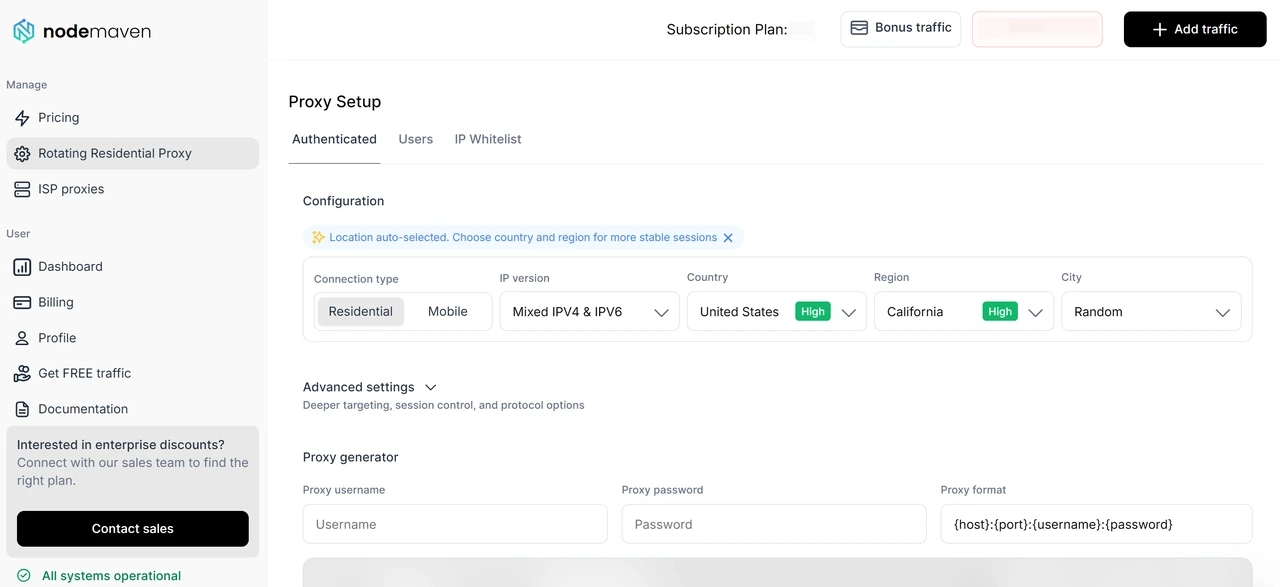
NodeMaven’s dashboard is clean and easy to use, with pricing, billing, usage statistics, and documentation sitting where you would expect them.
Generating a proxy takes just a few clicks. Choose residential or mobile proxies, then set the location, protocol, IP version, session type, session ID, and filter mode. The proxy string updates automatically and can then be copied or exported.
User Experience
NodeMaven holds a 4.7 rating across roughly 160 reviews on G2. Positive reviews mention the simple proxy generation process, stable residential and mobile connections, clean IPs, and responsive customer support most often, with the dashboard and session controls also earning regular praise from people managing accounts or running scraping tasks.
Feedback on Trustpilot runs more divided, sitting at 3.8 out of 5 across 102 reviews. Complaints center mainly on pricing, limited ISP order controls, occasional connection issues, and slow resolution when something goes wrong. A few users also mention proxy detection or leak concerns, though these read as individual reports.
Top Alternatives to NodeMaven
NodeMaven stands out for its IP filtering and long session controls, but the right pick still depends on your budget, project scale, and the proxy types your work actually needs. Here are a few alternatives worth considering.
IPcook
IPcook offers the strongest price-to-performance ratio among these alternatives. Coverage spans residential, static ISP, and datacenter proxies for scraping, SEO monitoring, account management, and automation, backed by a residential network of more than 55 million IPs across 185+ locations, city-level targeting, and support for both HTTP and SOCKS5. The dashboard also includes API access and up to 10 subaccounts for splitting usage across projects or team members.
Like NodeMaven, IPcook provides ethically sourced IPs and stable connections, just at a friendlier price. Pay-as-you-go residential plans range from $0.30 to $3.20 per GB, and traffic never expires. For ISP proxy plans, prices range from $0.048 to $0.080 per IP per day, with unlimited traffic included and additional discounts for longer terms. New users also get 100 MB of free residential traffic with no time limit.
Decodo
Decodo runs a bigger proxy and scraping platform, covering residential, mobile, static ISP, and datacenter proxies alongside a Site Unblocker and several ready-made scraping APIs. Its residential pool contains more than 115 million ethically sourced IPs across 195+ locations, with targeting down to country, state, city, ZIP code, and ASN, plus support for HTTP, HTTPS, and SOCKS5.
Regular residential subscriptions cost $2.75 to $3.75 per GB, while pay-as-you-go traffic costs $4 per GB. Enterprise pricing is $2 per GB, and a three-day, 100 MB trial is available too. The real draw here is the scraping toolkit bundled alongside the proxies, which is handy for teams that would rather not build and maintain every piece of their data collection workflow.

IPRoyal
IPRoyal is another option worth considering if flexible purchasing, non-expiring traffic, and precise location targeting matter to you. Its lineup covers residential, ISP, datacenter, and mobile proxies, with a residential pool of more than 64 million IPs across 195+ countries. Targeting reaches the country, state, and city levels, with support for HTTP and SOCKS5.
For plans containing 1 GB to 10 GB, pay-as-you-go prices range from $5.51 to $7.35 per GB, while subscription prices range from $5.25 to $7 per GB. Custom plans cost $1.84 per GB for pay-as-you-go traffic and $1.75 per GB for subscriptions.
Final Thoughts
NodeMaven works well if clean IPs, session control, and multi-accounting top your priority list, especially for US and European targets. That said, pricing is the main hurdle, and it can get steep for most users. Short-term use is fine, but if you need long-term proxies without burning through heavy volume, it's worth weighing other alternatives too.