6 Best Canada Proxies Where Reliability Beats Hype

Choosing the best Canada proxies is not just about getting an IP address that looks like it is in Canada. Location accuracy, IP quality, session stability, proxy type, and pricing all matter, and they can affect the results in ways that are not always obvious. As a result, what works for one project may not work for another.
Some projects need Canadian residential IPs for localized search results. Others care more about speed, stable sessions, or lower costs. So in this guide, we compare 6 Canada Proxy providers across proxy types, Canadian targeting, session control, pricing, and practical use cases. That way, you can get a clearer sense of which one is actually worth using.
Best Canada Proxy Providers at a Glance
To make the comparison easier to scan, the table below puts 6 Canada proxy providers side by side. It covers their proxy types, Canadian targeting options, pricing models, and typical use cases.
Provider | Proxy Types | Canada Targeting | Pricing Model | Best For |
IPcook | Residential, ISP, Datacenter | Country, city/state | Pay-as-you-go / plans | Flexible proxy requirements |
Decodo | Residential, ISP, Mobile, Datacenter | Country, city, ASN | Pay-as-you-go / plans | Large residential network and precise targeting |
Bright Data | Residential, Mobile, ISP, Datacenter | Country, city, ASN | Pay-as-you-go / plans | Advanced geo-targeting and data infrastructure |
Shifter | Residential, ISP | Province, city, ASN | Plans / usage-based options | Canadian residential coverage and flexible rotation |
Rayobyte | Residential, ISP, Datacenter | Canada | Plans / usage-based options | Fast connections and flexible proxy options |
DataImpulse | Residential, Mobile, Datacenter | Country; advanced targeting available | Pay-as-you-go | Usage-based pricing and flexible targeting |
Pricing, availability, and Canadian IP pools can change. Check each provider's current offering before purchasing.
The table highlights the main differences between the providers, but the right option depends on the requirements of each project. The sections below look more closely at their proxy types, Canadian coverage, key features, and practical limitations.
1. IPcook: Flexible Plans and Geo-Targeting
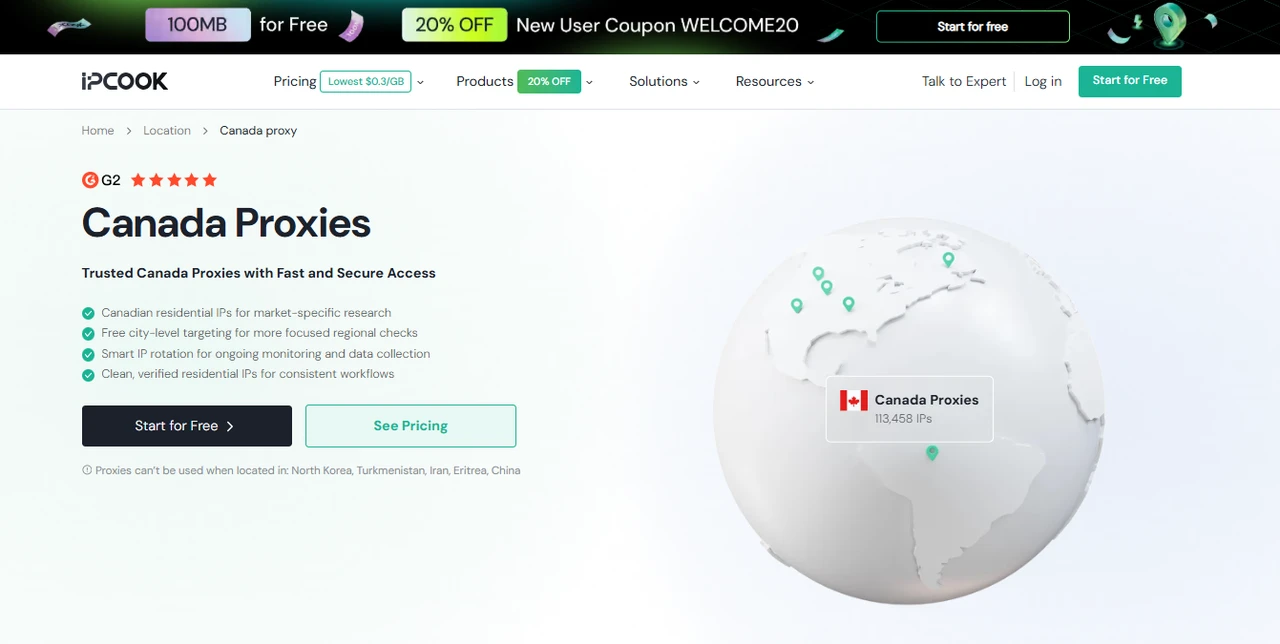
IPcook Canada proxies are available in Residential, ISP, and Datacenter options, covering different requirements for Canadian traffic. Its proxy offering combines flexible pricing with country and city/state geo-targeting, along with different bandwidth and session options across proxy types.
✨Key features
Residential Proxies: From $0.3/GB, with free geo-targeting and traffic that does not expire.
ISP Proxies: From $0.05/IP with unlimited traffic.
Datacenter Proxies: From $0.04/IP with unlimited traffic.
Geo-targeting: Country and city/state targeting.
Sticky sessions: Residential sessions of up to 24 hours.
Practical use: IPcook’s flexible proxy options let users choose between Residential, ISP, and Datacenter proxies based on their traffic requirements and budget. This gives users more control over proxy costs without committing to a proxy type that may not fit their project.
Its geo-targeting supports precise city-level geographic targeting, with coverage extending into smaller Canadian towns and local areas such as Victoria, Montague, and Clearwater. This is useful for SEO teams checking localized search results or e-commerce teams verifying regional content and product pages from specific Canadian locations.
Best for: Projects that need flexible proxy types, precise Canadian geo-targeting, and traffic that does not expire.
2. Decodo: Large Residential Network and Precise Targeting
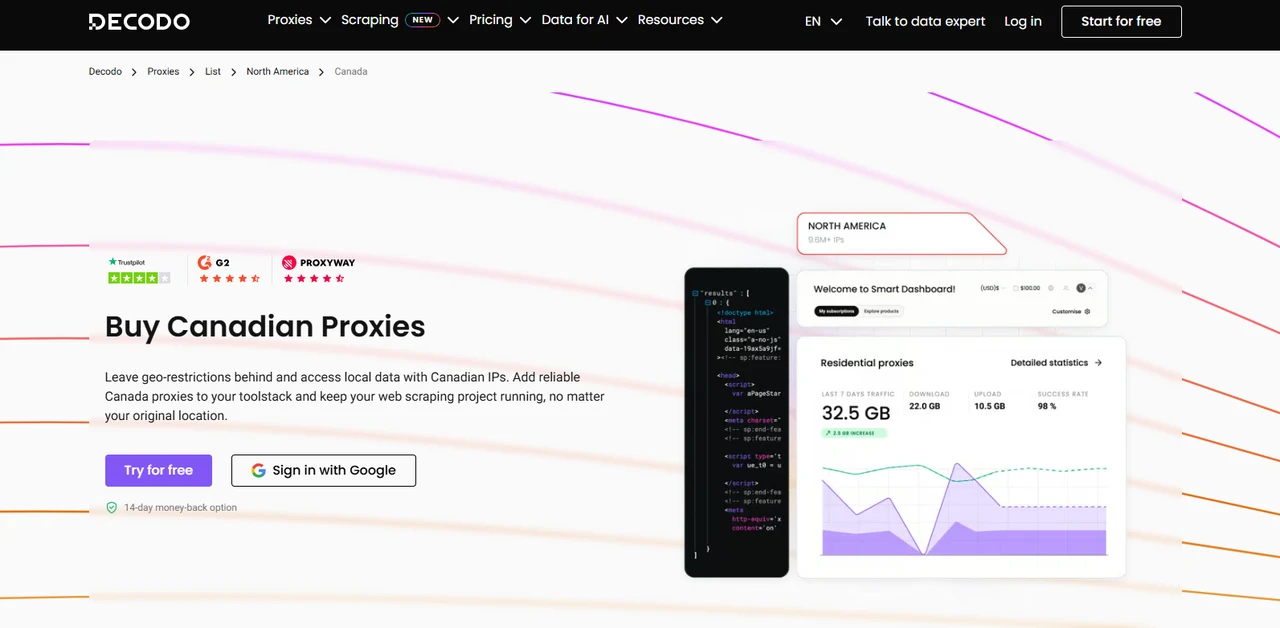
Decodo provides Residential, ISP, Mobile, and Datacenter proxies, with a large global residential network and detailed location controls. Its Canadian proxy offering supports multiple proxy types and targeting options.
✨Key features
Residential: From $2/GB.
ISP: From $0.27/GB.
Mobile: From $2.25/GB.
Datacenter: From $0.02/IP.
Targeting: Country, city, and ASN.
Sessions: Rotating and sticky sessions, with sticky sessions of up to 30 minutes.
Network: More than 115 million IPs globally.
Practical use: Decodo’s large residential network gives users access to a broad pool of IPs, which can be useful when a project needs multiple Canadian residential connections. Its range of proxy types also allows users to choose a connection based on traffic requirements and budget.
Country, city, and ASN targeting provides more control than simply selecting Canada as a location. However, Decodo’s sticky sessions are limited to up to 30 minutes, while IPcook supports Residential sticky sessions of up to 24 hours. This difference may matter for workflows that require the same IP to remain active for longer periods.
Best for: Projects that need a large residential network and detailed Canadian location targeting.
👀Need more precise sticky session control? IPcook Residential Proxies supports sticky sessions from 1 minute to 24 hours, giving you better control over task duration and IP continuity.
3. Bright Data: Advanced Geo-Targeting and Proxy Infrastructure
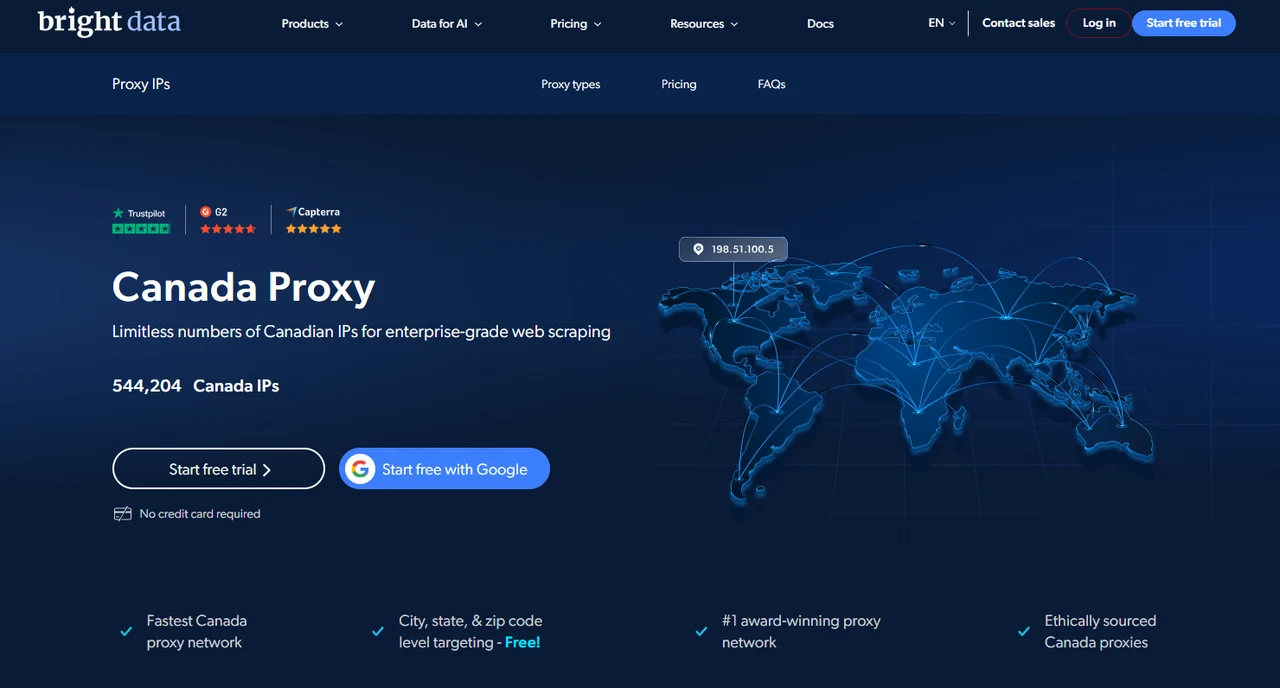
Bright Data offers Residential, Mobile, ISP, and Datacenter proxies, with detailed geographic and network-level targeting options. Its broader infrastructure also includes data-access products such as Web Unlocker and SERP API.
✨Key features
Proxy types: Residential, Mobile, ISP, and Datacenter.
Targeting: Country, city, ZIP code, carrier, and ASN.
Residential: $8/GB at the standard pay-as-you-go price; a promotional $4/GB rate is currently displayed.
Additional tools: Web Unlocker and SERP API.
Practical use: Bright Data’s detailed targeting gives users more control when country-level Canadian coverage is not precise enough. City, ZIP code, carrier, and ASN options can help projects work with more specific geographic or network-level requirements.
Its broader infrastructure also provides tools beyond a standard Canadian web proxy. Web Unlocker and SERP API can support automated data access and search-result collection. However, the standard Residential pay-as-you-go price is relatively high, so users may need to consider whether these advanced capabilities justify the additional cost for their project.
Best for: Projects that require advanced geographic targeting and broader data-access infrastructure.
4. Shifter: Large Residential Pool and Flexible Rotation
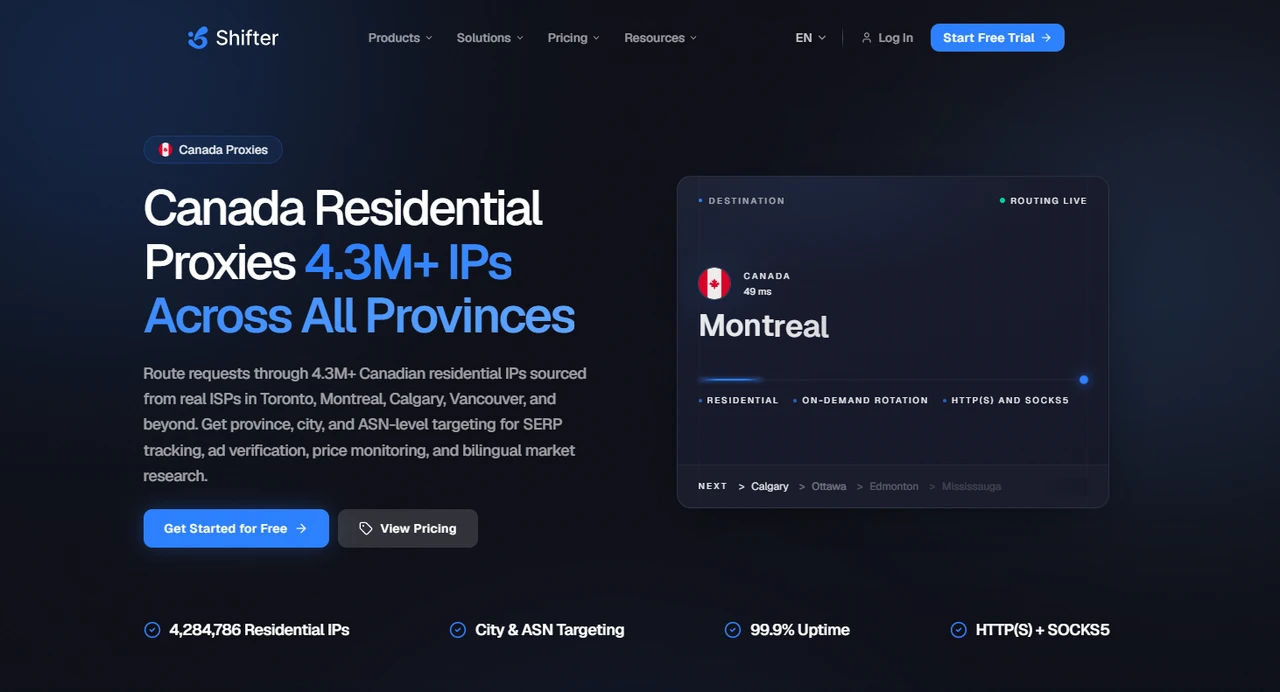
Shifter focuses on Residential and ISP proxies, with detailed geographic targeting for Canadian traffic. Its Canadian residential network includes more than 4.3 million IPs, with location controls extending beyond country-level selection.
✨Key features
Residential Country Geo: From $0.48/GB.
Residential Full Geo: From $0.75/GB.
Targeting: Province, city, and ASN.
Rotation: Per-request, timed rotation, and sticky sessions.
Canadian residential pool: More than 4.3 million IPs.
Practical use: Shifter’s large Canadian residential pool gives users access to a broader range of local IPs, while province and city targeting can narrow the connection to a specific Canadian market. This can be useful when localized Canadian coverage matters more than simply selecting the country.
Its rotation options also provide control over how often the IP changes. Per-request rotation can provide a new IP for individual requests, while timed rotation and sticky sessions support more consistent connection patterns. However, Shifter offers fewer proxy types than broader providers like Decodo, which may matter for projects that need several proxy categories from one service.
Best for: Projects that need large Canadian residential coverage, detailed location targeting, and flexible rotation.
5. Rayobyte: Fast Speeds and Flexible Proxy Options
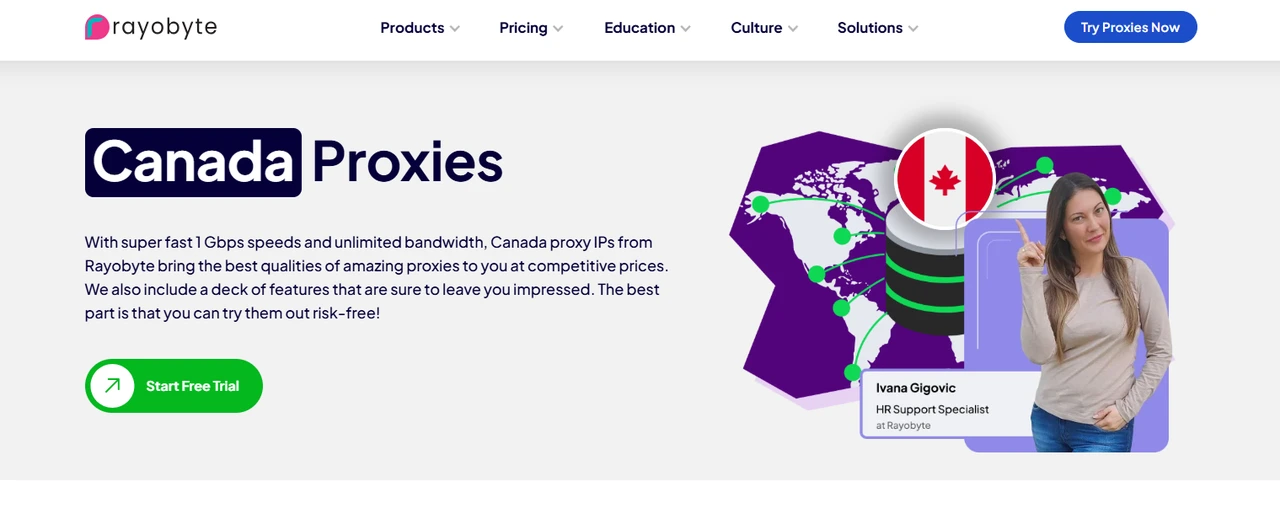
Rayobyte provides Residential, ISP, and Datacenter proxies for Canadian traffic, with options designed around speed, bandwidth, and connection flexibility. Its Canada proxy offering includes rotating residential and multiple Datacenter options.
✨Key features
Rotating Residential: From $3/GB/month.
Data Center Dedicated: From $2.13/IP/month.
Data Center Semi-Dedicated: From $0.85/IP/month.
Bandwidth: Unlimited bandwidth on listed Canadian proxy plans.
Speed: Up to 1 Gbps.
Network: 9 ASNs available for Data Center proxies.
Practical use: Rayobyte’s combination of unlimited bandwidth and high connection speeds can be useful for projects that handle larger amounts of Canadian traffic. Users can choose between Residential and Datacenter options based on whether they need a residential connection or prioritize speed and bandwidth.
The different Datacenter options also give users more flexibility when balancing dedicated resources and cost. However, users looking specifically for highly granular Canadian geo-targeting or a broad range of proxy types may need to compare Rayobyte with providers that offer more location or connection options.
Best for: Projects that prioritize fast Canadian connections, unlimited bandwidth, and flexible Residential or Datacenter options.
6. DataImpulse: Pay-As-You-Go Pricing and Flexible Targeting
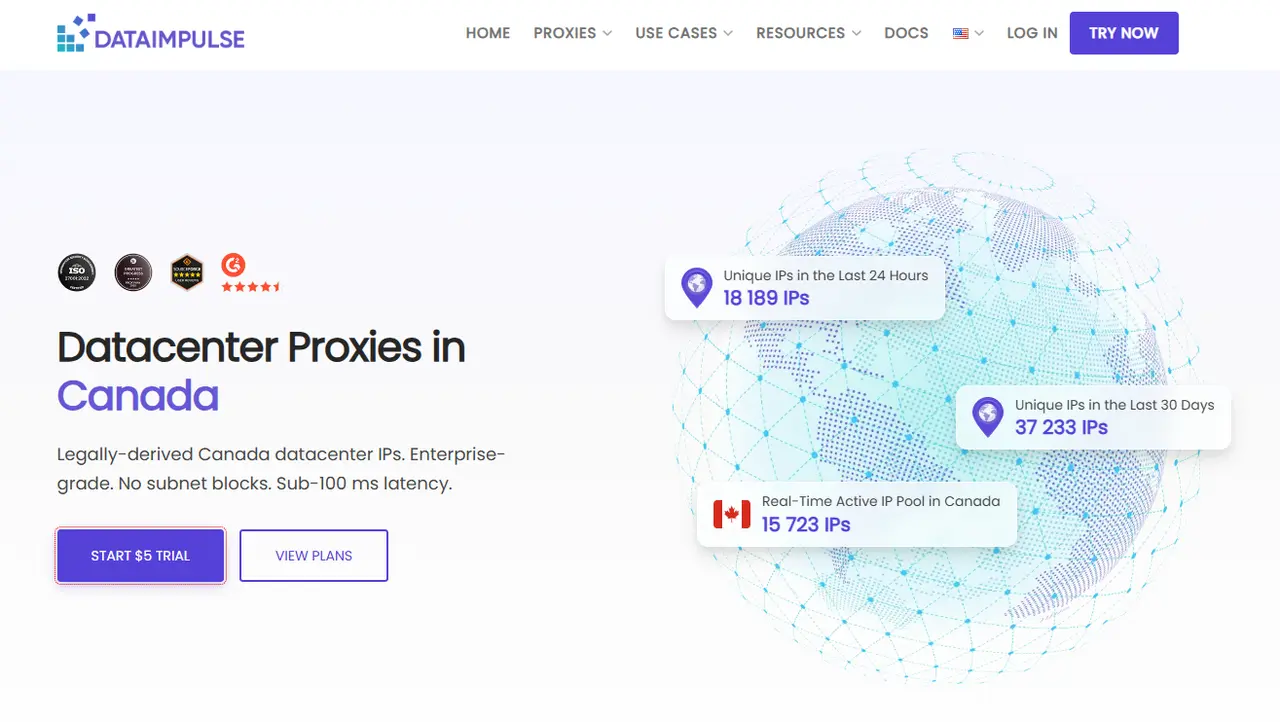
DataImpulse offers Residential, Mobile, and Datacenter proxies with a pay-as-you-go pricing model. Its residential offering also provides different levels of geographic targeting depending on the plan.
✨Key features
Residential: From $1/GB.
Mobile: From $2/GB.
Datacenter: From $0.50/GB.
Country targeting: Included in the standard offering.
Advanced targeting: City, state, ASN, and ZIP options are available with the premium residential offering.
Traffic: Does not expire.
Practical use: DataImpulse’s pay-as-you-go model allows users to pay for the traffic they actually use instead of committing to a large fixed package. This can make the pricing model easier to match with smaller or irregular Canadian proxy requirements.
Country-level targeting is sufficient when a general Canadian location meets the project requirements. However, users who need city, state, ASN, or ZIP-level targeting need the premium residential offering, so more precise geographic requirements can involve a higher-tier plan.
Best for: Projects that prioritize usage-based pricing and flexible Canadian proxy options.
How to Choose a Canada Proxy
The Best Canada Proxies vary by proxy type, location requirements, session needs, and budget. Before you buy Canadian proxies, consider the following factors.
Match the proxy type to the task. Residential, ISP, Datacenter, and Mobile proxies serve different requirements. Choose based on the type of traffic and connection you need.
Check Canadian location coverage. Country-level coverage may not be enough. Check whether the provider supports the specific city, province, or ASN required for your project.
Compare sessions and pricing. Rotating proxies suit tasks that need frequent IP changes, while sticky sessions work better when the same IP needs to remain active. Compare pricing, traffic expiration, and minimum purchases as well.
Test before scaling. Test a small number of IPs first. Check the detected location, ASN, response time, connection stability, and access to your target websites.
The best fit comes down to how well location accuracy, connection quality, and pricing align with your project's actual requirements. A provider with more features is not necessarily the right fit if those features do not support your specific workflow.
Final Thoughts
The 6 Canada proxy providers covered above each have different strengths and limitations. Your choice can depend on factors such as budget, proxy type, Canadian location coverage, session requirements, and traffic volume. Comparing these factors with your actual use case can help narrow down the options.
If stable connections, cost efficiency, and responsive support are priorities, IPcook is worth considering. Its Canada proxies support targeting across 13 provinces and 248 cities, giving you more flexibility when working with location-specific Canadian traffic. You can also register with IPcook and claim 100 MB of free Residential proxy traffic to test the connection and targeting before committing to a larger plan.
FAQs
- Best Canada Proxy Providers at a Glance
- 1. IPcook: Flexible Plans and Geo-Targeting
- 2. Decodo: Large Residential Network and Precise Targeting
- 3. Bright Data: Advanced Geo-Targeting and Proxy Infrastructure
- 4. Shifter: Large Residential Pool and Flexible Rotation
- 5. Rayobyte: Fast Speeds and Flexible Proxy Options
- 6. DataImpulse: Pay-As-You-Go Pricing and Flexible Targeting
- How to Choose a Canada Proxy
- Final Thoughts
- FAQs