








7 Best Free Proxy Servers in 2026: Complete Guide & Top Picks

Free proxy servers can sound too good to pass up. They hide your real IP address, unlock region-restricted sites, and cost nothing. The catch is that a free proxy is rarely as private or as reliable as it looks. Some are safe enough for light, low-stakes browsing. Others are run by unknown operators and can put your data at risk.
This guide rounds up the 7 best free proxy servers in 2026 and groups them into 3 simple categories. You will find free plans from premium providers, easy browser-based free web proxies, and free public proxy lists.
What to Look for in a Free Proxy Server
Not every free proxy is worth your time. These 4 factors help you identify the options that are actually worth using.
Free Access and Usage Limits: Check how much free traffic or access the provider offers. If it's a free trial from a paid provider, consider whether the allowance is sufficient to test IP quality and connection performance. If it's completely free, check whether there are daily limits, session restrictions, mandatory registration, or hidden costs.
IP Quality and Reliability: Look at where the IPs come from, whether they are residential or datacenter IPs, and how stable the connections are. Check response speed, uptime, and IP availability to avoid unreliable or frequently blocked proxies.
Connection Methods and Tool Compatibility: Consider how you can connect to the proxy and which protocols it supports, such as HTTP(S) and SOCKS5. Check whether it works with your browser, operating system, or third-party tools without complicated setup.
Privacy and Security: Check whether connections are encrypted, whether the provider logs browsing activity, and whether the proxy exposes your real IP or other identifying information. Avoid public proxies that lack transparent privacy policies or reliable security practices.
Types of Free Proxy Servers
Type | Description | Use Case | Advantages | Disadvantages |
Public Free Proxy Lists | Public IP lists requiring manual setup. | Basic, non-sensitive browsing. | Free and widely available. |
|
Free Plans from Premium Providers | Free trial access to paid proxy services, usually with limited features. | Small tasks and service testing. | Higher-quality IPs, more stable connections, and better security. |
|
Free Web Proxies | Access through a specific website where you enter the target URL | Quick access to blocked webpages. | No installation or manual configuration required. |
|
Free Proxy Access from Top Providers
Free trials and free tiers from premium providers are the most reliable way to try a proxy without paying. You get professionally managed IPs with real support and better security. The tradeoff is a limit on data, IPs, or time. These 3 providers offer the best free access in 2026.
IPcook: Premium Proxies with Free Access
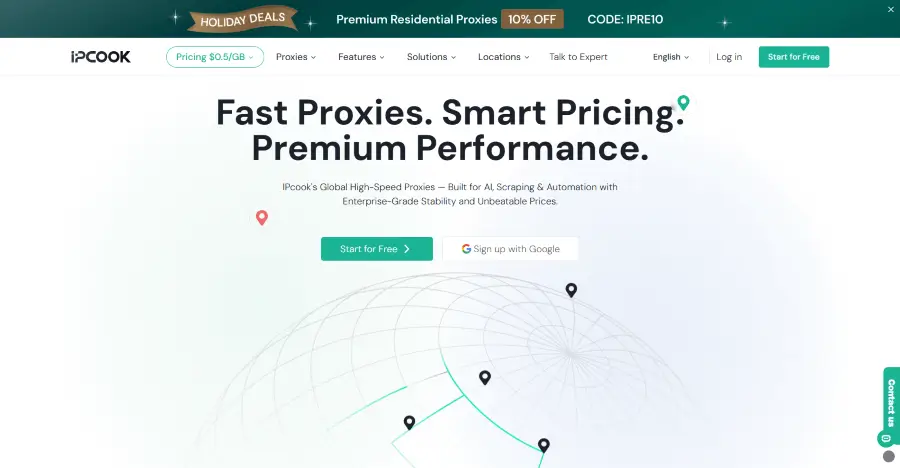
IPcook is a premium proxy provider that offers new users 100 MB of free residential traffic with no expiration date. It is enough to download roughly 30 to 50 short TikTok videos, depending on video quality. It can also cover a few thousand lightweight data points if you are running small data scraping jobs, or let you test a city-level geo-targeting campaign before committing to a paid plan. The traffic does not expire, so you can run small tests or long-term, low-volume projects without looking at the clock.
The free tier is not a stripped-down version of the paid service. You get the same features as the paid residential proxy service, backed by 55 million+ IPs across 185+ countries and precise geo-targeting. Both HTTP and SOCKS5 are supported, and you can choose rotating IPs or a sticky session that lasts up to 24 hours. IPcook maintains 99.9% uptime to ensure connection stability. As your workload grows, unlimited residential proxies offer unlimited traffic to support your larger projects.
Pros
Access to 55M+ IPs across 185+ countries
Global average response time is under 0.5s
IP whitelisting for password-free authentication
Real-time traffic and connection monitoring with report exports
Up to 10 free sub-accounts for team management
24/7 support via live chat, email, and phone
Cons
Free access is capped at the data allowance
Bright Data: Enterprise-Grade Proxy with Free Trial
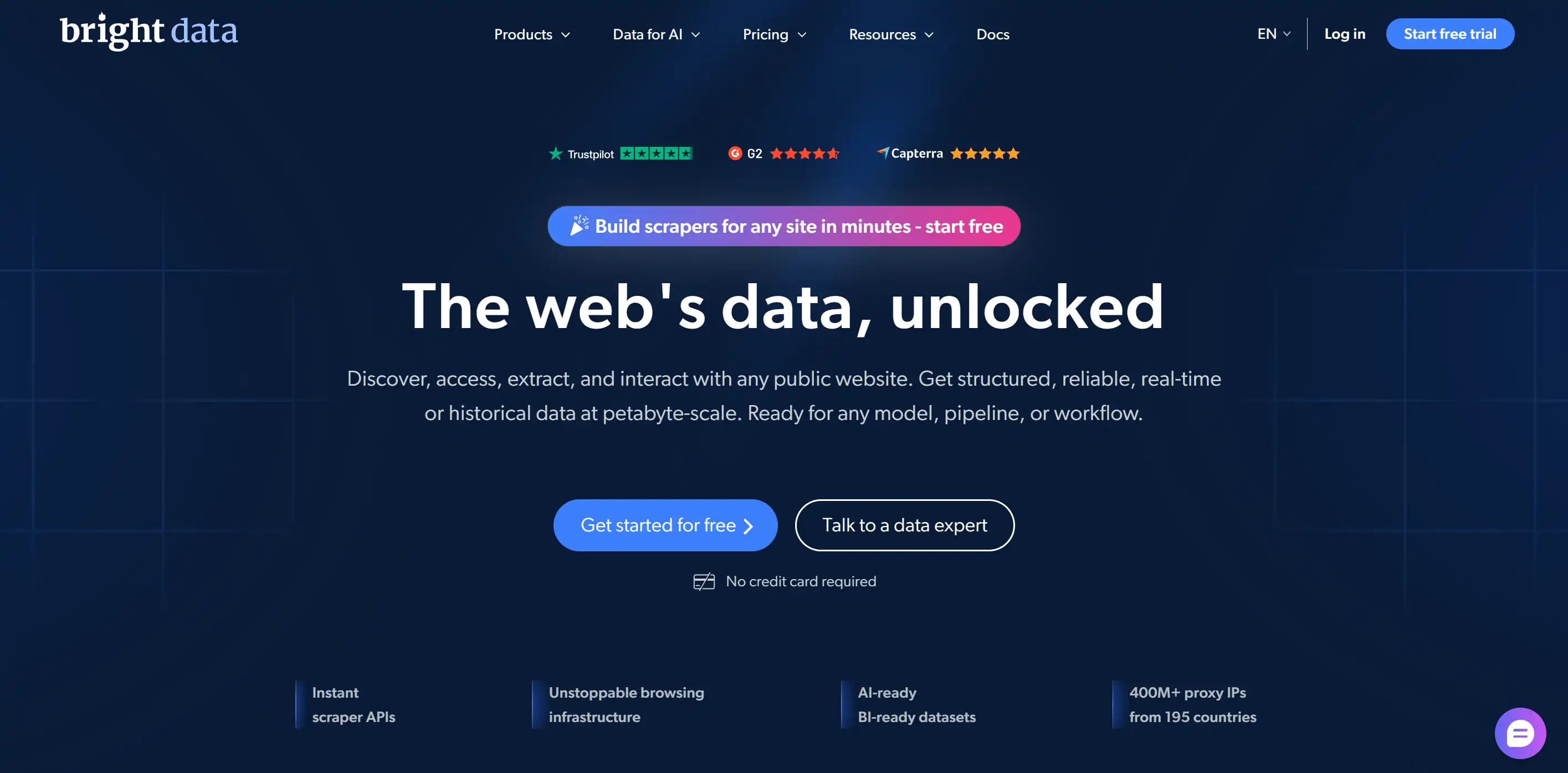
Bright Data runs one of the largest proxy networks in the world, covering residential, ISP, and datacenter proxies. Its residential pool spans 400 million+ monthly IPs across 195 countries, while its ISP and datacenter networks each include over 1.3 million IPs. New accounts may receive a one-time $2 proxy trial credit valid for seven days. Adding a payment method for verification can unlock an additional $5 credit and extend the trial period to 30 days, subject to account eligibility.
Bright Data also offers 5,000 free monthly credits for API products such as Web Scraper, Web Unlocker, and SERP APIs. These credits are separate from proxy trial credits. The main appeal is its extensive IP coverage and enterprise-focused infrastructure.
Pros:
400M+ residential IPs across 195 countries
IP targeting by country, state, city, ZIP code, and ASN
QUIC protocol for faster residential proxy connections.
Unlimited concurrent sessions with no code modifications.
Cons
Expect higher costs than with many other proxy providers.
Work within a limited initial trial credit and short validity period.
Webshare: Free Plan for Light Use
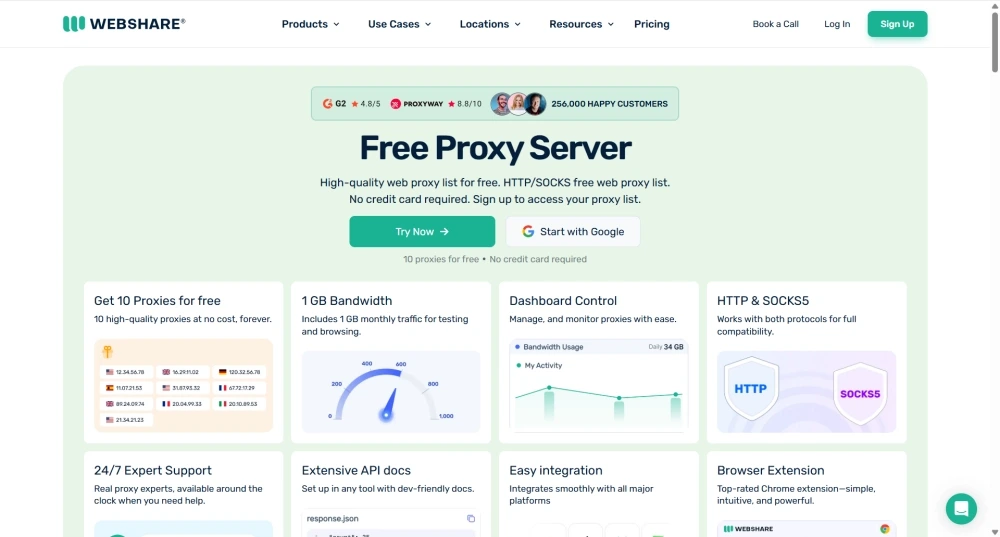
Webshare takes a different approach to free proxy services. Instead of offering a trial that expires, it provides a permanent free plan with 10 shared datacenter proxies and 1 GB of monthly traffic. There is no time limit and no credit card is required, so you can keep using proxies as long as your needs stay light. Both HTTP and SOCKS5 are supported. However, the free proxies are shared among multiple users, which means the same IPs may be used by others and could be blocked by certain websites.
You can manage these proxies through the dashboard directly and use the Chrome browser extension for easier setup. Its wider network includes 80 million+ IPs across 195 countries, covering datacenter, static residential, and residential proxies, but the free plan only includes datacenter IPs. It is best suited to light browsing, basic testing, and small-scale tasks rather than heavy scraping.
Pros
HTTP and SOCKS5 protocol support
10 free shared datacenter proxies
No credit card required to access the free plan
Chrome extension for easy proxy setup and management
Cons
Shared IPs may be blocked by certain websites
Free access is limited to datacenter proxies
Free Web Proxy Server (Web Proxy)
Web proxies work right in your browser, and they are the simplest form of an HTTP proxy. You visit the site, type the URL you want, and the service loads the page through its own server. There is nothing to install, which makes them perfect for quick, one-time access.
CroxyProxy: Simple Free Web Proxy Server
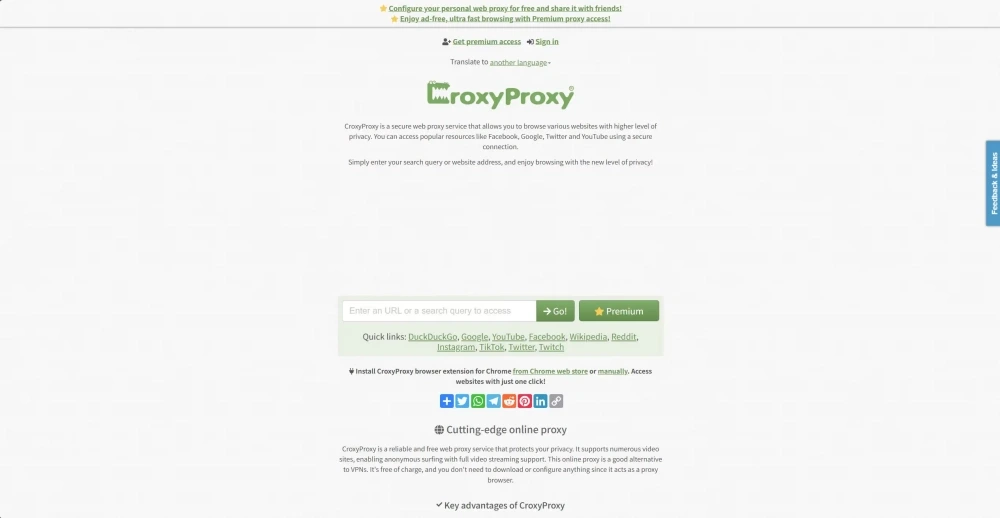
CroxyProxy is a popular browser-based proxy that keeps things simple. You enter a URL or search query, and the page loads through its servers without requiring downloads or manual setup. Basic use requires no registration, while an optional Chrome extension makes accessing websites through the proxy even more convenient.
Two strengths make it stand out among web proxies. First, it encrypts traffic between your device and its proxy servers, adding protection even when the destination website does not support HTTPS. Second, it supports full video and audio playback, which is not available with every free web proxy. The main trade-offs are ads in the free version and standard logs that may include your IP address, browser type, ISP information, and timestamps, retained for up to 60 days.
Pros
No registration or software installation for basic use.
SSL-encrypted connections between your device and proxy servers.
Full video and audio streaming support.
Chrome browser extension for one-click proxy access.
Cons
Ads displayed in the free version.
No clearly published server location selection for free users.
VPNBOOK: Free Proxy Server with Selectable Locations
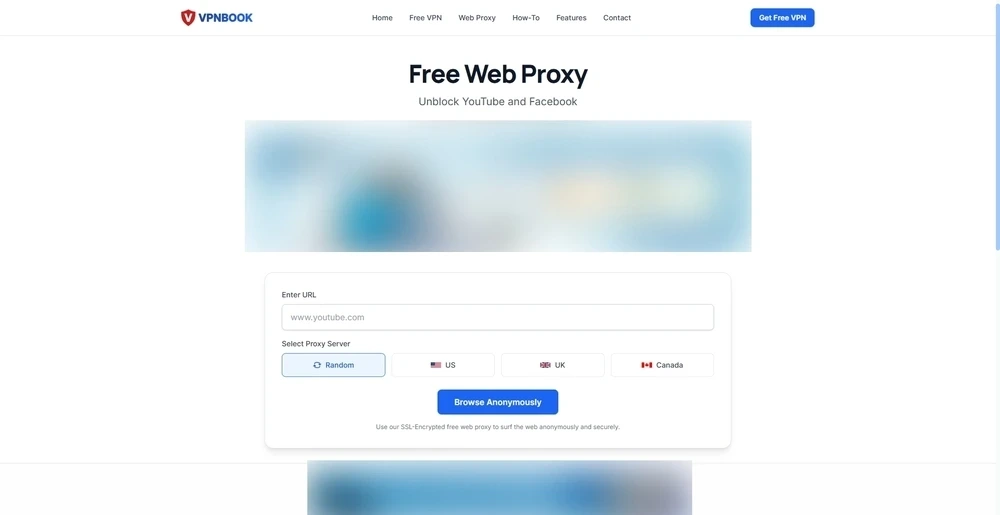
VPNBook is a long-running free web proxy with a simple setup. Enter a URL, select a server in the US, UK, or Canada, and click to browse anonymously. There is no download or sign-up required, and the connection between your browser and the proxy uses 256-bit SSL encryption. Dedicated YouTube and Instagram proxy pages also make it easier to access video and social content blocked by school or workplace networks.
It supports its free services through website ads and donations. Alongside its web proxy, it also offers a separate free VPN with servers in 6 countries and no bandwidth limits. Instagram access also works better on desktop browsers, as its mobile website does not currently load properly through the proxy. For occasional website unblocking without installing software, VPNBook provides a straightforward option.
Pros
No installation or sign-up required.
256-bit SSL encryption between your browser and the proxy.
Dedicated YouTube and Instagram proxy pages.
3 selectable proxy locations: US, UK, and Canada.
Cons
Ad-supported service.
Public Free Proxy Lists
Public proxy lists are the last category, and the riskiest. They publish raw IP addresses from unknown sources that you configure by hand. Treat them as disposable, and never send anything sensitive through them.
Spys.one: Popular Public Free Proxy List
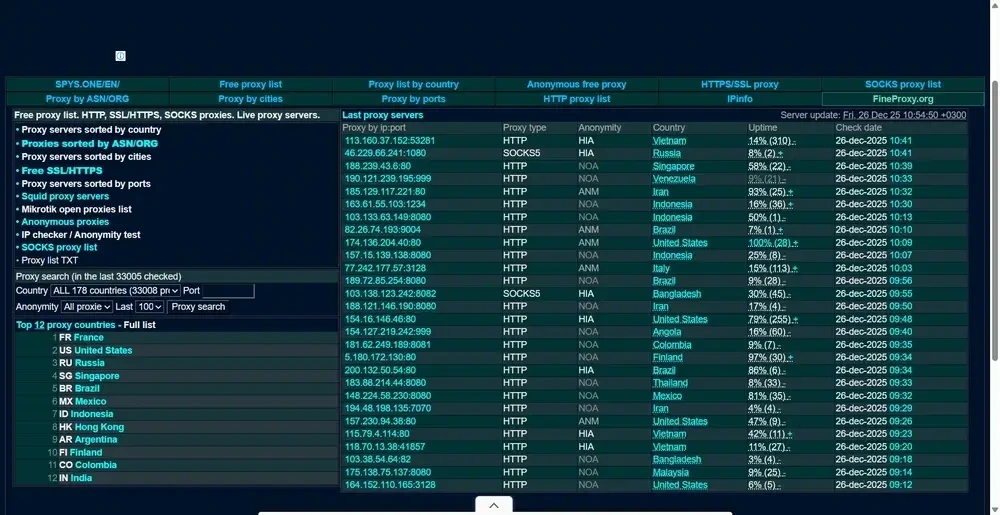
Spys.one is a public proxy directory and a useful option to consider when comparing the best free proxy list websites. It currently tracks around 33,000 recently checked proxy entries, although the number changes constantly and does not represent the number of working proxies. Each entry includes the IP and port, protocol, anonymity level, country, and uptime. Detailed listings also show city, latency, and relative speed. You can filter proxies by country, port, and anonymity, with dedicated pages for cities, ASN, protocols, and SSL support.
The site labels anonymity levels as NOA (non-anonymous), ANM (anonymous), and HIA (highly anonymous), helping you identify how much information each proxy may reveal. You can also download proxy entries as a plain text file for bulk configuration. However, these proxies are operated by unknown third parties, so avoid using them for sensitive data or account logins.
Pros
Around 33,000 recently checked proxy entries.
Filters for country, port, and anonymity level.
Separate proxy lists organized by city, ASN, protocol, and SSL support.
Anonymity labels and plain text export.
Cons
The listed count does not reflect the number of working proxies.
Many proxies have low uptime and inconsistent speeds.
Unknown third-party operators create privacy and security risks.
Free Proxy List: Regularly Updated Free Proxy Site
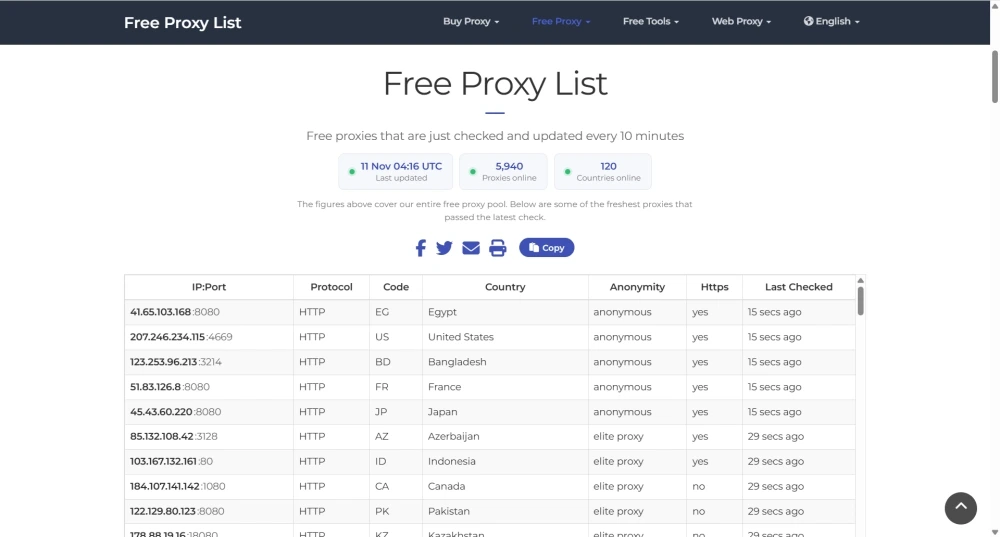
Free Proxy List is a straightforward option that focuses on frequently checked public proxies. Its main HTTP proxy list is rechecked every 10 minutes, and each entry shows when it was last verified. Separate pages provide SOCKS4 and SOCKS5 proxies with the same checking approach.
The sortable tables display the IP address, port, protocol, country, anonymity level, HTTPS support, and last check time. Proxies are labeled as elite, anonymous, or transparent. You can also download proxy lists through the site's free software or API. However, the site does not display per-proxy latency or uptime figures, making it difficult to compare connection performance.
Pros
Proxies are rechecked every 10 minutes.
Sortable lists with country, protocol, and anonymity details.
Separate HTTP, SOCKS4, and SOCKS5 proxy pages.
Free software and API for downloading proxy lists.
Cons
No per-proxy latency or uptime data.
Public proxies are often slow and unstable.
Limited compatibility with some major websites.
When Should You Upgrade to a Paid Proxy Provider
Free proxies can handle basic browsing and occasional tasks, but their limitations become more noticeable as your requirements grow. Consider upgrading to a paid proxy provider in the following situations:
Connection reliability becomes an issue: Free proxies often have unstable connections and inconsistent speeds. Frequent timeouts or failed requests can interrupt your tasks and make it difficult to collect data consistently. Paid services generally offer better-managed IP pools and more reliable connections.
Your workload grows: Public free proxies are rarely equipped to handle large volumes of requests. Limited IP availability and shared bandwidth can slow down scraping tasks or cause repeated connection failures. Paid providers offer larger IP pools and greater connection capacity.
Session continuity matters: Free proxy IPs can disconnect or become unavailable without notice. This makes them unreliable for tasks involving account logins, shopping carts, or repeated requests that depend on the same IP. Paid proxies with sticky sessions help maintain a consistent connection.
Location accuracy is important: Public free proxies usually provide limited or unverified location choices. This makes it difficult to access region-specific content or test how websites appear in different markets. Paid providers often offer country, state, and city-level targeting.
Data privacy becomes a concern: Some free proxy operators may monitor browsing activity, collect personal information, or expose sensitive data. Paid services with transparent privacy policies and clear data-handling practices make it easier to assess how your information is handled.
Verdict
The best free proxy server depends on your needs. CroxyProxy and VPNBook are convenient for quick website unblocking, while Spys.one and Free Proxy List offer public IPs for basic, non-sensitive tasks. Both options come with reliability and privacy limitations.
When speed, stability, and IP quality matter, a premium provider's free tier is a smarter choice. IPcook offers 100 MB of free residential proxy traffic with no expiration date. It supports precise country, state, and city targeting, while 99.9% uptime helps keep connections stable.