






6 Best Web Data Scraping Services Worth Considering in 2026

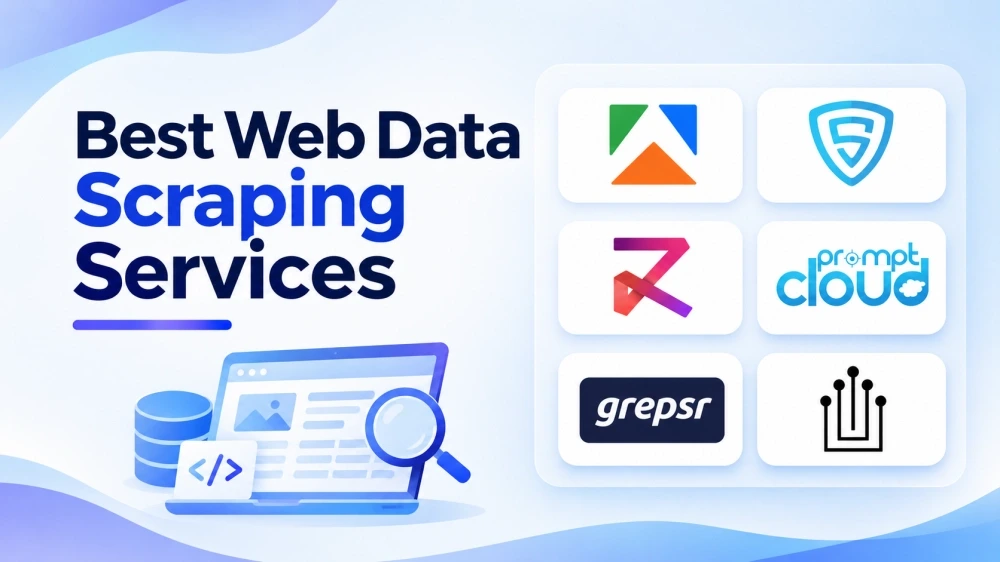
Tracking competitor prices across hundreds of product pages takes time. So does collecting listings from multiple marketplaces or building datasets for market research. As data needs grow, manual collection becomes harder to manage. Web data scraping services can handle the collection process and deliver structured data without requiring your team to build its own infrastructure.
The challenge? Providers differ in website coverage, data quality, delivery methods, and pricing. To make your decision easier, this guide compares 6 web data scraping services in 2026, highlighting their key features and differences to help you choose the right provider.
What Is a Web Scraping Service
A web data scraping service is a third-party service that collects information from websites and turns it into structured, ready-to-use data. Instead of building your own crawlers, you can use such a service to gather specific information, such as product prices, customer reviews, or business listings. Depending on the service, you can receive the results as a spreadsheet, JSON file, or through an API.
💡Web Scraping Service vs. Web Scraping Software
Web scraping services aren't the only way to collect website data. You can also use scraping software to manage the process yourself. Here are the key differences:
Web scraping service: A provider handles data extraction and, depending on the service, processing and delivery.
Web scraping software: Gives you tools to build and run scraping tasks yourself, with more control over the process but more setup and maintenance.
If you prefer the self-service approach, see our guide to the Best Website Scraping Software: Top Picks by Use Case for more options.
How We Evaluated the Best Web Scraping Services
We evaluated each provider based on how well it collects and delivers usable web data at scale, as well as the maintenance required to keep scraping tasks running. Our assessment focused on the following criteria:
Data Collection Capabilities: Our assessment covered the websites each service supports, its extraction methods and content types, and its ability to scrape JavaScript-rendered pages. We also evaluated how well each service handles large-scale scraping jobs.
Data Quality and Accuracy: Output quality was assessed based on field completeness, value accuracy, and format consistency. Checks for missing data and duplicate records helped identify issues that could affect the results.
Data Delivery and Integration: The review covered CSV and JSON exports, API access, and compatibility with existing workflows. A key consideration was whether teams could import the data directly or needed to reformat it first.
Scraper Maintenance and Reliability: We examined how providers respond to website redesigns, failed requests, and broken extraction tasks. The assessment also considered how much manual maintenance customers need to perform.
Pricing and Service Transparency: Pricing comparisons accounted for billing structures, usage limits, additional charges, included features, and service terms. We also checked whether prices covered the required usage or whether extra costs applied.
Top 1. Apify – Best for Automated Web Data Collection
Apify is a self-service web scraping and automation platform built around cloud-based programs called Actors. Each Actor handles a specific scraping or automation task. You can build your own or choose from thousands of ready-made Actors in the Apify Store to collect data from popular websites. Apify also develops Crawlee, an open-source library for building web crawlers in JavaScript and Python. It offers a Free plan with $5 in usage credit and paid plans starting at $19 per month.
Best For: Developers and technical teams that need flexible scraping solutions for complex or frequently changing data collection tasks.
Key Features:
Cloud-based web scraping and automation with Actors
Thousands of ready-made Actors in the Apify Store
Custom Actor development and deployment
Open-source Crawlee library for JavaScript and Python
API, webhooks, and third-party integrations
However, Apify may fall short when scraping large volumes of data across multiple countries and cities due to the limitations of its built-in residential proxies. For example, collecting local product prices and stock levels may require a larger IP pool, precise city targeting, and longer sessions. Apify does not disclose its residential IP pool size, and its $8/GB starting rate can also add up on high-volume projects. In these cases, a professional proxy provider like IPcook can supplement Apify's built-in proxies with a larger pool of residential IPs and more flexible functions.
IPcook Residential Proxies offer 55M+ residential IPs across 185+ countries and free, precise targeting at the country, state, and city levels. You can rotate IPs with each request or at set time intervals, or use sticky sessions for up to 24 hours. Pricing starts at $3.20/GB, with rates as low as $0.30/GB. You can use IPcook with Apify to handle large-scale, geo-targeted scraping tasks. Simply configure it as a custom proxy, and your Actors can use IPcook's residential IPs for scraping.
Top 2. ScrapeHero – Best for Custom Data Scraping Projects
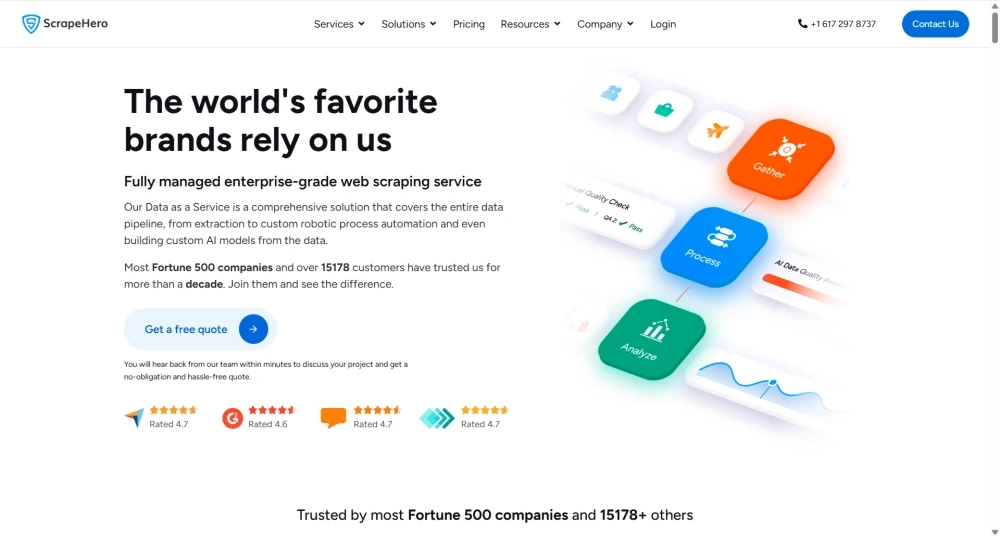
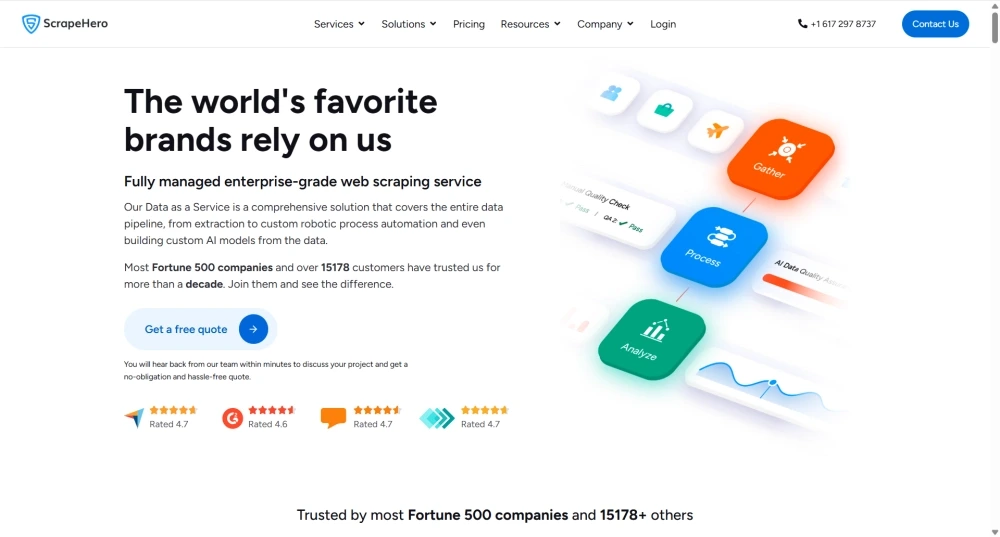
ScrapeHero builds custom scrapers for specific websites and data requirements, including niche sources that may not have ready-made solutions. Clients can review sample records before full collection to confirm that the extracted fields meet their needs. For more common sources, ScrapeHero Cloud offers ready-made scrapers for websites such as Amazon and Walmart, providing an alternative to commissioning a custom project. One-off projects start at around $550, while monthly plans start at $199 per website.
💡Key Features:
Custom scraping projects for selected websites and data fields
Data consolidation from multiple sources
Sample data review before full-scale collection
ScrapeHero Cloud with pre-built website scrapers
One-time projects and recurring data collection plans
Best for: Businesses that need data collected and organized around specific internal datasets, especially when standard website scrapers cannot provide the required fields or structure.
Top 3. Zyte – Best for AI-Assisted Web Data Extraction
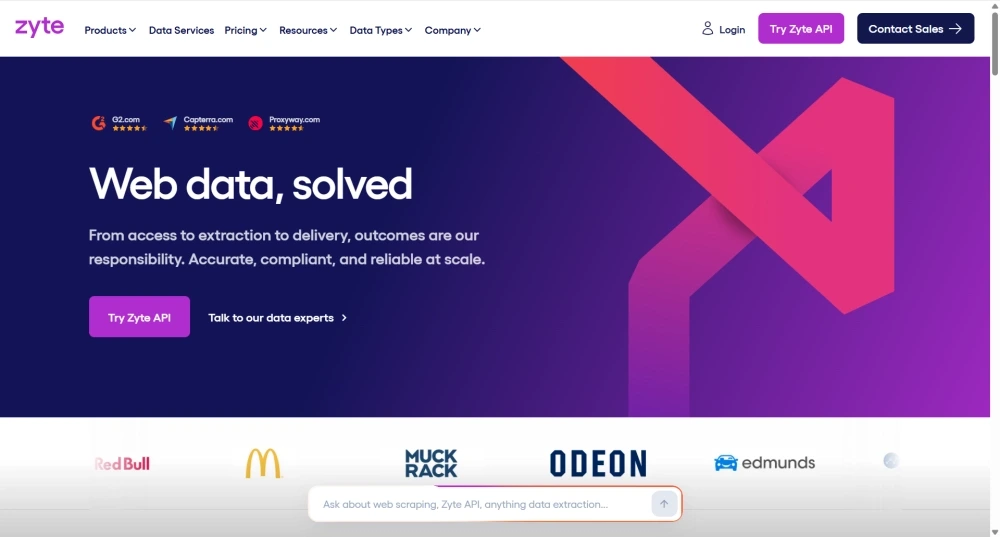
Zyte, formerly known as Scrapinghub, is also the company behind Scrapy, the open-source Python web scraping framework. Its flagship product, Zyte API, combines website access, proxy management, browser rendering, and AI-powered data extraction in one service. The AI extraction feature can identify and structure data from product pages, articles, job listings, and other supported page types, returning clean fields without requiring you to write and maintain parsing rules for every website.
It also offers managed data extraction services for businesses that prefer to outsource the entire collection process. Its team builds and maintains custom data feeds, with scheduled delivery based on the websites, fields, and frequency you specify. Zyte API pricing starts at $0.06 per 1,000 successful responses, although actual costs vary by website, request type, and additional extraction features.
💡Key Features:
AI-powered extraction for product, article, job, and other structured data
Automatic proxy selection, IP rotation, and ban handling
Headless browser rendering and page interactions
Scrapy integration and Python client support
Managed data extraction with scheduled delivery
Best For: Data-driven businesses that rely on accurate, up-to-date web data for pricing intelligence, market research, and AI development.
Top 4. PromptCloud – Best for Enterprise-Scale Data Collection
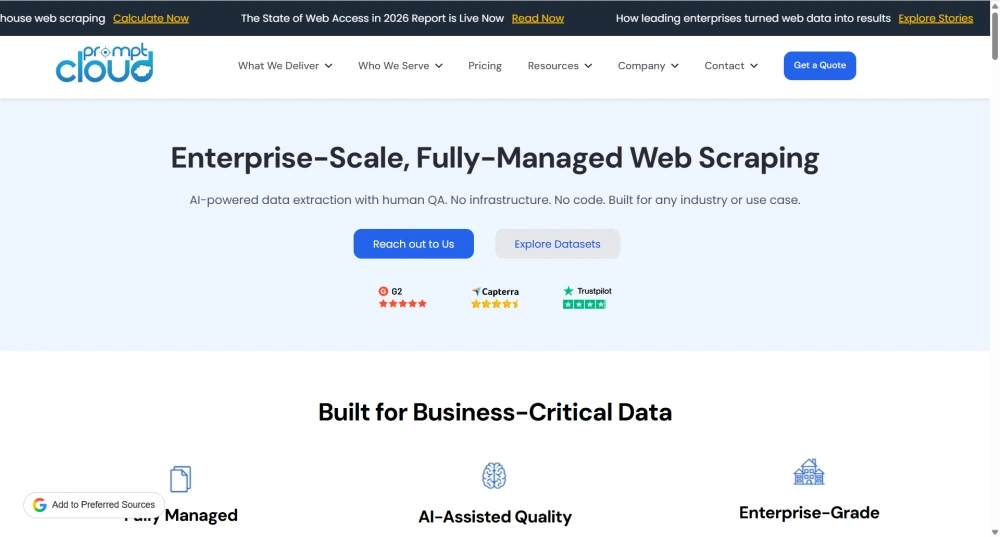
PromptCloud is a fully managed web scraping service designed for businesses with ongoing, large-scale data requirements. Rather than providing a self-service scraping platform, it builds and maintains custom data pipelines around your target websites, required fields, collection frequency, and delivery format. Its team handles crawler setup, data extraction, validation, and ongoing maintenance, then delivers structured datasets through an API, S3, FTP, or other agreed channels.
This hands-off approach can save engineering teams the work of maintaining scrapers as websites change. However, the managed model offers less direct control over crawler operations, and custom pricing may be a consideration for businesses with limited budgets. Costs depend on factors such as source count, data volume, crawl frequency, and project complexity.
💡Key Features:
Fully managed web scraping with custom crawler development and maintenance
Recurring data collection based on your preferred schedule
API, S3, FTP, and webhook delivery options
Custom project pricing based on data requirements
Best for: Enterprises and data teams that depend on continuously updated web data for market research, e-commerce intelligence, price monitoring, and business analytics.
Top 5. Grepsr – Best for Quality-Assured Web Data Scraping
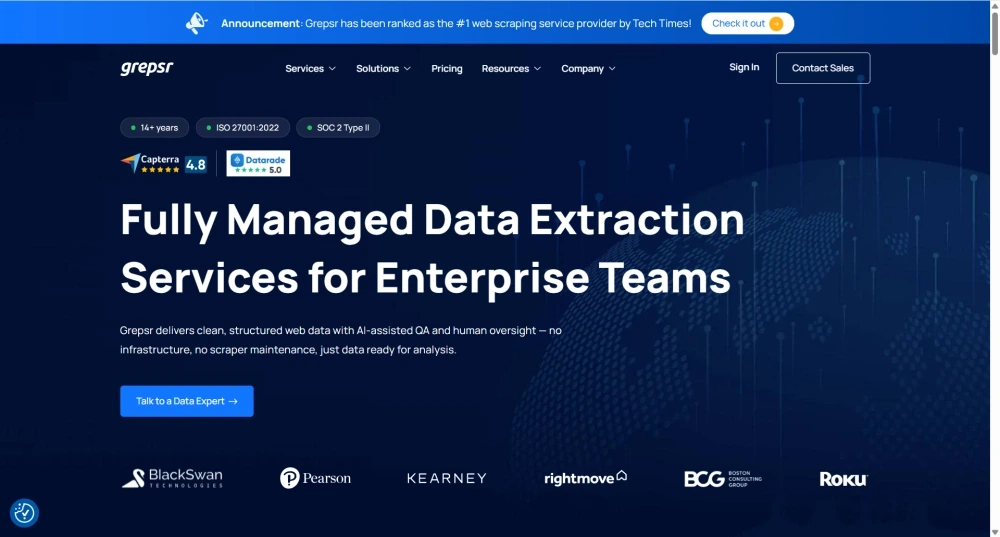
Grepsr is a fully managed web scraping service that handles extraction, cleaning, quality checks, and delivery. You define the dataset and approve a sample before full-scale collection begins, helping catch mismatched fields or formats early. Its team also maintains the crawlers as source websites change, reducing the need for in-house troubleshooting. CSV, JSON, Parquet, and XML exports give you flexibility to choose a format that fits your existing workflow.
Quality assurance sets it apart in our assessment. You review a sample before full collection begins to check the fields and format. Grepsr then uses automated checks and human review to catch data issues before delivery, leaving your team with less cleanup. Pricing starts at $100 for simple, one-time scraping projects. Ongoing data collection requires a custom quote.
💡Key Features:
Support for JavaScript-rendered pages and infinite scrolling
Cross-source deduplication and field normalization
API access for querying data and managing schedules
Project health reports and dedicated messaging channels
Webhook integration for triggering downstream workflows
Best for: Enterprise data teams and businesses with recurring, high-volume data collection needs and strict data quality requirements.
Top 6. Datahut – Best for E-commerce Web Data Scraping
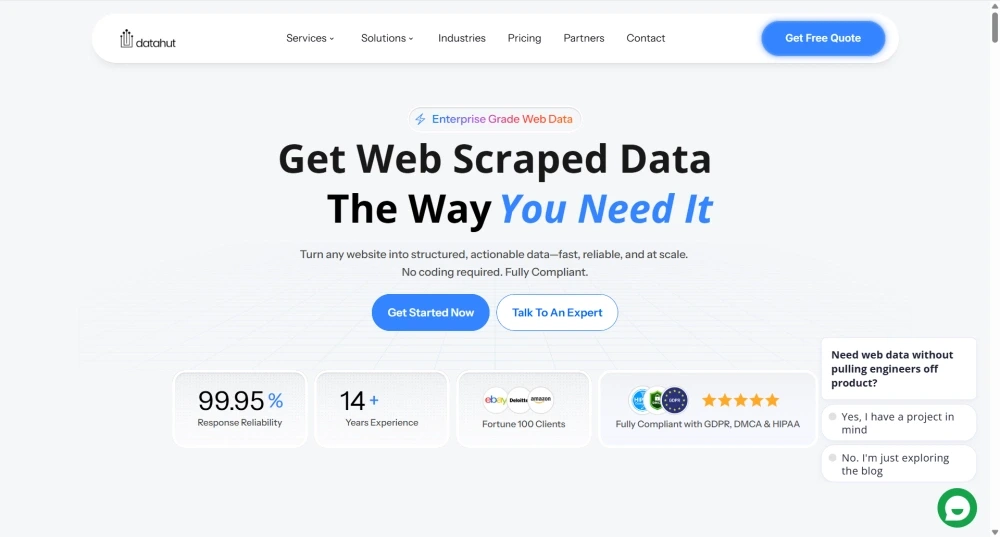
Datahut specializes in e-commerce web scraping, helping retailers and brands collect product listings, prices, stock availability, and promotional data from online stores and marketplaces. It supports major platforms such as Amazon, Walmart, and Flipkart, as well as individual retail websites. As a fully managed service, Datahut handles crawler development, data extraction, validation, and ongoing maintenance, so your team can focus on pricing decisions and market analysis instead of managing scraping infrastructure.
Its strongest use cases include competitor price tracking, stock monitoring, MAP violation detection, and assortment gap analysis. Datahut uses automated validation and dedicated QA to check collected data before delivery.
💡Key Features:
Competitor price tracking and historical pricing analysis
Stock availability monitoring and out-of-stock alerts
MAP violation monitoring and assortment gap analysis
Automated data validation, deduplication, and quality checks
Scheduled updates, with frequency options depending on the plan
Best for: E-commerce brands, retailers, and market intelligence teams that need recurring product, pricing, and inventory data to monitor competitors, optimize pricing, and make assortment decisions.
Compare the Best Web Scraping Services
To help you compare the 6 top providers, the table below highlights their workflows, industry coverage, and infrastructure.
Service | Workflow | Industries | Infrastructure |
Apify | Choose ready-made Actors or build your own | Cross-industry | Cloud platform, Crawlee, proxy services |
Zyte | Use APIs or outsource scraping | E-commerce, travel, finance | AI extraction, proxies, browser rendering |
ScrapeHero | Submit requirements and receive custom data | Retail, healthcare, finance, travel | Custom crawlers, proxy management |
PromptCloud | Set up recurring data collection | Retail, travel, finance, recruitment | Automated crawlers, premium proxies, human QA |
Grepsr | Request-managed scraping and scheduled delivery | E-commerce, real estate, travel, healthcare | Scraping engine, rotating IPs |
Datahut | Request-managed e-commerce data collection | E-commerce, retail, real estate | Proxy rotation, data validation |
Verdict
The right web scraping service depends on your data needs and how much control you want over the process. Grepsr is a strong choice for fully managed data collection, while ScrapeHero suits projects with custom requirements. Zyte stands out for AI-powered extraction, PromptCloud for ongoing enterprise data pipelines, and Datahut for e-commerce data. Apify is a good fit if you prefer a self-service platform with flexible scraping and automation tools.
If you choose Apify for large-scale or location-specific scraping, IPcook can complement its built-in proxy service with a large residential IP pool and more proxy options. You can try it with 100 MB of free residential proxy traffic that never expires.
FAQs
- What Is a Web Scraping Service
- How We Evaluated the Best Web Scraping Services
- Top 1. Apify – Best for Automated Web Data Collection
- Top 2. ScrapeHero – Best for Custom Data Scraping Projects
- Top 3. Zyte – Best for AI-Assisted Web Data Extraction
- Top 4. PromptCloud – Best for Enterprise-Scale Data Collection
- Top 5. Grepsr – Best for Quality-Assured Web Data Scraping
- Top 6. Datahut – Best for E-commerce Web Data Scraping
- Compare the Best Web Scraping Services
- Verdict
- FAQs