6 Best Datacenter Proxies for Fast, Unlimited Scraping in 2026

If you've been searching for the best datacenter proxies, you already know the drill: you need speed, you need reliability, and you really don't want to blow your budget. The good news? There are some genuinely excellent providers out there in 2026.
In this guide, we've rounded up the top datacenter proxy providers so you can pick the one that actually fits you. Whether you're scraping data at scale, bypassing geo-restrictions, tracking SEO rankings across regions, or automating high-volume data collection, there's a right tool for every use case here.
What Are Datacenter Proxies?
Datacenter proxies are IP addresses hosted on servers inside commercial data centers. They're not assigned by a residential internet provider, which means they don't look like someone's home Wi-Fi. Think of them as performance-first proxies: fast, cheap, and built for volume. See our article on residential vs. datacenter proxies for a deeper comparison.
Datacenter proxies give you fast, consistent response times, and the best providers offer unlimited bandwidth, even unmetered, at a fraction of what residential IPs cost. However, because these IPs come from known data center ranges, websites with aggressive anti-bot systems can sometimes flag them. They're a great fit for targets that care more about what you do than where your IP is registered.
The sweet spot for datacenter proxies includes:
Large-scale web scraping: price monitoring, product catalog collection, and news aggregation
SEO rank tracking: checking keyword positions across different locations without getting rate-limited
Ad verification: seeing exactly how your campaigns render in different markets
Market and competitor research: pulling public data at a volume that would cost a fortune with residential IPs
High-volume automation: any task where speed and throughput matter more than mimicking a home user
Quick Comparison of Best Datacenter Proxies
Before we dive into each provider, here’s a quick look at the best datacenter proxy services in 2026. Use this table to spot which provider fits your needs at a glance.
Provider | Best For | Bandwidth | Starting Price |
IPcook ⭐ | Speed + value at scale | Unlimited | $0.04/IP/day |
Bright Data | Enterprise tooling | Plan-based / fair use | $1.40/IP/mo |
Oxylabs | Largest dedicated pool | Fair-use threshold | $2.25/IP/mo |
Decodo | Balanced price + performance | Plan-based | $0.035/IP |
Webshare | Free tier + self-service | Optional unlimited | Free / $0.0299/IP |
IPRoyal | Low-commitment plans | 100GB/IP cycle | $1.39/IP |
1. IPcook — Best Overall Datacenter Proxy from $0.04/IP
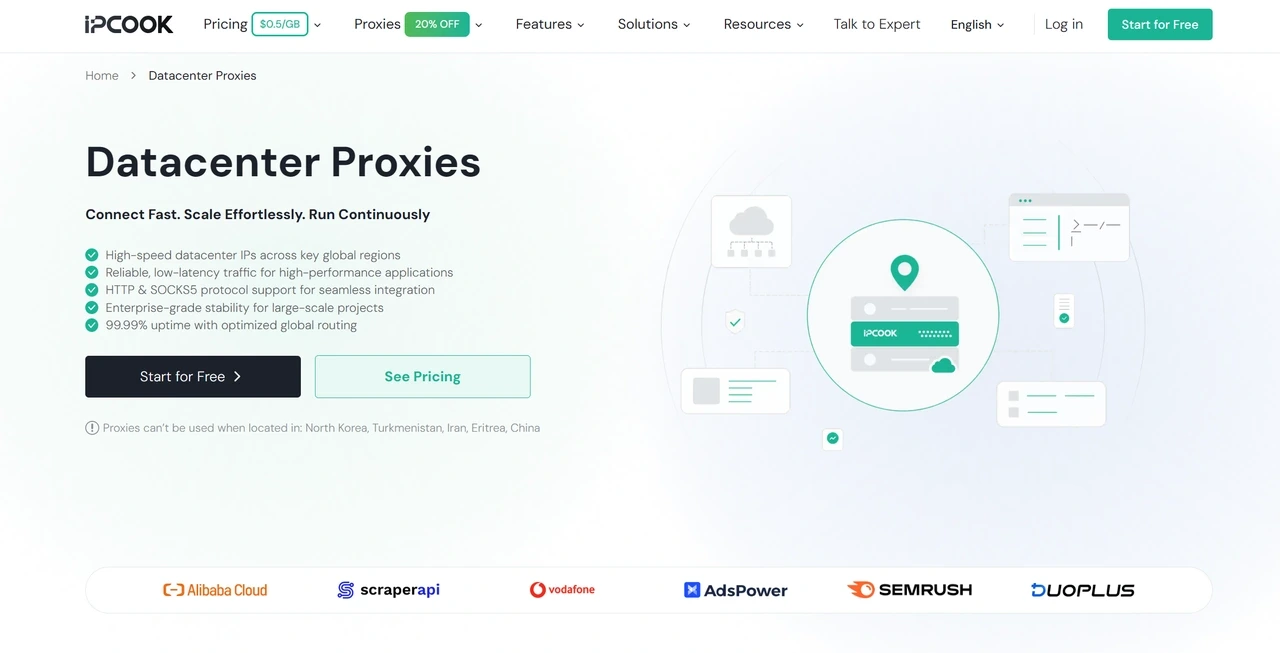
Best for: fast, unlimited traffic, and unbeatable pricing
If you're looking for the best datacenter proxy provider that checks every box without charging enterprise prices, IPcook is our top pick. It's purpose-built for high-performance applications, from AI workloads and large-scale scraping to automated data collection tasks that can't afford slowdowns.
What separates IPcook from most of the competition is the combination of features you actually care about. You can get millions of high-speed datacenter IPs across key global regions, unlimited traffic with no hidden limits, and 99.99% uptime backed by optimized global routing.
Why it stands out for scraping and automation:
IPcook’s datacenter proxy pool spans major regions across the Americas, Europe, and Asia-Pacific, covering key markets including the US, UK, Canada, and Japan. You can also get full HTTP and SOCKS5 protocol support, real-time dashboards, DNS customization, flexible authorization, and API access, all included without premium tier required.
Extended plans come with additional discounts, and 24/7 live support is included across all tiers.
Affordable Pricing:
IPcook uses per-IP pricing for datacenter proxies, with flexible validity periods:
IP Quantity | Price per IP/day | 5-Day Total |
10 IPs | $0.04 | $2 |
50 IPs ⭐ Bestseller | $0.039 | $9.75 |
100 IPs | $0.039 | $19.50 |
200 IPs | $0.038 | $38 |
500 IPs ⭐ Best Value | $0.037 | $92.50 |
2. Bright Data — Best for Enterprise-Scale Operations
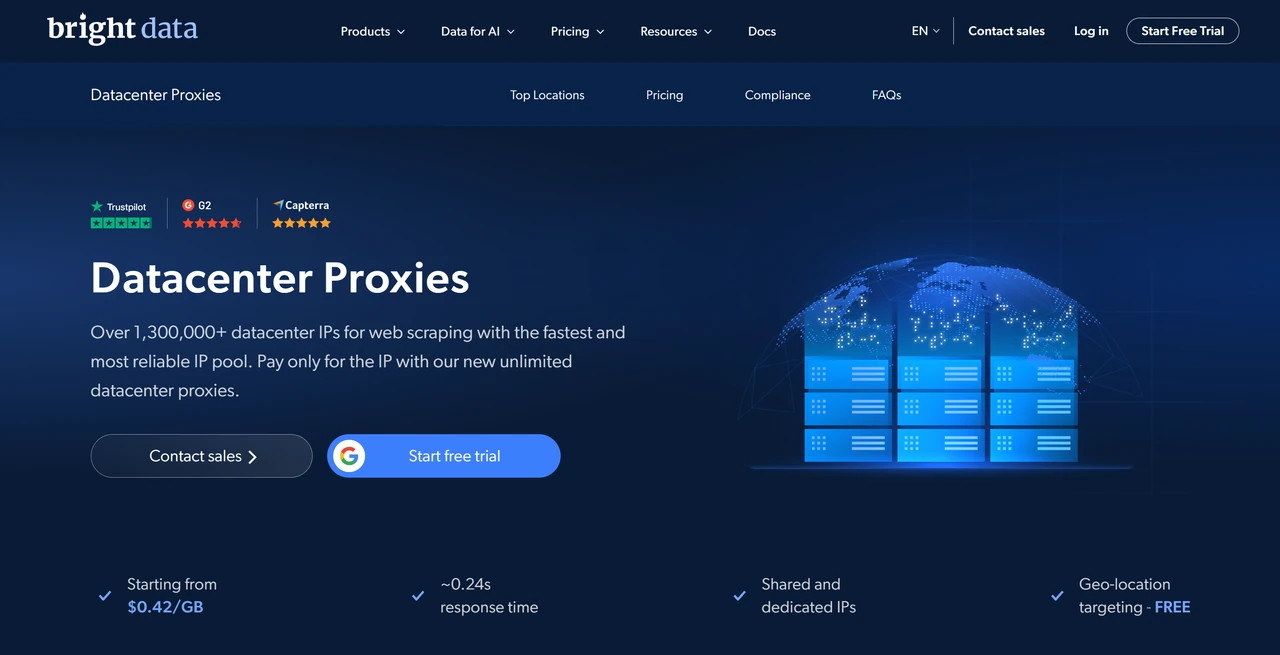
Best for: Large organizations that need advanced tooling and maximum flexibility
Bright Data has been in the proxy space longer than most, and its datacenter offering reflects that depth. With over 1.3 million datacenter IPs, it's one of the most versatile providers on the market, especially once you factor in its scraping tools, Proxy Manager, API access, and compliance infrastructure.
They offer both shared and dedicated datacenter IPs, plus free geo-targeting for country and city-level access. The setup is also built for more technical teams, with a Proxy Manager, Control Panel/API management, third-party integrations, and developer documentation support.
Pricing: Bright Data’s datacenter pricing starts at $1.40/IP for shared proxies and $2.20/IP for dedicated proxies, both with a 10-IP monthly plan. Pay-as-you-go traffic is $0.60/GB, while larger pay-by-GB plans can drop as low as $0.42/GB.
Worth knowing: Bright Data's pricing is complex, with multiple billing models, fair-use limits on some plans, and a KYC verification process that adds friction if you need to get started fast. Enterprise plans require a sales call, which isn't ideal if you just want to test and scale without jumping through hoops.
For more information, read our full Bright Data review.
3. Oxylabs — Best for the Largest Dedicated IP Pool
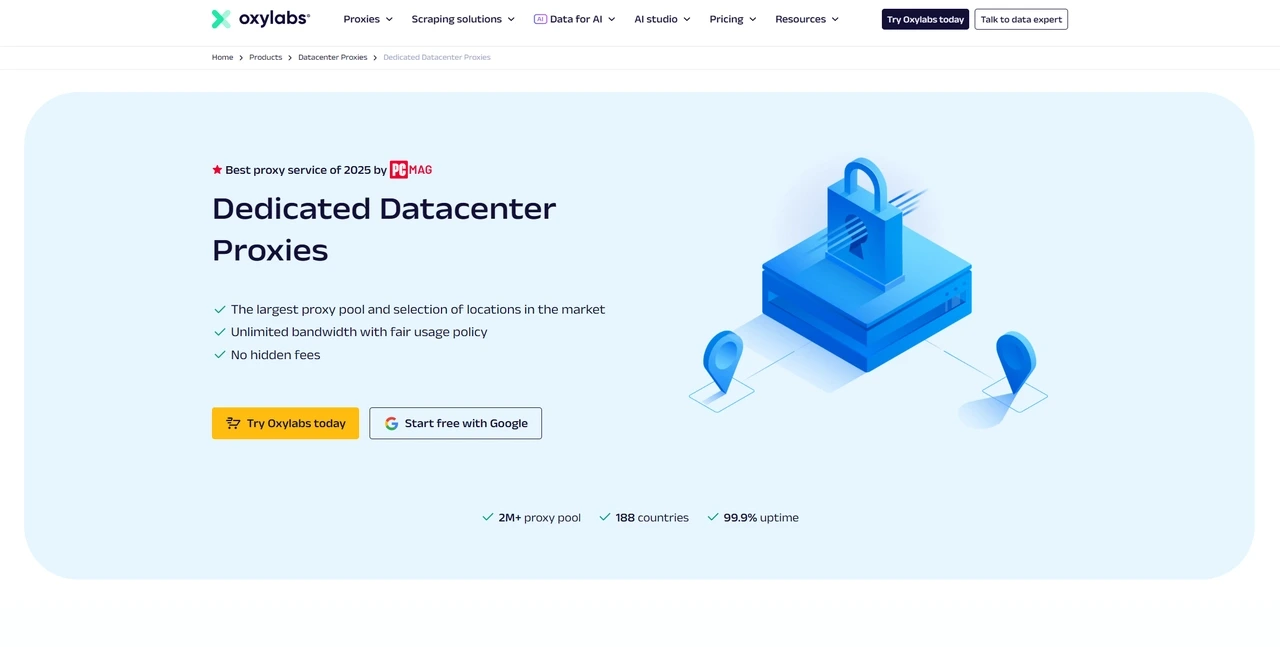
Best for: Operations that need exclusive IPs with maximum location coverage
Oxylabs' Dedicated Datacenter Proxies give you access to over 2 million exclusive-use IPs across 188 countries, making it one of the largest dedicated datacenter proxy pools on the market. Because these IPs are not shared with other users, your address reputation stays more in your own hands, which can make a real difference on targets that track IP history.
Performance specs are strong: 99.9% uptime, a 0.25s response time, up to 100 concurrent sessions per IP, and a 100GB per IP monthly threshold before concurrent sessions are reduced under the fair usage policy. HTTP, HTTPS, and SOCKS5 are all supported.
Pricing: Starts at $2.25/IP/month with a minimum of 3 IPs. City and state-level targeting is available on Enterprise plans.
Worth knowing: The entry price is steep compared to most providers on this list, and city-level geo-targeting is locked behind Enterprise plans only. If budget is a priority, IPcook covers similar high-speed datacenter use cases at a lower cost.
For more information, read our full Oxylabs review.
4. Decodo — Best for Balanced Performance and Pricing
Best for: Mid-range teams who want strong performance without overpaying
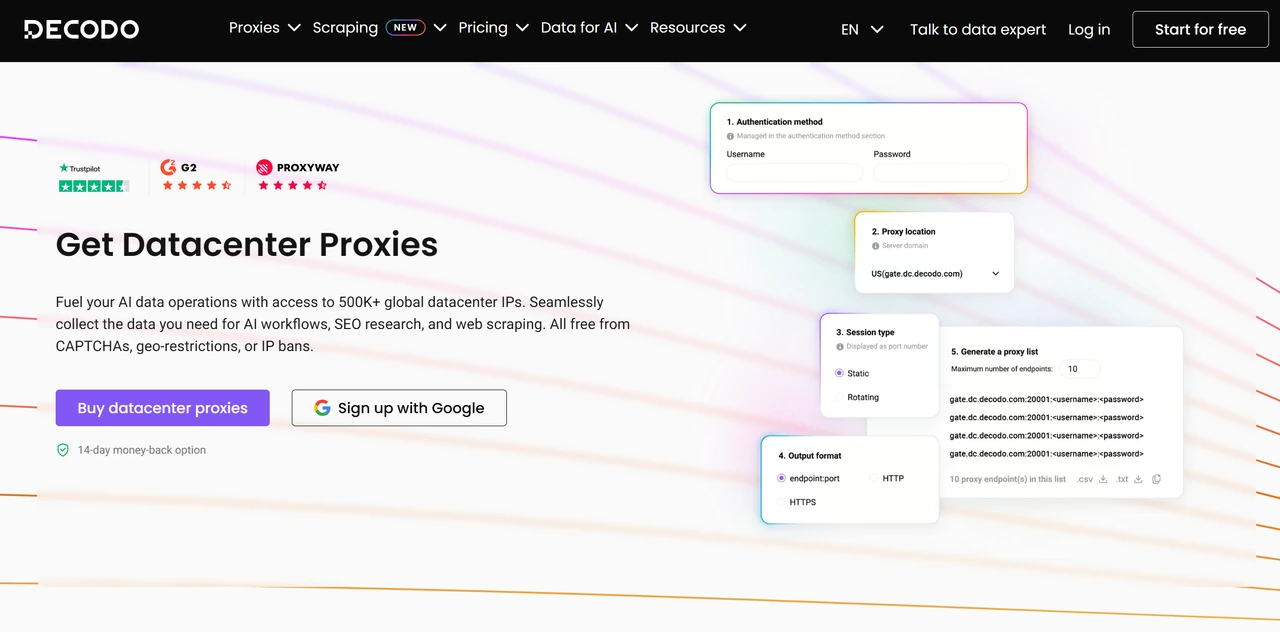
Decodo has quietly become one of the best-value datacenter proxy services on the market. Its datacenter proxies deliver <0.3s response time, a 99.98% success rate, and 99.99% uptime, which is impressive at this price point.
Decodo offer three billing options to match different needs: pay-per-GB for shared traffic, pay-per-IP for shared proxies, and dedicated IPs for users who want exclusive access. The shared pool includes 100K+ rotating and static IPs, while dedicated datacenter proxies come from a 400K+ pool. HTTP(S) and SOCKS5 are supported across all datacenter proxy types.
Pricing: Pay/GB starts at $0.60/GB, pay/IP shared starts at $0.035/IP for 100 IPs, and dedicated starts at $1.85/IP for 3 IPs.
Worth knowing: Dedicated IPs are currently limited to three locations: the US, UK, and Japan. If your task requires dedicated IPs in other regions, you'll need to look elsewhere. For pay-per-GB plans, make sure you estimate your traffic needs carefully before choosing a plan.
For more information, read our full Decodo review.
5. Webshare — Best Free Starter Tier for Datacenter Proxies
Best for: Developers who want to prototype before spending anything
Webshare's free tier is the real deal: 10 datacenter proxies and 1GB of bandwidth per month, with no credit card required. That's enough to test basic requests, build a small scraper, and see whether datacenter proxies work for your target before committing to a paid plan.
Beyond the free tier, the platform is highly self-serve and customizable. You can filter by country, choose bandwidth and thread options as your plan grows, and use HTTP or SOCKS5 endpoints. Three tiers cover most needs: shared proxies for budget-friendly scraping, private proxies shared with up to two other users, and dedicated proxies for fully exclusive IPs. All plans run on a 100+ Gbps aggregated network with 99.97% uptime.
Pricing: Free plan: 10 proxies + 1GB/month. Paid shared proxies start from $0.0299/IP for 100 IPs, or $2.99/month. Private proxies start from $0.43/IP, and dedicated proxies start from $0.77/IP.
Worth knowing: Shared proxies come from a pool used by many customers, so free and low-cost IPs may have a higher chance of being flagged on competitive targets. Webshare is excellent for prototyping and low-stakes scraping, but if your targets have meaningful anti-bot protection, you may need to upgrade to private or dedicated proxies fairly quickly.
For more information, read our full Webshare review.
6. IPRoyal — Best for Flexible, Low-Commitment Plans
Best for: Teams with irregular scraping schedules or smaller budgets
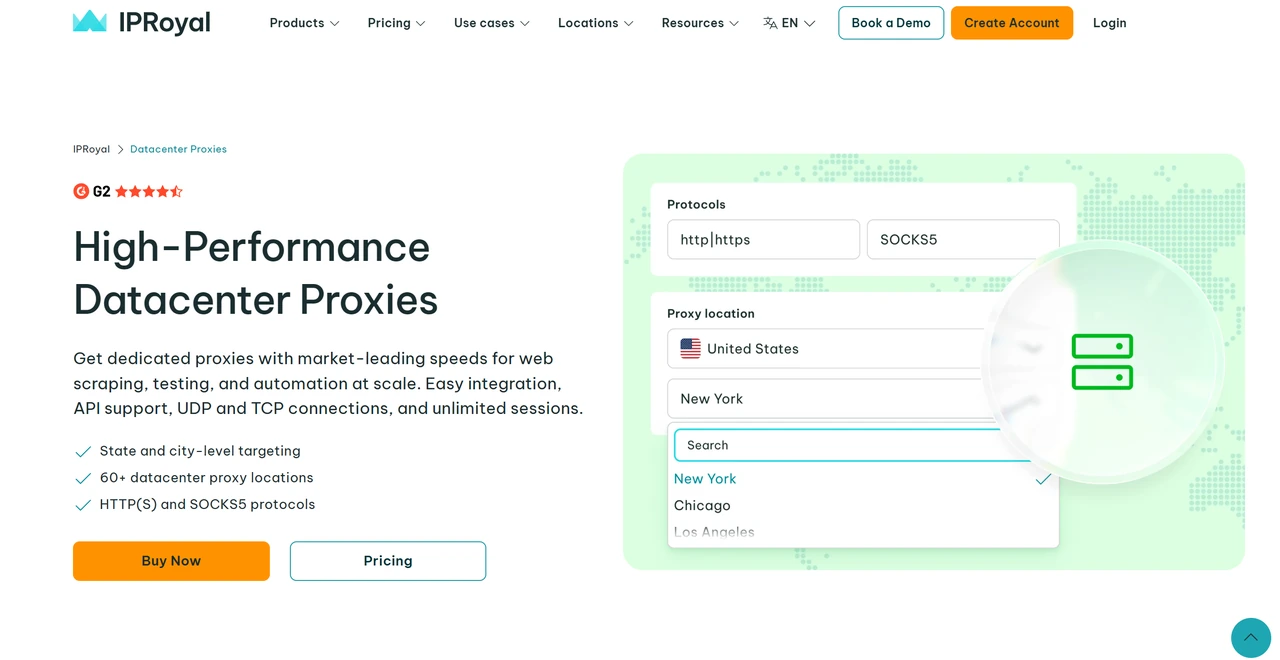
IPRoyal offers dedicated datacenter proxies starting at $1.39/IP on the 90-day plan, with no minimum purchase requirement, so you can buy a single proxy if that's all you need. Coverage spans 60+ locations globally, with state and city-level targeting supported.
IPRoyal also puts up respectable performance numbers: ~99.9% uptime, ~10ms latency, ~2Gbps throughput, and up to 10,000+ concurrent sessions. You also get zero rate limits, 24/7 support, and dedicated IPs that are never shared with other users.
Pricing: 30-day plans from $1.57/IP; 60-day from $1.48/IP; 90-day from $1.39/IP. Each IP includes 100GB of traffic per cycle, with additional bandwidth purchasable from the dashboard.
Worth knowing: IPRoyal’s “unlimited bandwidth” claim comes with fair-use limits. Each IP includes a 100GB monthly allowance, and speeds are reduced if the order’s traffic pool runs out before the cycle ends. That is enough for many smaller scraping jobs, but high-volume users should factor in possible top-up costs.
For more information, read our full IPRoyal review.
Dedicated vs. Shared Datacenter Proxies: Which Do You Need?
Choosing between shared and dedicated datacenter proxies mostly comes down to one question: do you care more about lower cost or more predictable performance? To help you decide, here's a quick comparison of both:
Factor | Shared Datacenter Proxies | Dedicated Datacenter Proxies |
Cost | Lower, and usually the most budget-friendly option. | Higher, but worth it for production workloads where consistent performance matters. |
Speed & Performance | Can fluctuate because you're sharing resources with other users, so performance depends on what they're doing too. | More stable and predictable because the IPs are reserved for you. |
IP Reputation Risk | Higher. If another user abuses the same IP, your tasks may be affected too. | Lower. Your IP reputation stays in your own hands. |
Pricing Model | Often priced by traffic, shared pools, or very low per-IP rates. | Usually priced per IP, often with larger bandwidth allowances or unlimited-bandwidth plans. |
Best For | Testing, development, low-risk scraping, and budget-sensitive projects. | Production scraping, SEO monitoring, price intelligence, market research, and long-running automation. |
How to Choose the Right Datacenter Proxy Provider
Choosing the right provider, especially if you're looking for the best datacenter scraping proxies, comes down to your project's technical needs, budget, and target websites. Before signing up, ask yourself these four questions:
1. What’s my target?
If it's a lightly protected website, almost any provider on this list will get the job done. If you're targeting a stricter ecommerce platform, search engine, or high-traffic marketplace, prioritize IP pool size, subnet diversity, location coverage, and how clean the IPs are. For very aggressive anti-bot systems, residential or ISP proxies are a better choice than datacenter IPs.
2. Do I need dedicated or shared IPs?
For one-off tests, small scrapers, or low-volume tasks, shared proxies are usually fine. For scraping, SEO rank tracking, price monitoring, or any project where IP reputation matters, dedicated proxies are the safer long-term choice because other users are not affecting the same IPs.
3. How much do I value setup simplicity?
IPcook, Webshare, and Decodo are good starting points if you want a clean dashboard and self-serve setup. Bright Data and Oxylabs offer more advanced tooling, but also more pricing tiers, configuration options, and onboarding steps.
4. What’s my real bandwidth situation?
Some providers offer truly unlimited traffic, while others use fair-use limits, per-IP traffic allowances, optional top-ups, or pay-per-GB billing. Before choosing a plan, check how much traffic is included, what happens when you exceed it, and whether unused bandwidth rolls over to the next cycle.
Final Verdict
For most users looking for the best datacenter proxies for fast and reliable access, IPcook is the strongest overall choice in this list. With truly unlimited traffic, transparent per-IP pricing, global coverage, and enterprise-grade uptime, it’s a reliable pick for fast datacenter proxies. Whether you're running a small scraper or scaling to thousands of concurrent requests, IPcook gives you the speed and flexibility to keep moving.
Whatever you choose, always test against your actual targets before committing to a large plan. The best datacenter proxy service is the one that performs well for your specific use case.
FAQ
- What Are Datacenter Proxies?
- Quick Comparison of Best Datacenter Proxies
- 1. IPcook — Best Overall Datacenter Proxy from $0.04/IP
- 2. Bright Data — Best for Enterprise-Scale Operations
- 3. Oxylabs — Best for the Largest Dedicated IP Pool
- 4. Decodo — Best for Balanced Performance and Pricing
- 5. Webshare — Best Free Starter Tier for Datacenter Proxies
- 6. IPRoyal — Best for Flexible, Low-Commitment Plans
- Dedicated vs. Shared Datacenter Proxies: Which Do You Need?
- How to Choose the Right Datacenter Proxy Provider
- Final Verdict
- FAQ