6 Best Static Residential Proxy Providers for Reliable Connections

Finding the right static residential proxy can be surprisingly tricky. At first glance, provider product pages often look almost identical, making it hard to compare their plans directly. However, even among services offering a dependable fixed IP, actual user experience and total costs can vary significantly.
In this guide, we evaluate the 6 best static residential proxies available today: IPcook, IPRoyal, Decodo, Webshare, Rayobyte, and Proxy-Cheap. By comparing their features, pricing, and service terms, you can understand how they differ and find the option that best fits your needs.
Types of Static Residential Proxies
Static residential proxies, also widely known as ISP proxies, combine the high trust of residential IPs with the speed of datacenters. Based on how IP addresses are allocated, they fall into three main types:
Dedicated (Private) Proxies: Assigned to a single user, offering maximum control and security without interference from others. Best for long-term account management, ad verification, and continuous scraping, though at a higher cost.
Shared Proxies: Used by multiple users at once, providing an economical choice for basic web browsing and low-frequency scraping. However, actions by other users can harm the IP's reputation and lead to blocks.
Semi-dedicated Proxies: Shared among a small group of users, balancing cost and performance. Ideal for medium-scale scraping and routine SEO monitoring, though control remains partially limited.
Before you buy static residential proxy plans, verify whether an IP is dedicated or shared and check the provider's allocation rules. These factors affect IP reputation, stability, and risk exposure, determining if a static residential proxy server fits your specific workflow before you evaluate pricing and bandwidth terms.
Top 6 Static Residential Proxy Providers Overview
To help you quickly evaluate your options, the table below summarizes key metrics across 6 leading static residential proxy providers, including starting prices, bandwidth allowances, location coverage, and notable features.
Provider | Starting Price | Geographic Coverage | Key Features |
IPcook | $0.05/IP/day | Worldwide targeting | HTTP, SOCKS5, API management, 99.99% uptime |
IPRoyal | $1.80/IP/24 hours | 31+ countries (state & city targeting) | HTTP(S), SOCKS5, dashboard management, dedicated IP pool |
Decodo | Dedicated: $2/IP/month | Americas, Europe & select APAC | HTTP(S), SOCKS5, usage analytics, whitelist & user/pass auth |
Webshare | ~ $0.23/IP | Multiple global locations | HTTP, SOCKS5, geo-targeting, Chrome extension, API |
Rayobyte | $0.95/IP/month | US, UK, CA, DE, FR, IT | HTTP(S), SOCKS, IP whitelist or user/pass auth |
Proxy-Cheap | $1.99/7 days | 24+ countries (country & ISP targeting) | HTTP, SOCKS5, country & ISP targeting, dedicated IPs, 100+ threads |
Note: Starting prices are based on the lowest-priced plans listed on each provider’s official website. Billing periods vary by provider.
1. IPcook
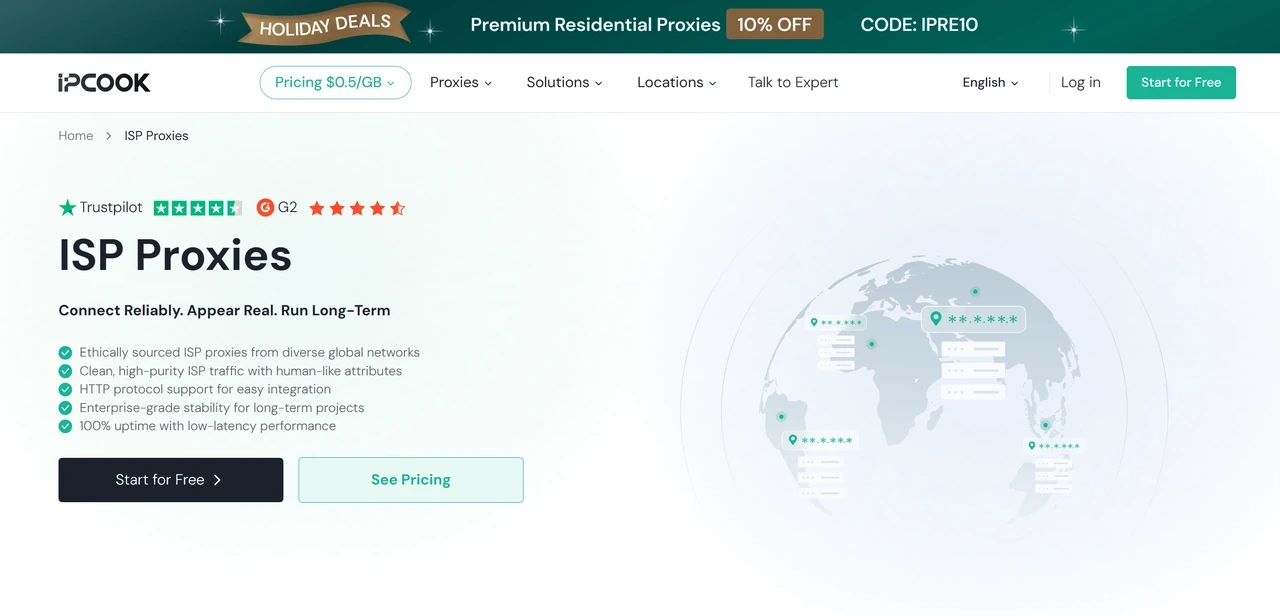
IPcook offers high-performance ISP proxies designed for stable, long-term connections, charging based on the number of IPs and duration rather than data usage. Starting at $0.05 per IP per day, its plans feature unlimited traffic and global location coverage, including key regions such as the United States, France, and Canada. Users can easily integrate a reliable proxy into automated setups via API management.
Pros:
Unlimited traffic allows cost-effective, continuous data collection without unexpected usage fees.
Full support for HTTP, SOCKS5, and API management enables smooth integration into automated workflows.
High reliability with an officially advertised 99.99% uptime guarantee.
Cons:
Per-IP pricing varies according to order volume, requiring careful evaluation based on scale.
Best For: Teams that manage fixed IPs via API and run continuous, large-scale automated data extraction tasks.
2. IPRoyal
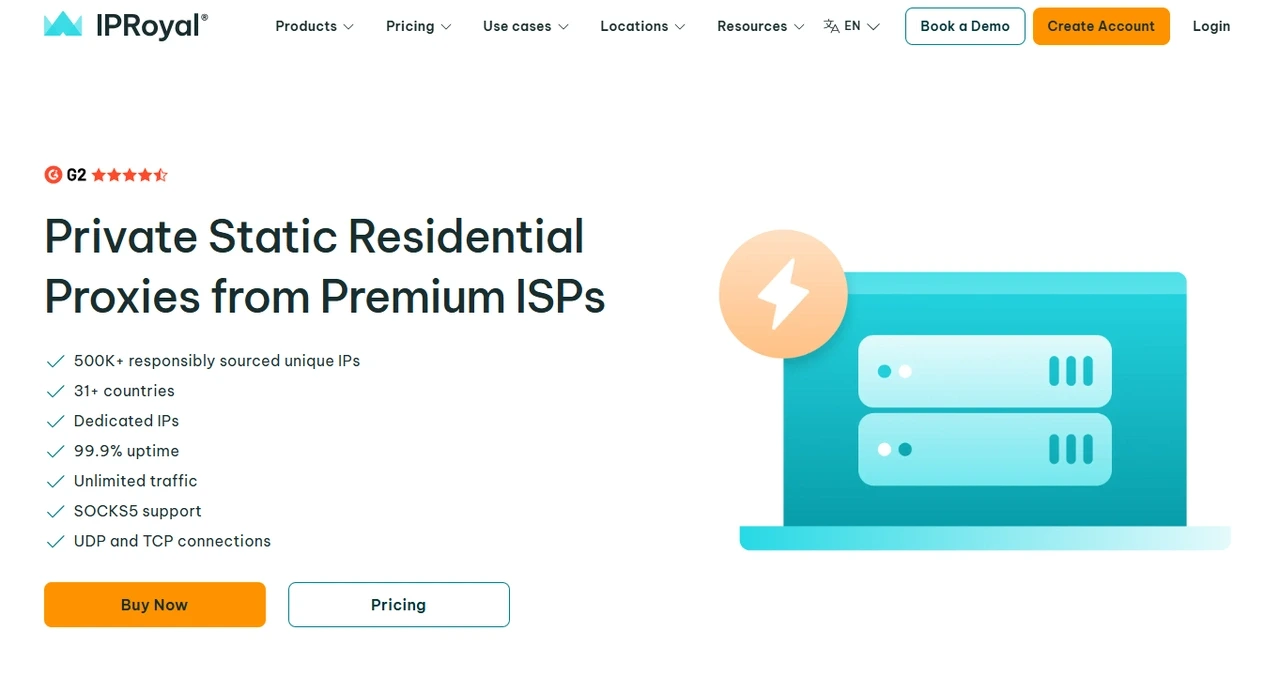
IPRoyal provides dedicated ISP proxy solutions designed for reliable performance and strict privacy, starting at $1.80 per IP for 24 hours. Its service features unlimited traffic and expansive location coverage spanning 31+ countries, complete with precise state- and city-level targeting. Users can easily control their proxies using a central management dashboard with support for HTTP(S) and SOCKS5 protocols.
Pros:
Dedicated IPs guarantee exclusive resource usage, minimizing interference from other users' online activities.
Broad geographic reach across 31+ countries with state and city targeting enables precise local access.
Unlimited traffic provides predictability for high-volume, long-running tasks.
Cons:
Success rates and response times for static ISP proxy options may vary depending on the target destination.
Best For: Users who need dedicated, fixed IPs for cross-region account management or long-term region-specific tasks.
3. Decodo
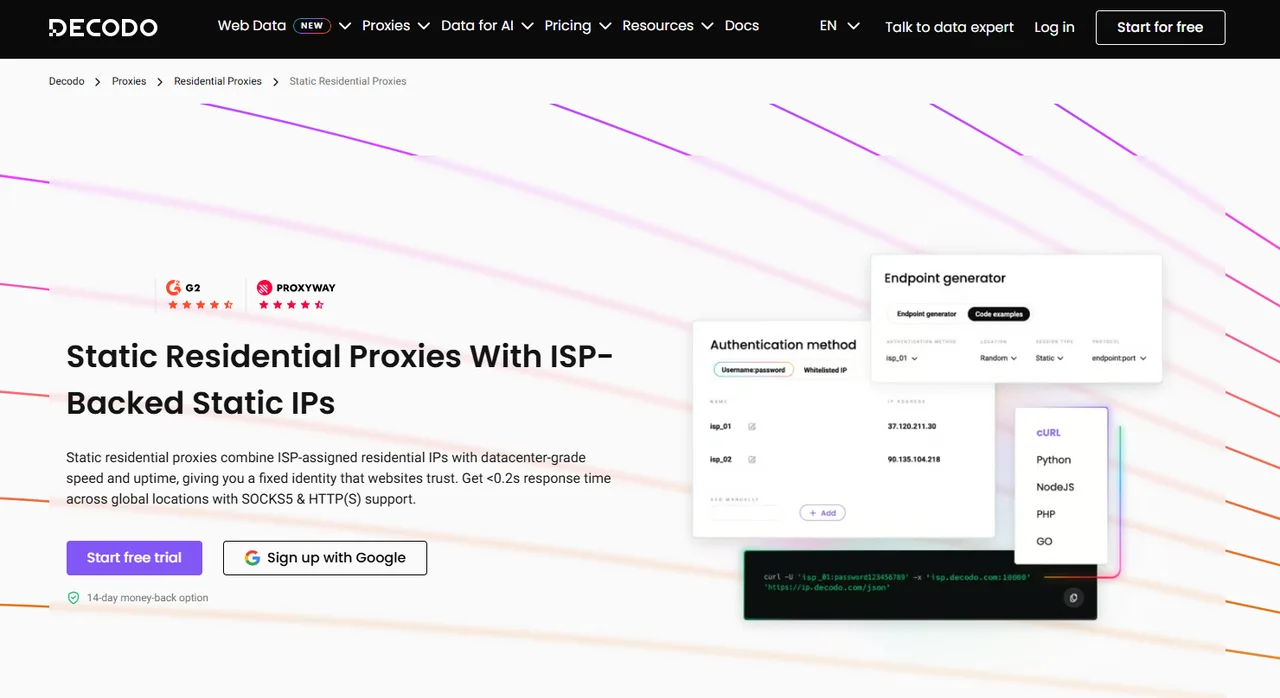
Flexibility defines Decodo through its diverse IP allocation and billing options, which include dedicated ($2/IP/month), shared ($0.27/IP), and pay-as-you-go ($1.30/GB) plans. Spanning the Americas, Europe, and select APAC regions, the service combines usage analytics, IP whitelisting, and credential authentication to deliver stable connectivity over HTTP(S) and SOCKS5. By leveraging reliable ISP proxies, users can manage long-term sessions with confidence.
Pros:
Multiple pricing and allocation models allow flexible alignment with varied budgets and usage demands.
Full protocol compatibility (HTTP/S and SOCKS5) ensures smooth integration with diverse tools.
Built-in usage statistics and security controls make monitoring traffic and connection safety straightforward.
Cons:
Lacks city-level or ASN-specific targeting capabilities.
Best For: Users looking to test different IP allocation models before scaling up based on actual bandwidth consumption and budget.
4. Webshare
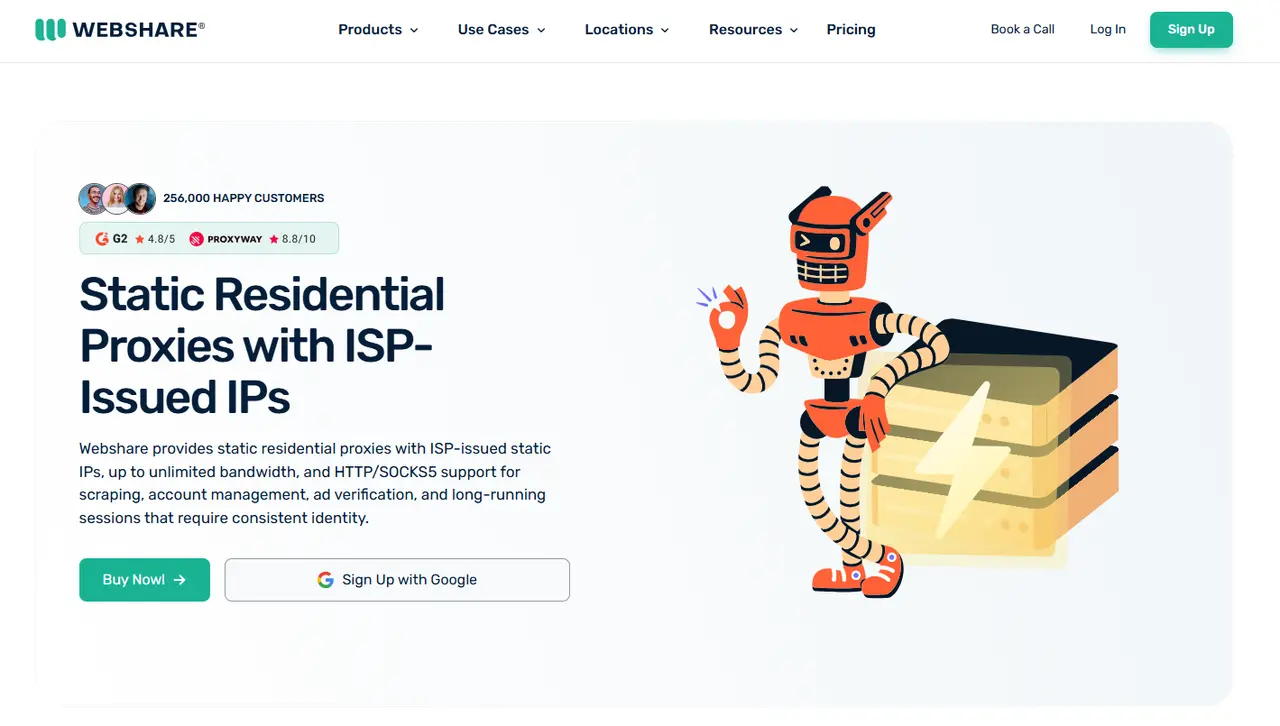
Webshare is known for low-cost entry points around $0.23/IP, delivering multi-region connectivity alongside shared and dedicated IP options. Built-in HTTP/S, SOCKS5, API integration, and a dedicated Chrome extension make configuration straightforward. While high-tier plans feature unlimited traffic, usage remains subject to fair-use policies.
Pros:
Browser extension and API access enable rapid proxy switching and seamless script integration.
Comprehensive self-service dashboard simplifies setup and management without requiring manual support.
Cons:
Geographic distribution leans heavily toward the US, with fewer choices in other regions.
Unlimited traffic packages are constrained by Fair Use restrictions.
Best For: Individuals and small teams seeking self-managed proxies via browser extensions or custom API integrations.
5. Rayobyte
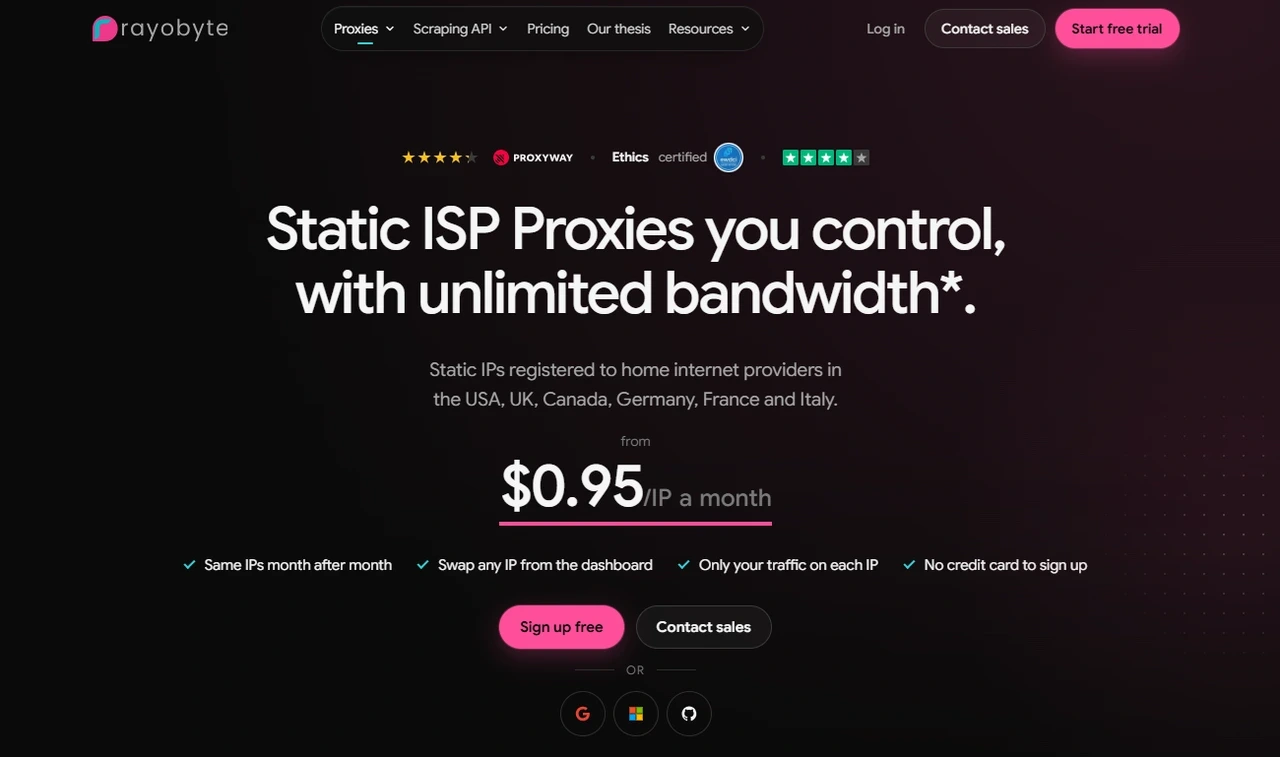
Targeting core digital markets like the US, UK, Canada, Germany, France, and Italy, Rayobyte prices its static ISP proxy options competitively at $5/IP/month (5 to 99 IPs). Customers can pick between shared and dedicated setups, leveraging HTTP(S) and SOCKS protocols alongside IP whitelisting or username and password authentication. Unlimited traffic is included, though governed by fair-use thresholds.
Pros:
Both shared and dedicated options let users balance privacy requirements against cost constraints.
Tiered bulk pricing reduces the per-IP cost for larger order volumes, lowering deployment expenses.
Flexible authentication options suit a variety of software setups and environments.
Cons:
Location coverage is restricted to a smaller set of core countries compared to broader providers.
Unlimited bandwidth plans are bound by Fair Use guidelines.
Best For: Marketing teams verifying ad placements and testing geo-targeting accuracy across North American and key European markets.
6. Proxy-Cheap
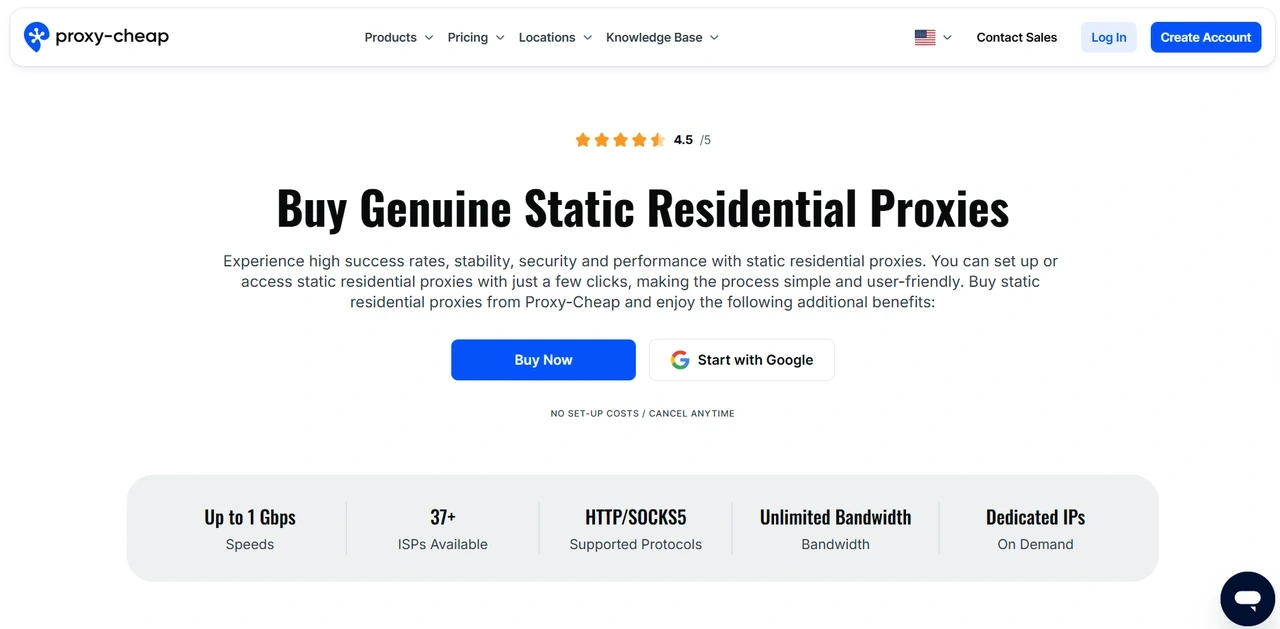
For those seeking a more budget-friendly or cheap static residential proxy, Proxy-Cheap serves as a strong contender with its weekly plans starting at $1.99 alongside standard monthly options. The platform supports unlimited traffic across 24+ countries, backed by precise country and ISP targeting, HTTP/S and SOCKS5 compatibility, and high concurrency allowing over 100 threads simultaneously.
Pros:
Weekly and monthly billing cycles offer financial flexibility for short-term projects and testing.
Country and ISP targeting allow users to route traffic through specific internet service providers.
High concurrency support (100+ threads) ensures efficient multi-tasking and parallel processing.
Cons:
Pricing structures vary across billing cycles, requiring careful calculation before committing.
Best For: Users who need specific ISP targeting and parallel connections for short-term, week-by-week scraping or testing projects.
What Matters Most When Choosing a Static Residential Proxy
When evaluating different options, unit price alone rarely tells the whole story. IP allocation models, traffic policies, and geographic reach heavily impact both overall costs and operational success. Keep these core factors in mind when comparing providers:
IP Exclusivity and Stability: Confirm whether IPs are dedicated, remain fixed during your subscription, and understand replacement policies. This stability is vital for account management and long-term sessions.
Pricing and Bandwidth: Compare daily, monthly, or pay-as-you-go models against your projected workload. Check for hidden caps, minimum purchase requirements, or fair-use restrictions.
Location Coverage: Ensure the provider spans your target countries and supports granular needs like city-level or specific ISP targeting if your project requires it.
Connection Quality: Review advertised uptime, speed metrics, and stability, testing against your target platforms whenever a trial is available.
Protocols and Management: Verify that supported protocols (HTTP/S, SOCKS5) match your software, and check for developer APIs, IP whitelisting, or credential authentication.
Different tasks demand different priorities. Tasks requiring persistent sessions should prioritize IP exclusivity and stability, while heavy-traffic projects need close attention to bandwidth policies, and geo-sensitive operations should verify location coverage first. Use these benchmarks alongside the provider profiles to choose a proxy provider that best fits your technical requirements, usage patterns, and budget.
Conclusion
The 6 options compared in this guide each cater to distinct operational priorities, spanning flexible short-term plans, bulk pricing models, and specialized location targeting.
As one of the best static residential proxy providers on the market today, IPcook offers long-term fixed IP costs and unhindered data extraction workflows with predictable overhead. Its flexible daily billing and robust API-driven architecture make IPcook the ultimate choice for your next data-heavy project. Explore their plans today!